
Explore the innovative ways multiphysics simulation is being used worldwide to advance research
Multiphysics modeling and simulation drives innovation across industries and academia — as is evidenced by the many uses showcased in the technical papers and posters presented by engineers, researchers, and scientists at the COMSOL Conference each year.
Draw inspiration from the recent proceedings collected below, or, to find a specific presentation or filter by application area or conference year/location, use the Quick Search tool.
View the COMSOL Conference 2025 Collection

Sediment transport in shallow water is of concern in many hydro-ecological problems. Erosion or sedimentation processes are not only relevant in perennial systems as rivers, lakes, reservoirs and coastal regions, but also in ephemeral phenomena like gullies, inundations and floods. ... Read More

In a first approach towards application of the magnetic frequency mixing technique to microfluidic structures, microplanar coils have to be designed along with sample reservoir. For this, a COMSOL Multiphysics® electrical model along with an analytical calculation is used in order to ... Read More

This paper is an investigation into the effect of blood vessel movement on measurement accuracy of blood flow rate using magnetic flow meters. The investigation used a Finite Element model of the magnetic flowmeter built using COMSOL Multiphysics® software by integrating the modules of ... Read More
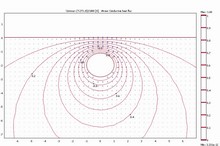
Many theoretical studies concerning lava tubes focus on the thermal disturbances generated on the earth surface. Recently a solution was suggested, where a lava tube located at a great depth h in the soil, where the ratio between h to the major axis of the ellipse a is higher than 10. ... Read More
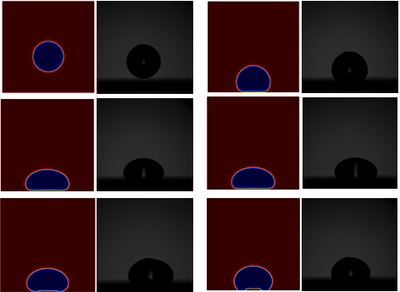
The nanofluid is a class of fluids with high thermal conductivity and non-Newtonian flow behaviors. In this work, we present numerical simulations of spreading characteristics for nanofluids droplet impinging on the solid surface which is of great importance in a number of applications ... Read More
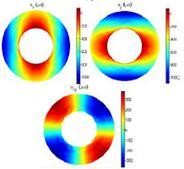
This paper describes using thermal structural interaction to model the shrinkage behavior in cement paste under drying. An inverse method of combining the finite element analysis and the least-squares method is implemented to fit experimentally determined shrinkage in order to obtain ... Read More
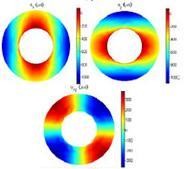
This paper describes using thermal-structural interaction to model the shrinkage behavior in cement paste under drying. An inverse method of combining the finite element analysis and the least-squares method is implemented to fit experimentally determined shrinkage in order to obtain ... Read More

The good electrical, thermal, mechanical and chemical properties of solid organic dielectrics, such as PTFE, predestine them as good candidates for the electrical insulation of transport devices and systems. In the particular case of power converters involved in the future hybrid and ... Read More

Hunting Lodge St. Hubertus is one of the most prominent Dutch buildings from the early twentieth century. An extensive study of wind and wind-driven rain (WDR) was conducted to provide insight into the moisture load of the building facade, using measurements and CFD simulations. COMSOL ... Read More
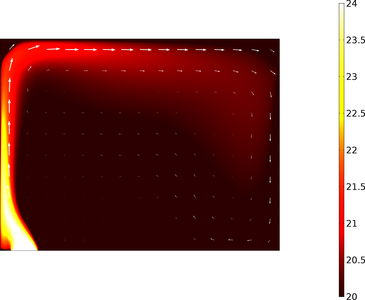
Museum buildings strive for a stable indoor climate to reduce the risk of cultural object degradation. An incorrect temperature or relative humidity can induce or accelerate deterioration processes such as biological, chemical or mechanical degradation. In order to reduce these risks, ... Read More


