
Explore the innovative ways multiphysics simulation is being used worldwide to advance research
Multiphysics modeling and simulation drives innovation across industries and academia — as is evidenced by the many uses showcased in the technical papers and posters presented by engineers, researchers, and scientists at the COMSOL Conference each year.
Draw inspiration from the recent proceedings collected below, or, to find a specific presentation or filter by application area or conference year/location, use the Quick Search tool.
View the COMSOL Conference 2025 Collection
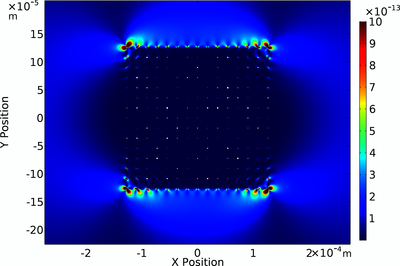
The main mechanisms of acoustic attenuation in a bundle of fibres typical of lightweight fibrous porous materials are the dynamic viscous drag forces on the surface of the fibres, and the thermal heat transfer between the solid fibres and the surrounding fluid. Microstructure models ... Read More
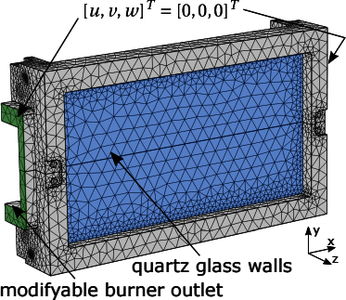
Enhanced operational flexibility and low levels of pollutant emissions are achieved with a sequential arrangement of premixed combustion stages in gas turbines for power generation. In the second – reheat – combustion stage, hot flue gases of approximately 1500K are enriched with fuel ... Read More
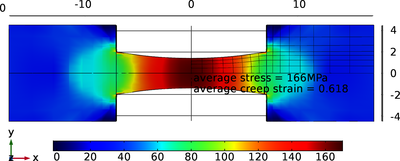
Heat treatment of the advanced steel grades (like micro-alloyed steels or AHSS steel grades) is a challenging process as the residual stress/deformation are very pronounced and the customer quality requirements are getting stricter. Instead of a trial and error based process control, a ... Read More

The present work deals with dynamic simulation of magnetic particles present in the carrier fluid when subjected to external magnetic field. Magneto rheological fluid comes under classification of smart materials, which contain pure CI iron particles, silicon oil as carrier fluid and ... Read More

The solidification of a fluid in a partially-filled circular cylinder is encountered in a number of industrial processes and in the oil and gas sector. The characteristics of the process depends on various fluid and geometrical parameters. In the current study, a fluid with temperature ... Read More
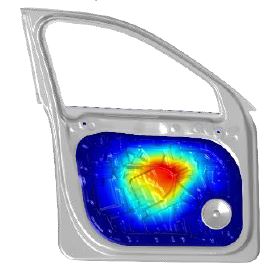
COMSOL Multiphysics® was used to evaluate the performance of a woofer coupled to an automotive door. Two uses cases were considered: rigid and non-rigid door structures. Using the Structural Mechanics Module, the speaker membrane displacement was computed for both cases from 20Hz to 500 ... Read More
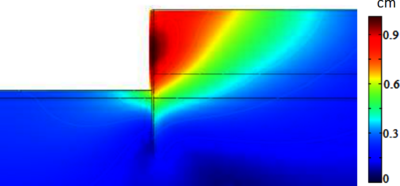
Deformation prediction is an important part of the structure stability analysis. However, the deformation of bank protection structure which is affected by many factors, such as structural stiffness, earth pressure and hydrostatic pressure. It contains a complex mechanical process, which ... Read More
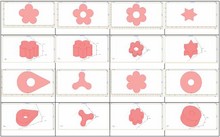
The global demand for sulfuric acid has been forecast to grow at an average of 2.6% per year from 2005 – 2010. The primary objective of this work is to analyze the performance of various heterogeneous catalyst shapes that have been proposed for the oxidation of SO2 to SO3 used in the ... Read More
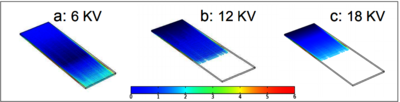
Electrostatic precipitation is an extremely efficient way of filtering fine particles from the airstream. Electrostatic precipitators (ESPs) can control airborne emission without significantly slowing down the rate of flow, because of the low pressure drop across this type of filters. A ... Read More
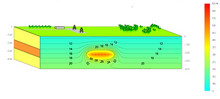
Disposal in deep clay geological formations is one of the promising options for disposal of high-level radioactive waste. Yet, they can generate considerable amounts of heat as a side effect of radioactive decay. This paper shows how COMSOL Multiphysics has been used to evaluate the ... Read More


