
See How Modeling and Simulation Is Used Across Industries
Multiphysics modeling and simulation drives innovation across industries and academia — as is evidenced by the many uses showcased in the technical papers and posters presented by engineers, researchers, and scientists at the COMSOL Conference each year.
Draw inspiration from the recent proceedings collected below, or, to find a specific presentation or filter by application area or conference year/location, use the Quick Search tool.
View the COMSOL Conference 2025 Collection
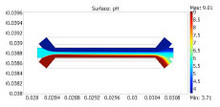
A portable device that can identify protein and peptides real time in complex biological systems such as human bodily fluids reliably and accurately is in high demand to properly diagnose and treat medical conditions. Lynntech has developed an innovative Polydimethylsiloxane (PDMS) based ... Read More
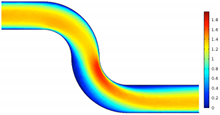
Reynolds Numbers effect: In the first bend, the higher the Reynolds number, the longer the first pair of vorticities stays attached to the wall. In the second bend, the higher Reynolds Numbers, the secondary flow from the first bend dominates. Curvature Radius effect: The smaller the ... Read More
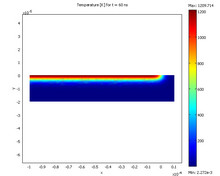
A 2D transient heat conduction model was created in COMSOL Multiphysics to simulate temperature changes in material irradiated by a KrF laser beam confined on silicon’s surface. In this paper, the obtained results are shown and discussed in case of bulk Silicon. The heat source is ... Read More
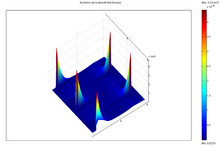
Excilamps are artificial Ultraviolet sources based on the emission of excimers or exciplexes. The latter are excited states of weakly bound rare gas or halide/rare gas atoms which emit a photon in the UV region when they dissociate. Dielectric Barrier Discharge (DBD) excilamps are ... Read More
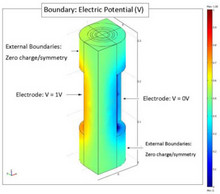
A beneficial method for transporting highly viscous hydrocarbons (e.g. heavy oil and bitumen) through a pipeline is known as Lubricated Pipe Flow (LPF). A major challenge for this technology is flow instability caused by the formation of a wall-coating of oil or the thinning and/or loss ... Read More
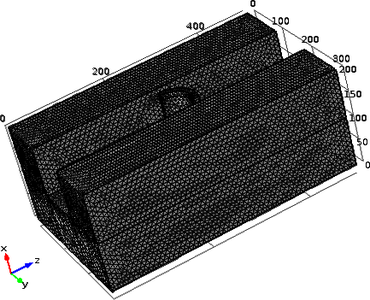
The Finite Element Model is analyzed with impounded water considering appropriate boundary conditions between the water & the upstream face of the dam .The fluid on the upstream side is considered to be incompressible, inviscous, and irrotational. Here the effect of fluid ... Read More
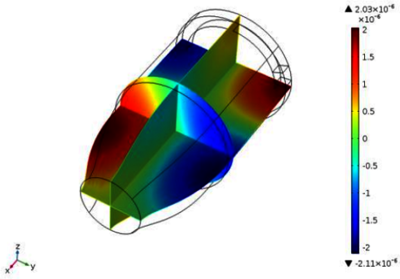
Airbus Safran Launchers is the market leader in Space Launch services. Rocket engines are among the most powerful machines that exist. The core of the rocket engine is the combustion chamber where in the case of liquid propellant rocket engines, fuel and oxidizer are injected, mixed and ... Read More
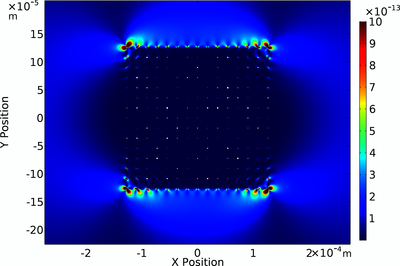
The main mechanisms of acoustic attenuation in a bundle of fibres typical of lightweight fibrous porous materials are the dynamic viscous drag forces on the surface of the fibres, and the thermal heat transfer between the solid fibres and the surrounding fluid. Microstructure models ... Read More
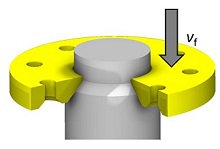
The machining of hardened steel or powder metallurgical steel, for example to manufacture impact extrusion punches, is a big challenge for conventional machining technology as milling or turning. A non-conventional machining technology is Electrochemical Machining (ECM), which allows ... Read More

Since the industrial demand in the energetic, mining and oil & gas sectors has increased exponentially these last decades, security standards and fire protection methods are extremely important not only for the employees, but also for the infrastructure involved in production areas ... Read More


