
In accordance with our Quality Policy, COMSOL maintains a library of hundreds of documented model examples that are regularly tested against the latest version of the COMSOL Multiphysics® software, including benchmark problems from ASME and NAFEMS, as well as TEAM problems.
Our Verification and Validation (V&V) test suite provides consistently accurate solutions that are compared against analytical results and established benchmark data. The documented models below are part of the COMSOL Multiphysics® software’s built-in Application Libraries. They include reference values and sources for a wide range of benchmarks, as well as step-by-step instructions to reproduce the expected results on your own computer. You can use these models not only to document your software quality assurance (SQA) and numerical code verification (NCV) efforts, but also as part of an in-house training program.
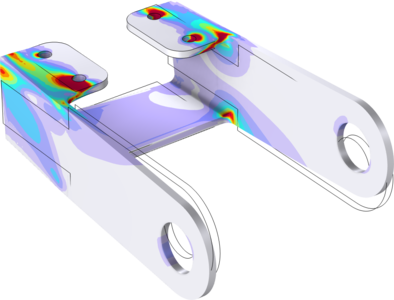
The bracket model tutorials are used as an introduction to the features and functionality within the Structural Mechanics Module. The following features are introduced: The following features are introduced: The fundamentals: static linear analysis Parametric study Including initial ... Read More
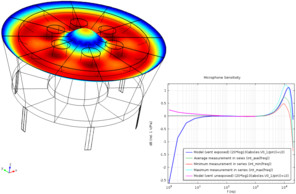
This is a model of the Brüel and Kjær 4134 (BK 4134) condenser microphone. The geometry and material parameters are those of the actual microphone. The modeled sensitivity level is compared to measurements performed on an actual microphone and shows good agreement. The membrane ... Read More
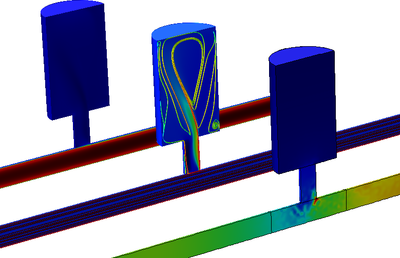
Helmholtz resonators are used in exhaust systems, as they can attenuate a specific narrow frequency band. The presence of a flow in the system alters the acoustic properties of the resonator and the transmission loss of the subsystem. In this tutorial model, a Helmholtz resonator is ... Read More
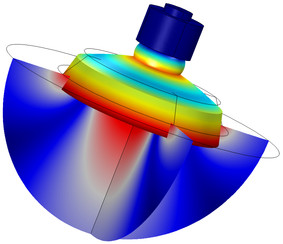
The tonpilz (sound mushroom) piezoelectric transducer is a transducer for relatively low frequency, high power sound emission. The transducer consists of piezoceramic rings stacked between massive ends and pre-stressed by a central bolt. The tail and head mass lower the resonance ... Read More
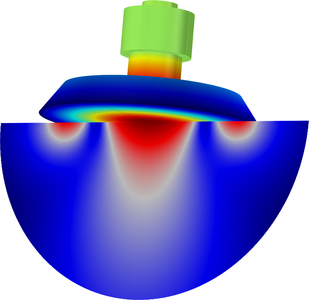
A tonpilz transducer is used for relatively low frequency, high power sound emission. It is one of the popular transducer configurations for SONAR applications. The transducer consists of piezoceramic rings stacked between a head mass and a tail mass which are connected by a central ... Read More
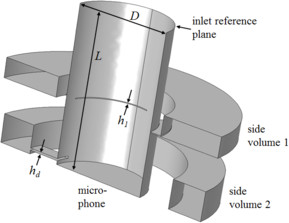
This is the model of an occluded ear canal simulator (a generic 711 coupler). Besides certain details the geometry corresponds to the Brüel & Kjær Ear Simulator Type 4157. The real life couplers are used for simulating the acoustics of a standardized human ear canal and can be used ... Read More
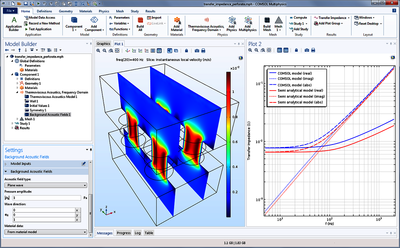
Perforates are plates with a distribution of small perforations or holes. They are used in muffler systems, sound absorbing panels, and in many other places as liners, where it is important to control attenuation precisely. As the perforations become smaller and smaller, viscous and ... Read More
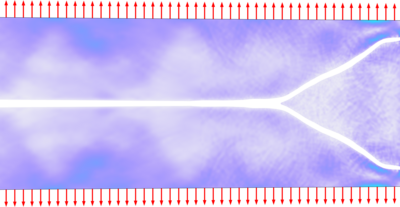
In this example, a benchmark problem in dynamic fracture of brittle materials is analyzed using the AT1 phase-field damage model. An instantaneous tensile load is applied to a planar tension specimen with a pre-existing crack. Initially, the crack propagates perpendicular to the loading ... Read More
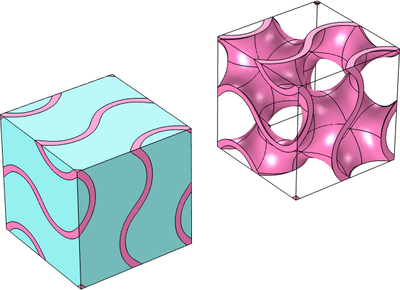
In this example, the homogenized elastic and thermal properties of a composite material based on a triply periodic minimal surface (TPMS) are computed. A gyroid TPMS-based unit cell is subjected to periodic boundary conditions to get the homogenized material properties. The effects of ... Read More

Many piezoelectric materials are ferroelectric. Ferroelectric materials exhibit nonlinear polarization behavior, such as hysteresis and saturation at large applied electric fields. In addition, the polarization and mechanical deformations in such materials can be strongly coupled due to ... Read More


