
In accordance with our Quality Policy, COMSOL maintains a library of hundreds of documented model examples that are regularly tested against the latest version of the COMSOL Multiphysics® software, including benchmark problems from ASME and NAFEMS, as well as TEAM problems.
Our Verification and Validation (V&V) test suite provides consistently accurate solutions that are compared against analytical results and established benchmark data. The documented models below are part of the COMSOL Multiphysics® software’s built-in Application Libraries. They include reference values and sources for a wide range of benchmarks, as well as step-by-step instructions to reproduce the expected results on your own computer. You can use these models not only to document your software quality assurance (SQA) and numerical code verification (NCV) efforts, but also as part of an in-house training program.
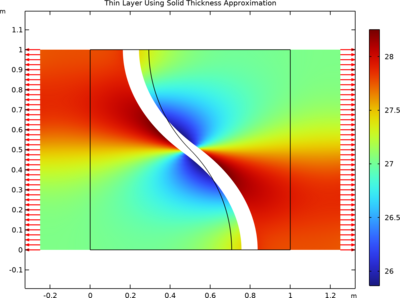
This model demonstrates alternative implementations used for describing a thin layer and the impact of the choice on the continuity of the displacement and stress fields. It is shown how a perfect interface can be obtained by asymptotically changing the material parameters. Read More
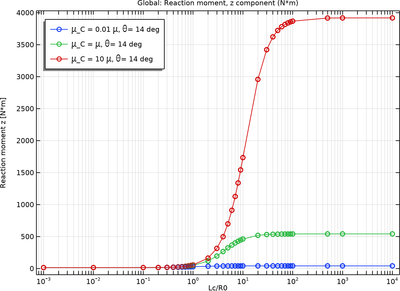
In this example, it is demonstrated how to extend the built-in linear elastic material model to a Cosserat material through the addition of microrotation degrees of freedom. A cylindrical bar under pure torsion is analyzed and the effect of the Cosserat length scale parameter on the ... Read More
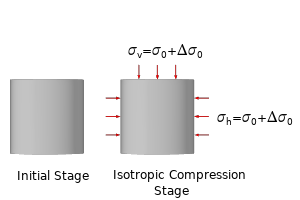
This model simulates the isotropic compression of naturally structured and artificially structured clays using the Modified Structured Cam-Clay (MSCC) material model. The aim of the example is to reproduce the compression behavior given in a benchmark for four structured clays. Read More

The vibration modes of a thin or thick circular disc are well known, and it is possible to compute the corresponding eigenfrequencies to arbitrary precision from a series solution. The same is true for the acoustic modes of an air-filled cylinder with perfectly rigid walls. A more ... Read More
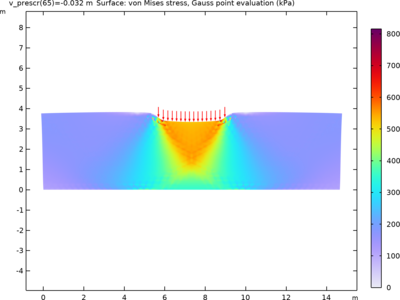
A common verification problem for geotechnical problems is a shallow stratum layer of clay. In this example a vertical load is applied on the clay strata and the static response and the collapse load are studied. The clay is modeled as an elastic-perfectly plastic material and the ... Read More
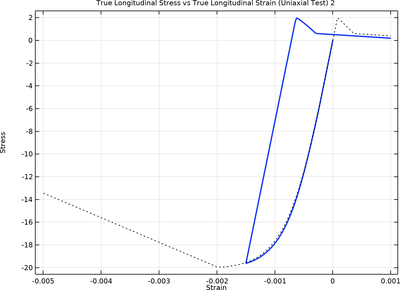
This example shows the behavior of the coupled damage-plasticity material model for concrete when subjected to different loading conditions. Read More
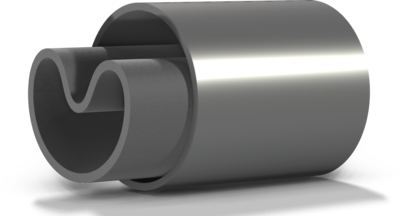
In this example, the Bergstrom–Bischoff material model is used to model the temperature and strain dependent behavior of High Density Polyethylene (HDPE) used, for example, to make liners for damaged pipes in oil and gas applications, or to make type IV hydrogen storage vessels for fuel ... Read More
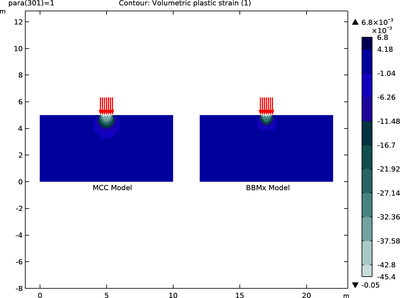
In this example, a settlement and heave analysis of a shallow foundation resting on an unsaturated soil stratum is conducted with the Modified Cam-Clay and Extended Barcelona Basic soil models. The effect of pore suction due to movements in the phreatic line and the resulting settlement ... Read More

This tutorial model demonstrates how to estimate the material parameters of a viscoplastic Bergstrom–Boyce model suitable for nonequilibrium modeling of rubber-like materials. The data used for parameter estimation consists of cyclic uniaxial tension and compression tests at two ... Read More
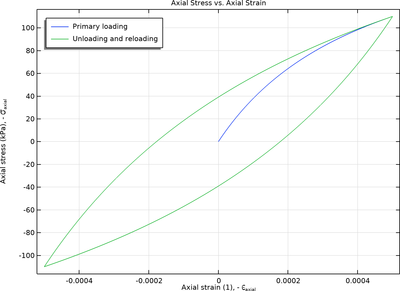
The small strain overlay material model captures the effect of high stiffness at low strain as well as the hysteresis under cyclic loading, which is a common effect for most soils. The formulation allows stiffness degradation with an increase in shear strain, and the full recovery of ... Read More


