
Modeling EM Waves in Periodic Structures with COMSOL Multiphysics®
Duration: 24:58
Press O for more options
Video Thumbnail
COMSOL Multiphysics offers a comprehensive platform for modeling electromagnetic waves in periodic structures. The software provides various modules tailored to different wave regimes, depending on the size of the device relative to the wavelength. For devices ranging from one-tenth to tens of wavelengths, explicit modeling of wavelengths is feasible. Larger devices may employ the beam envelopes formulation, while even larger systems can utilize the ray optics approach. The ACDC module is suitable for low-frequency applications, while the RF and wave optics modules are ideal for RF and millimeter-wave engineering or optical devices, respectively. The RF module in COMSOL is particularly useful for modeling resonant devices, such as metallic guiding structures and transmission lines, whereas the wave optics module is designed for electrically large optical beams, including dielectric waveguides and free space modes. These modules allow for the coupling of electromagnetic modeling with other physics interfaces, such as heat transfer, to account for thermal effects like expansion or heat production due to RF radiation. Users can choose between frequency domain and transient approaches, depending on whether they are interested in frequency response or time evolution. COMSOL provides several features for modeling periodic structures, including the Floquet periodicity condition, which accounts for phase shifts in electromagnetic waves with various angles of incidence. The software also supports a range of material models, allowing for isotropic or anisotropic properties and frequency-dependent dispersion models. Users can customize these properties to be dependent on fields or other variables, and couple them with other physics interfaces. The software's user interface facilitates model building through a logical sequence of steps, from defining parameters and geometry to applying materials and physics conditions. Users can visualize results through electric field plots and S-parameters, and export data in formats like touchstone files. COMSOL also offers animation capabilities for dynamic data visualization. For those interested in learning more, the COMSOL website provides extensive resources, including blog posts, videos, user stories, and downloadable model files.

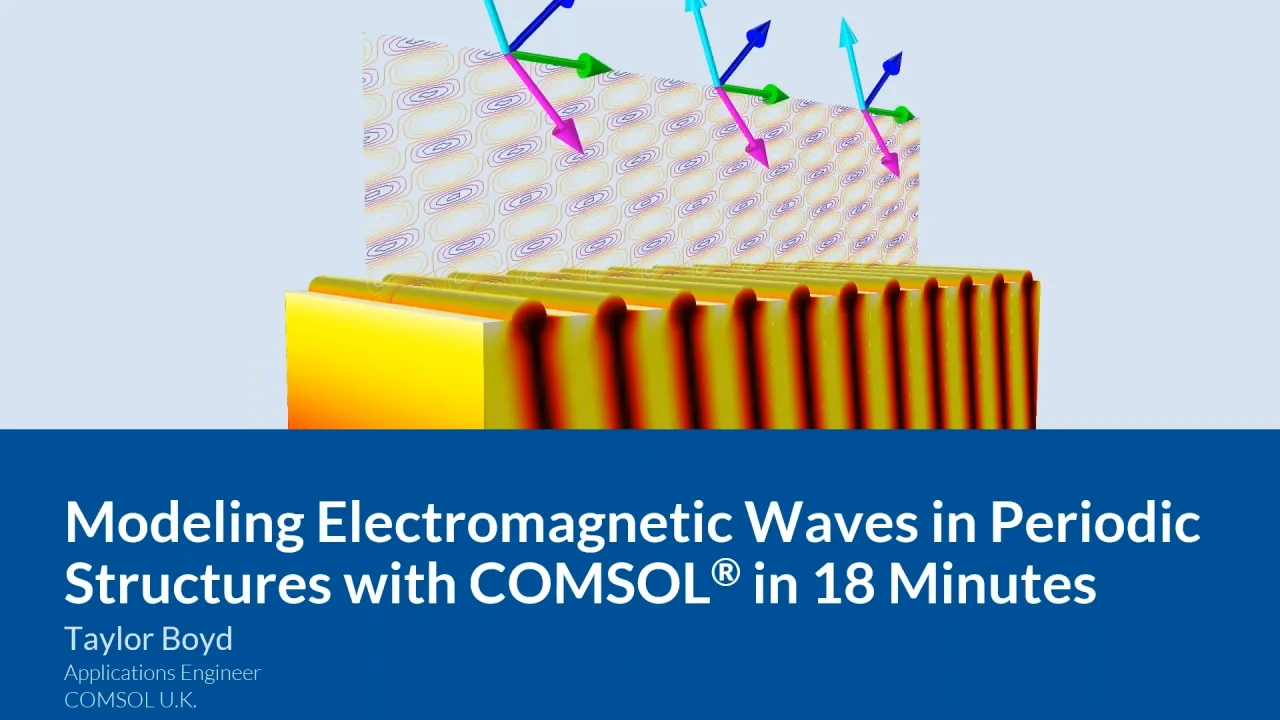
In this archived webinar, we focus on the use of COMSOL Multiphysics® for modeling the interaction between electromagnetic waves and periodic structures. The video begins with a brief introduction to modeling electromagnetics in the software, highlighting the capabilities of various add-on products, including the RF Module and Wave Optics Module. We then explore periodic structures, the features that are especially useful when modeling them, and the material models available for modeling the behavior of specific materials.

The presentation also includes a demonstration of modeling a plasmonic wire grating embedded in a dielectric substrate, with the goal of determining the transmission and reflection characteristics. In the demonstration, we build the geometry, assign the appropriate physics settings and boundary conditions, introduce materials, build an appropriate mesh, and solve and visualize the results.

Next Steps

To download the files, please sign into your COMSOL Access account.*


