
The Application Gallery features COMSOL Multiphysics® tutorial and demo app files pertinent to the electrical, structural, acoustics, fluid, heat, and chemical disciplines. You can use these examples as a starting point for your own simulation work by downloading the tutorial model or demo app file and its accompanying instructions.
Search for tutorials and apps relevant to your area of expertise via the Quick Search feature. Note that many of the examples featured here can also be accessed via the Application Libraries that are built into the COMSOL Multiphysics® software and available from the File menu.
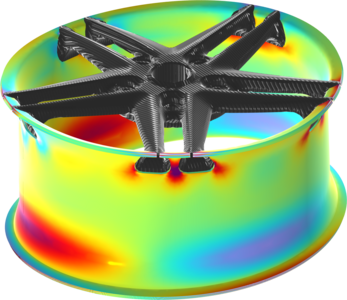
Nowadays, there is a trend toward manufacturing wheel rims from composite materials instead of aluminum. The main motivation is to reduce unsprung mass, which improves dynamic response and can enhance acceleration, braking, and cornering performance. Carbon-fiber-reinforced polymer ... Read More
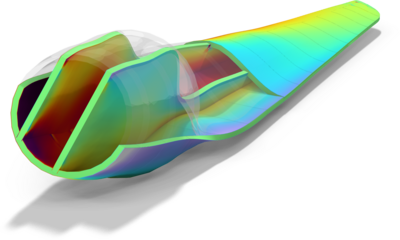
Wind turbines are an increasingly popular source of renewable energy. As such, the design, analysis and manufacture of wind turbines are important to the energy industry. The turbine blades are critical components of a wind turbine. When generating electric power through rotation, they ... Read More
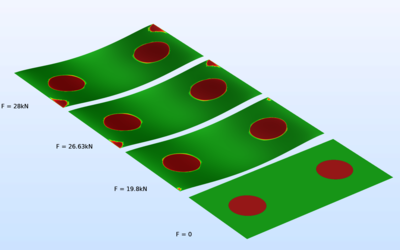
Interfacial failure, or delamination, in a composite material can be simulated using a cohesive zone model (CZM). A key component of a CZM is the traction-separation law, which describes softening in the cohesive zone near the delamination tip. This example demonstrates the ... Read More
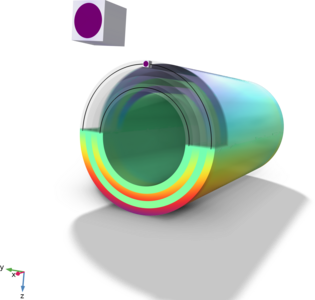
In this example, the structural integrity of a cylinder made of a fiber-reinforced composite is assessed at both the macroscale and the microscale. In addition to macroscale analyses, structural composites require microscale stress and failure analyses to identify the critical ... Read More
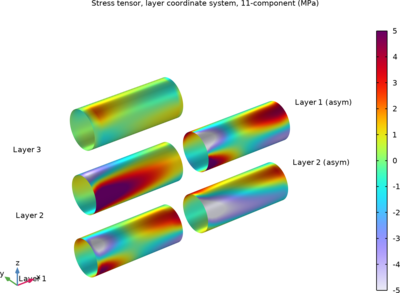
Fiber composites are widely used in industrial applications. Compared with traditional metallic engineering materials, fiber composites often offer higher specific stiffness and strength, as well as greater corrosion resistance. In addition, properties such as strength, stiffness, and ... Read More
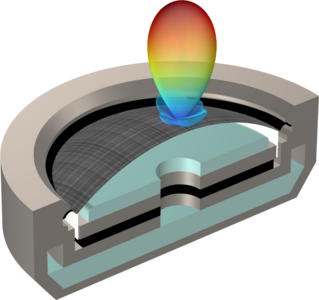
Loudspeaker design is a challenging task. The objective is to achieve high sound quality while satisfying manufacturing and operational constraints. Sound quality depends on many factors, including the ability to control, damp, and shift diaphragm resonances and to control diaphragm ... Read More
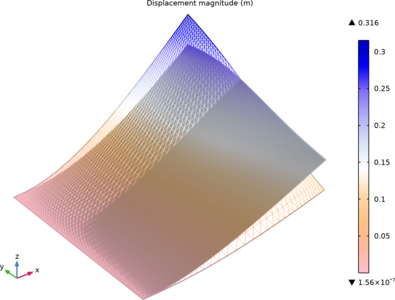
Composite laminates are synthetic structures and there is always a possibility to optimize the design in terms of the number of layers, the material of each layer, the thickness of each layer, and the stacking sequence for the specified loading conditions. Designers need to know how safe ... Read More
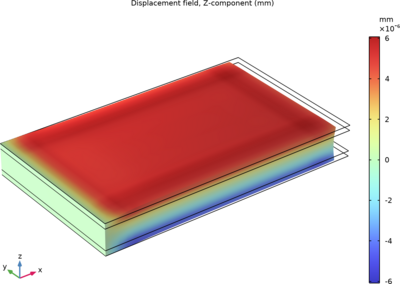
This tutorial is intended as a simple example showing how to model piezoelectric devices using the layered shell functionality. Two cases of material orientation are studied. In the first case, the pole axis is normal to the shell surface, which results in a thickness change. In the ... Read More
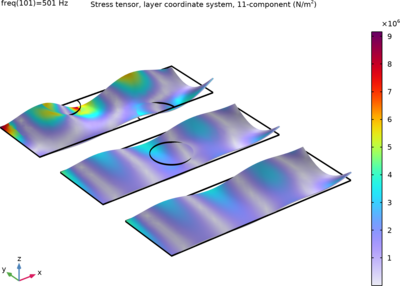
Delamination or the separation of layers is a common failure mode in laminated composite materials. Various factors, including loading, defects in the material, and environmental conditions, can trigger the initiation and propagation of layer separation. This leads to degraded structural ... Read More
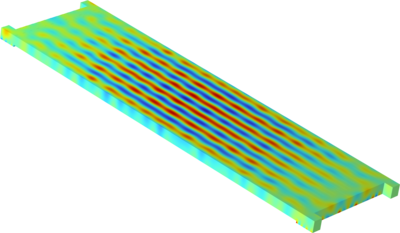
Lamb-wave resonators are useful components for many radio-frequency applications. This example shows how you model an aluminum nitride Lamb wave resonator and perform eigenfrequency and frequency-response analyses to characterize the device. The tutorial uses the Electric Currents in ... Read More


