
The Application Gallery features COMSOL Multiphysics® tutorial and demo app files pertinent to the electrical, structural, acoustics, fluid, heat, and chemical disciplines. You can use these examples as a starting point for your own simulation work by downloading the tutorial model or demo app file and its accompanying instructions.
Search for tutorials and apps relevant to your area of expertise via the Quick Search feature. Note that many of the examples featured here can also be accessed via the Application Libraries that are built into the COMSOL Multiphysics® software and available from the File menu.
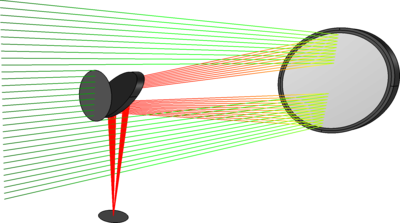
Newtonian telescopes, first invented in 1668 by Isaac Netwon, are still used today because of their low cost and simple design. Rays of light propagate from sources located at infinity, into the telescope. The rays reflect off a parabolic mirror, onto a flat mirror, and into the focal ... Read More
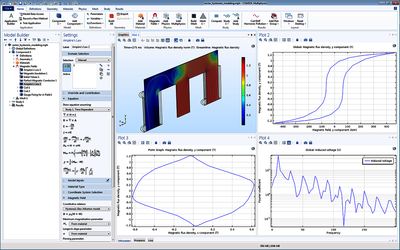
This tutorial is a benchmark model that reproduces the Testing Electromagnetic Analysis Method (TEAM) Problem 32, which evaluates numerical methods for the simulation of anisotropic magnetic hysteresis. A hysteretic three-limbed laminated iron core is subject to a time-varying magnetic ... Read More
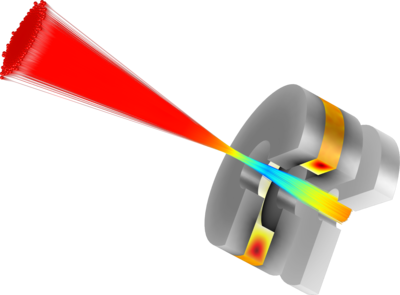
A scanning electron microscope samples images by scanning a target with a high-energy beam of electrons. The subsequent electron interactions produce signals such as secondary and back-scattered electrons that contain information about the sample surface topography. Electromagnetic ... Read More
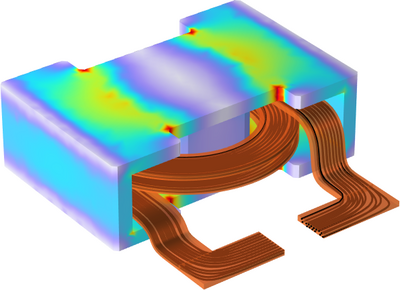
Inductors are used in many applications for low pass filtering or for impedance matching of predominantly capacitive loads. They are used in a wide frequency range from near static up to several MHz. An inductor usually has a magnetic core to increase the inductance, while keeping its ... Read More
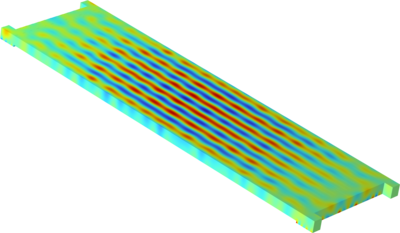
Lamb-wave resonators are useful components for many radio-frequency applications. This example shows how you model an aluminum nitride Lamb wave resonator and perform eigenfrequency and frequency-response analyses to characterize the device. The tutorial uses the Electric Currents in ... Read More
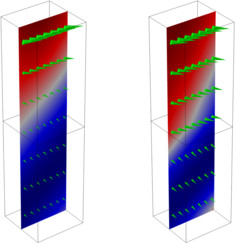
A plane electromagnetic wave propagating through free space is incident at an angle upon an infinite dielectric medium. This model computes the reflection and transmission coefficients and compares the results to the Fresnel equations. Read More
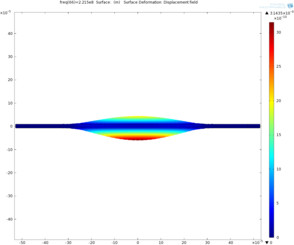
Bulk Acoustic Wave (BAW) resonators can be used as narrow band filters in radio-frequency applications. The chief advantage compared with traditional ceramic electromagnetic resonators is that BAW resonators, thanks to the acoustic wavelength being much smaller than the electromagnetic ... Read More
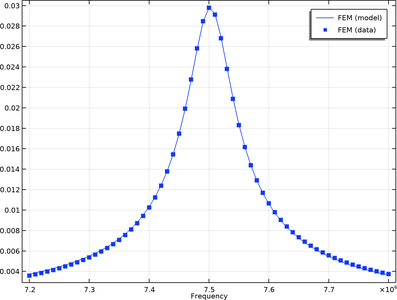
This tutorial demonstrates how a lumped model of a MEMS transducer can be derived from its FEM model. It includes an FEM model of a capacitive micromachined ultrasonic transducer (CMUT) and the corresponding lumped model created using the Lumped Mechanical System (LMS) interface. The ... Read More


