
The Application Gallery features COMSOL Multiphysics® tutorial and demo app files pertinent to the electrical, structural, acoustics, fluid, heat, and chemical disciplines. You can use these examples as a starting point for your own simulation work by downloading the tutorial model or demo app file and its accompanying instructions.
Search for tutorials and apps relevant to your area of expertise via the Quick Search feature. Note that many of the examples featured here can also be accessed via the Application Libraries that are built into the COMSOL Multiphysics® software and available from the File menu.
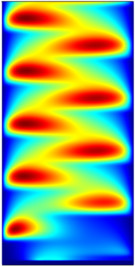
This model simulates electrical breakdown in an atmospheric pressure gas. Modeling dielectric barrier discharges in more than one dimension is possible, but the results can be difficult to interpret because of the amount of competing physics in the problem. In this simple model the ... Read More
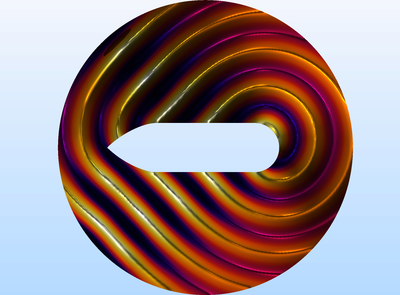
This tutorial model demonstrates the use of a background field in an electromagnetic scattering problem. Although this example is a boat hit by a radar, this same technique can be used in any situation where an isolated object meets electromagnetic waves from a distant source. For ... Read More
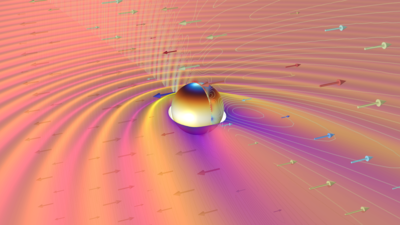
This verification model uses the Electromagnetic Waves, Boundary Elements interface to simulate the RCS of perfectly conducting sphere. The simulated result is compared to analytical calculation to verify the accuracy. Read More
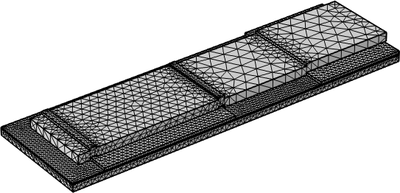
This tutorial demonstrates how to build the geometry for the 3D biased resonator from GDS file using the ECAD Import Module and the Design Module. The procedure emulates semiconductor and MEMS fabrication processes to build 3D geometry more efficiently and is more intuitive for those ... Read More
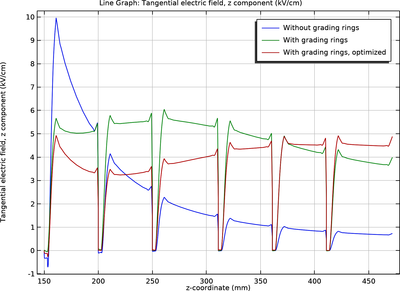
Extending the High Voltage Insulator model, this example shows how to set up an Optimization Study to determine the optimum position of the grading rings to obtain the highest flashover voltage. Read More
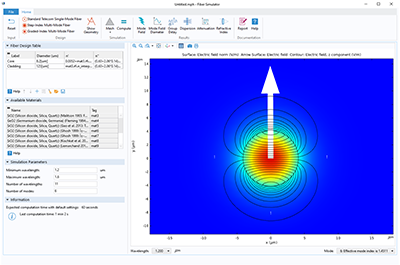
The transmission speed of optical waveguides is superior to microwave waveguides because optical devices have a much higher operating frequency than microwaves, enabling a far higher bandwidth. Single-mode step-index fibers are used for long-haul (even transoceanic) communication, ... Read More
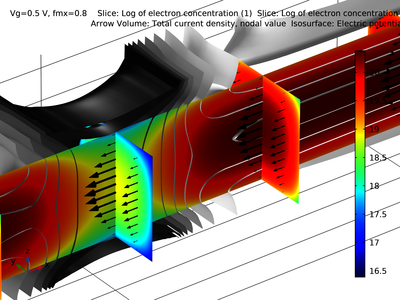
This 3D model of a nanowire MOSFET employs the density-gradient theory to add the effect of quantum confinement to the conventional drift-diffusion formulation, without requiring excessively high computational costs. The oxide layer is simulated explicitly with geometric domains, and ... Read More
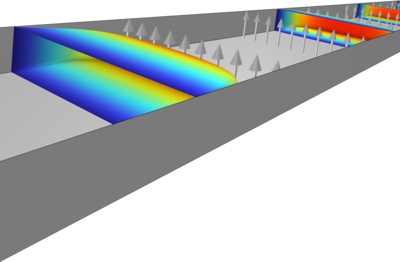
In nuclear fusion reactors, the conducting fluid, such as the fusion plasma and the liquid metal in the reactor blanket, will interact with the background magnetic field. This phenomenon is referred to as magnetohydrodynamics (MHD). The electromagnetic field and fluid flow are fully ... Read More


