
The Application Gallery features COMSOL Multiphysics® tutorial and demo app files pertinent to the electrical, structural, acoustics, fluid, heat, and chemical disciplines. You can use these examples as a starting point for your own simulation work by downloading the tutorial model or demo app file and its accompanying instructions.
Search for tutorials and apps relevant to your area of expertise via the Quick Search feature. Note that many of the examples featured here can also be accessed via the Application Libraries that are built into the COMSOL Multiphysics® software and available from the File menu.
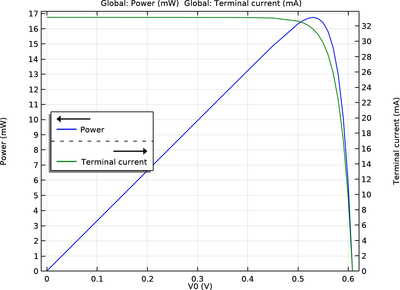
This tutorial uses a simple 1D model of a silicon solar cell to illustrate the basic steps to set up and perform a device physics simulation with the Semiconductor Module. A user-defined expression is used for the photo-generation rate and the result shows typical I–V and P–V curves of ... Read More
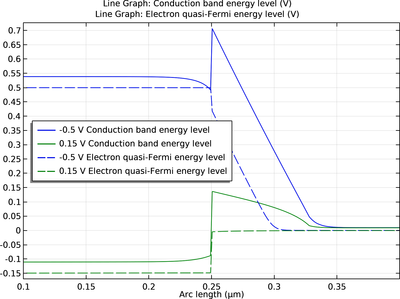
This benchmark model simulates a graded heterojunction using the thermionic emission formulation for the charge transfer over the junction. It shows the additional contribution to the current density from the quantum tunneling effect across the potential barrier, using the WKB ... Read More
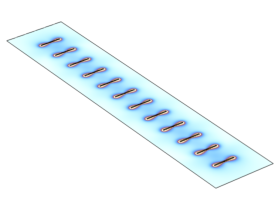
This example of a dipole antenna array demonstrates a cost-effective analysis using the Boundary Element Method (BEM). When dealing with a large array made of metallic radiators, the Finite Element Method (FEM) would necessitate greater computational resources. The simulation results ... Read More
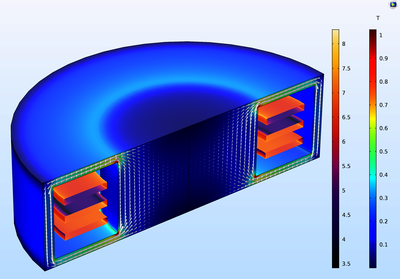
Inductive devices experience capacitative coupling between conductors at high frequencies. Modeling this phenomenon requires that you describe electric fields that have components both parallel with and perpendicular to the wire. This consideration might lead to the conclusion that a 3D ... Read More

A large reflector can be modeled easily with the 2D axisymmetric formulation. In this model, the radius of the reflector is greater than 20 wavelengths and the reflector is illuminated by an axial feed circular horn antenna. The simulated far-field shows a high-gain sharp beam pattern Read More
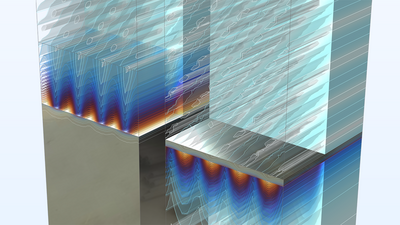
This example demonstrates a simulation setup for exciting surface plasmon polaritons using Otto and Kretschmann configurations. The underlying mechanism is enabled by the interplay between total internal reflection and evanescent-wave coupling phenomena. It also calculates the ... Read More
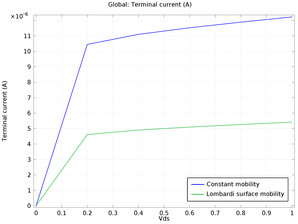
Surface acoustic phonons and surface roughness have an important effect on the carrier mobility, especially in the thin inversion layer under the gate in MOSFETs. The Lombardi surface mobility model adds surface scattering resulting from these effects to an existing mobility model using ... Read More
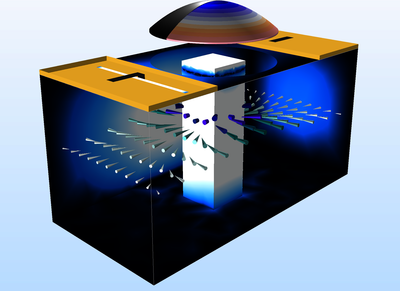
An evanescent mode cavity filter can be realized by adding a structure inside of the cavity. This structure changes the resonant frequency lower than the dominant mode of the unfilled cavity. A piezo actuator is used to control the size of a small air gap which provides the tunability of ... Read More


