
The Application Gallery features COMSOL Multiphysics® tutorial and demo app files pertinent to the electrical, structural, acoustics, fluid, heat, and chemical disciplines. You can use these examples as a starting point for your own simulation work by downloading the tutorial model or demo app file and its accompanying instructions.
Search for tutorials and apps relevant to your area of expertise via the Quick Search feature. Note that many of the examples featured here can also be accessed via the Application Libraries that are built into the COMSOL Multiphysics® software and available from the File menu.
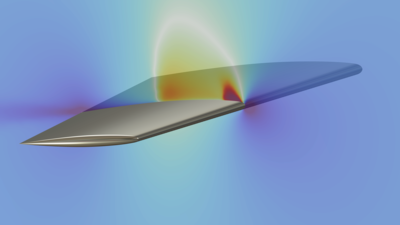
This example demonstrates how to set up the classical external-flow problem of solving for the high-speed, compressible, turbulent flow over the ONERA-M6 wing. The problem involves finding a steady-state solution of the flow field around the 3D, swept wing geometry, immersed in a ... Read More
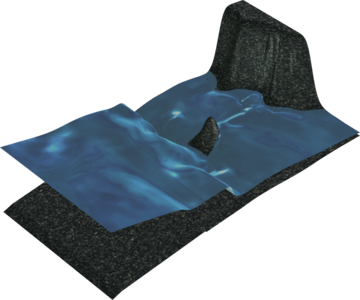
This example is an established benchmark case for the shallow water equations that models a 1/400 scaled laboratory experiment of the tsunami runup in Monai Valley in Japan. The experiment was made at the Central Research Institute for Electric Power Industry (CRIEIPI) in Abiko, Japan, ... Read More
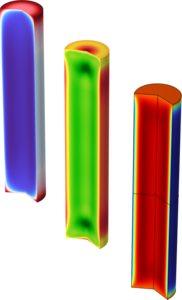
A steel billet is quenched in oil from its austenitic state. A 2D axisymmetric model is used to simulate the coupled problem of austenite decomposition, heat transfer, and solid mechanics. During the quenching process, the austenite decomposes into a combination of ferrite, pearlite, ... Read More
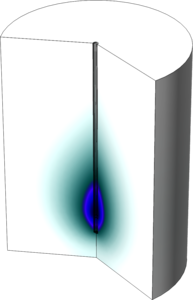
Electromagnetic heating is ideally suited for modeling in COMSOL Multiphysics. This model shows the area of hyperthermic oncology but the modeling issues and techniques are generally applicable to any problem involving electromagnetic heating. The purpose of this model is to compute the ... Read More
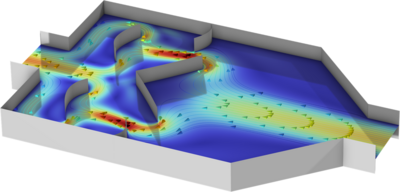
The topology optimized Tesla microvalve is used as an inspiration for an initial geometry. Second order Bernstein polynomials are used to perturb the shape of the geometry. The resulting design is remeshed in the deformed configuration and the performance is investigated for a range of ... Read More
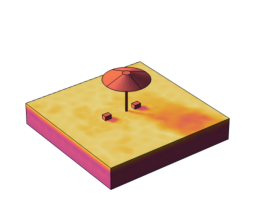
This tutorial model illustrates how to analyze the thermal effects of the sun as an external radiative source and considers wavelength-dependent surface emissivities. Specifically, the model features two coolers containing beverage cans that are exposed to ambient conditions and a beach ... Read More
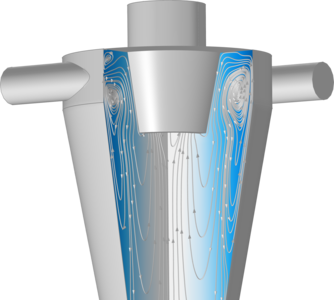
Cyclones are used in a variety of applications ranging from the mining industry to vacuum cleaners. The flow in a cyclone is characterized by a very strong swirl, which makes it difficult to simulate. In this tutorial example, the v2-f turbulence model is used to simulate the flow in a ... Read More
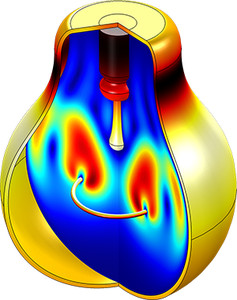
This model treats the free convection of argon gas within a light bulb. It shows the coupling of heat transport (conduction, radiation and convection) to momentum transport (non-isothermal flow) induced by density variations caused by temperature. COMSOL Multiphysics model makes it ... Read More
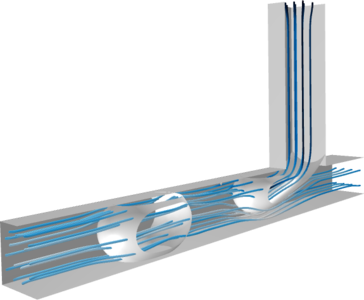
Emulsions consist of small liquid droplets immersed in an immiscible liquid and widely occur in the production of food, cosmetics, fine chemicals, and pharmaceutical products. The quality of the product is typically dependent on the size of the droplets. Simulating these processes can ... Read More
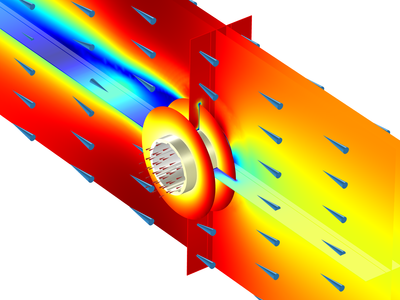
This app demonstrates the following: Geometry parts and parameterized geometry A results table form object containing outputs Finned pipes are used for coolers, heaters, or heat exchangers to increase heat transfer. They come in different sizes and designs depending on the ... Read More


