
The Application Gallery features COMSOL Multiphysics® tutorial and demo app files pertinent to the electrical, structural, acoustics, fluid, heat, and chemical disciplines. You can use these examples as a starting point for your own simulation work by downloading the tutorial model or demo app file and its accompanying instructions.
Search for tutorials and apps relevant to your area of expertise via the Quick Search feature. Note that many of the examples featured here can also be accessed via the Application Libraries that are built into the COMSOL Multiphysics® software and available from the File menu.
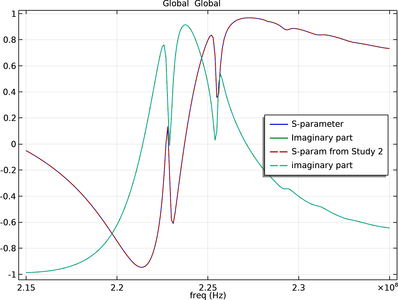
This model shows how to compute the S-parameter for a piezoelectric MEMS device by extending the tutorial Thin-Film BAW Composite Resonator. The measurement of S-parameter is commonly used to characterize such devices for RF applications. The terminal feature in the Electrostatics ... Read More
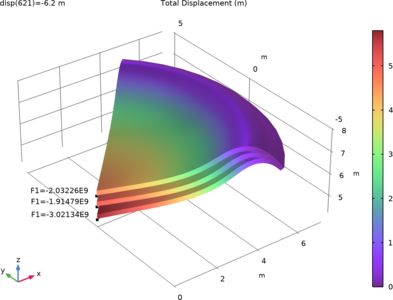
This benchmark studies the nonlinear deformation of a spherical cap subjected to point load at center using 2D axisymmetric Solid Mechanics and Shell interfaces. The results from the Shell interface are compared with Solid Mechanics interface as well as with analytical results given in ... Read More
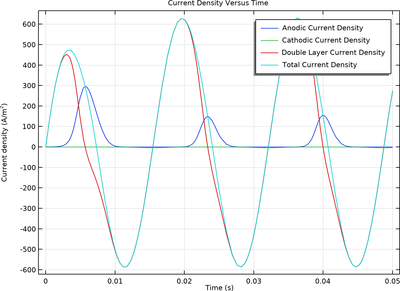
Corrosion induced due to alternating current (AC) is evident in the oil and gas industry, particularly when a pipeline is in close proximity to the high power transmission lines. A numerical model presented here first evaluates the effect of direct current (DC) applied potential on ... Read More
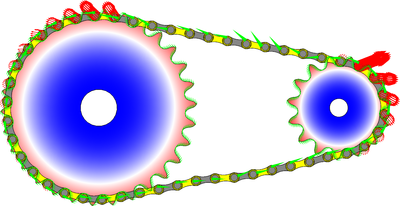
Chain drives are used for transmitting power from one shaft to another, located at some distance. This example simulates the dynamics of a chain sprocket assembly in 2D. The geometry consists of a roller chain wrapped around two sprockets. Both chain links and sprockets are assumed to be ... Read More
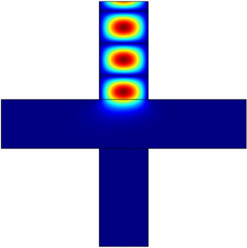
Wave heated discharges may be very simple, where a plane wave is guided into a reactor using a waveguide, or very complicated as in the case with ECR (electron cyclotron resonance) reactors. In this example, a wave is launched into reactor and an Argon plasma is created. The wave is ... Read More
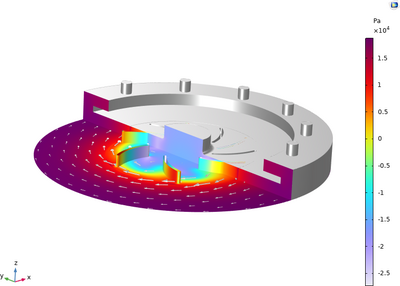
The present example simulates the steady-state flow in a radial pump using the mixing plane methodology. It solves for the averaged flow resulting from different blade positions of the rotor, thus circumventing the need to perform costly time-dependent simulations. Read More
The mutual inductance and induced currents between a single turn primary and twenty turn secondary coil in a concentric coplanar arrangement is computed using a frequency domain model. The secondary coil is modeled using a homogenized approach which does not explicitly consider each turn ... Read More
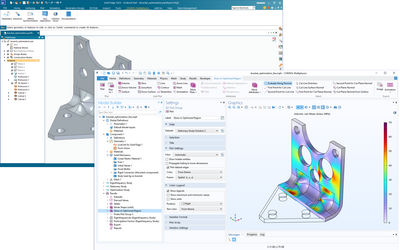
This tutorial minimizes the mass of a bracket that is synchronized from Solid Edge® via the LiveLink™ interface. There are limits both for the lowest natural frequency, and for the maximum stress in a static load case. The size and position for a number of geometrical features ... Read More


