
The Application Gallery features COMSOL Multiphysics® tutorial and demo app files pertinent to the electrical, structural, acoustics, fluid, heat, and chemical disciplines. You can use these examples as a starting point for your own simulation work by downloading the tutorial model or demo app file and its accompanying instructions.
Search for tutorials and apps relevant to your area of expertise via the Quick Search feature. Note that many of the examples featured here can also be accessed via the Application Libraries that are built into the COMSOL Multiphysics® software and available from the File menu.
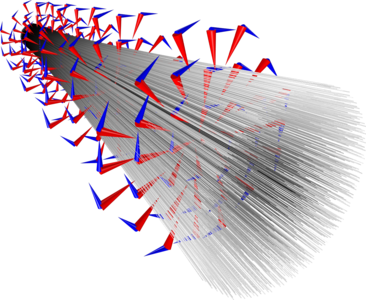
When modeling the propagation of charged particle beams at high currents and relativistic speeds, the space charge and beam current create significant electric and magnetic forces that tend to expand and focus the beam, respectively. The Charged Particle Tracing interface uses an ... Read More
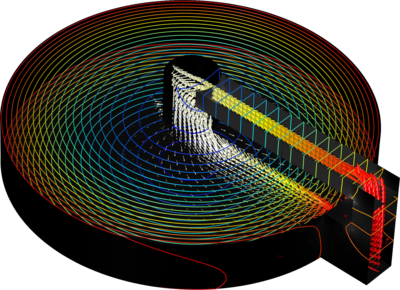
A homopolar generator is composed of an electrically conductive rotating disc placed in a uniform magnetic field that is perpendicular to the plane of rotation. The motion of the conductor through the static magnetic field induces Lorentz currents in the disc. By connecting the outside ... Read More
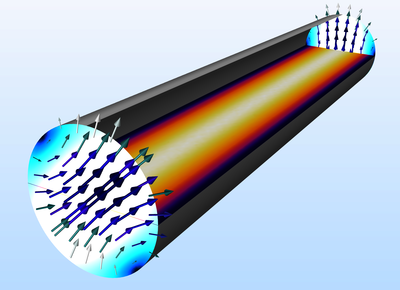
This model of a circular waveguide demonstrates how to use ports with numerical solution of the port modes. It illustrates how to align the polarization of degenerate port modes and in particular how to model and excite the TE11 mode of circular waveguides in 3D. Read More
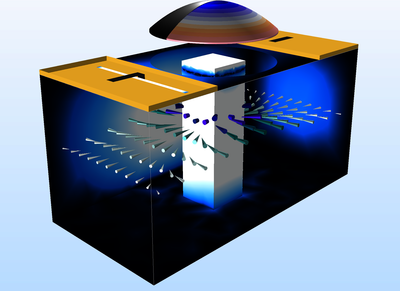
An evanescent mode cavity filter can be realized by adding a structure inside of the cavity. This structure changes the resonant frequency lower than the dominant mode of the unfilled cavity. A piezo actuator is used to control the size of a small air gap which provides the tunability of ... Read More

This example illustrates the principle of electrochemical polishing. The simplified 2D model geometry consists of two electrodes and an intermediate electrolyte domain The positive electrode has a protrusion, representing a surface defect. The purpose of the model is to examine how this ... Read More
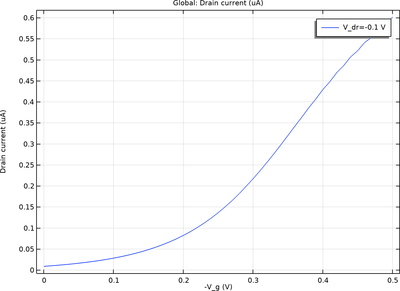
This model shows how to model an electrolyte-gated organic field-effect transistor based on a general drift-diffusion model. The model uses the Stabilized Convection-Diffusion Equation interface and the Electrostatics interface. The transistor characteristics are visualized. Formation of ... Read More
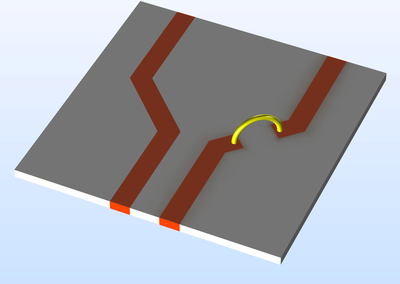
Mixed-mode S-parameters describe the responses of a circuit with balanced ports excited and terminated by two types of modes: common and differential modes. They are calculated using a full S-parameter matrix of a four-port network that is composed of four single ended lines. This ... Read More
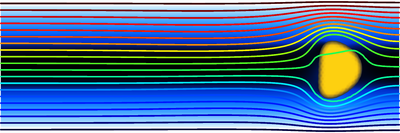
Applying an electric field across a suspension of immiscible liquids may stimulate droplets of the same phase to coalesce. The method known as electrocoalescence has important applications, for instance, in the separation of oil from water. To model electrocoalescence, you need to solve ... Read More
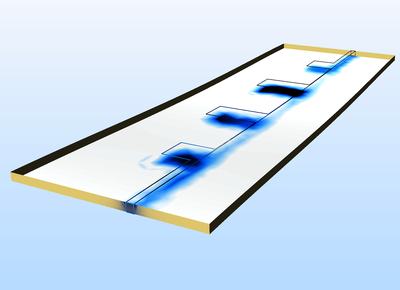
Microstrip filters can be fabricated directly on a printed circuit board (PCB) with a microstrip line going from the input to the output. Along the microstrip line there are a number of stubs of certain lengths and widths. The design of the filter involves choosing the impedance of the ... Read More
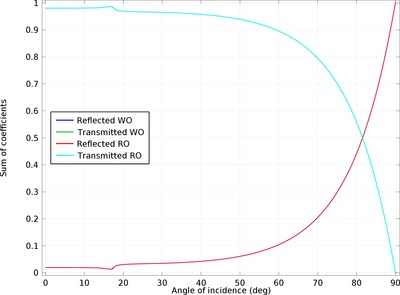
This model uses the Wave Optics Module and the Ray Optics module to model the propagation of rays through a diffraction grating at different angles of incidence. It uses the S-parameters computed by the Electromagnetic Waves, Frequency Domain interface on a unit cell of the grating to ... Read More