
The Application Gallery features COMSOL Multiphysics® tutorial and demo app files pertinent to the electrical, structural, acoustics, fluid, heat, and chemical disciplines. You can use these examples as a starting point for your own simulation work by downloading the tutorial model or demo app file and its accompanying instructions.
Search for tutorials and apps relevant to your area of expertise via the Quick Search feature. Note that many of the examples featured here can also be accessed via the Application Libraries that are built into the COMSOL Multiphysics® software and available from the File menu.
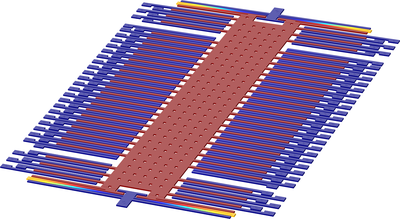
This model shows how to simulate a capacitively actuated surface micromachined accelerometer, using the Electromechanics Interface. It is based on a case study from the book Microsystem Design by Stephen D. Senturia (Kluwer Academic Publishers, 5th Edition, 2003, pages 513-525). Read More
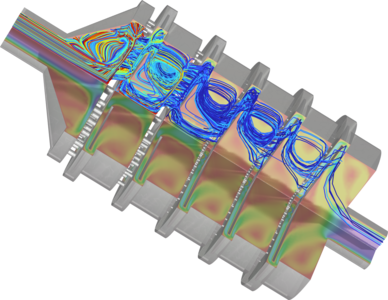
This example simulates particles in a range of sizes that move through different levels of a cascade impactor. A cascade impactor is an inertial particle separation device consisting of multiple levels separated by collecting plates and nozzles. Particle-laden air enters from the top ... Read More
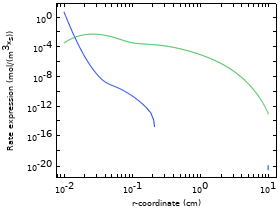
This tutorial presents a study of positive and negative corona discharges in dry air at atmospheric pressure. The discharges are sustained within two electrodes in a coaxial configuration by a high voltage DC source applied to the inner electrode. Two different types of models are used: ... Read More
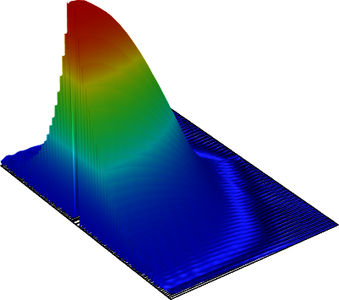
An eigenfrequency study is used to find the resonance frequency and threshold gain for an oxide-confined, GaAs-based, vertical-cavity surface-emitting laser (VCSEL). The simulations are performed in two steps. A regular eigenfrequency analysis is first performed, to find good initial ... Read More
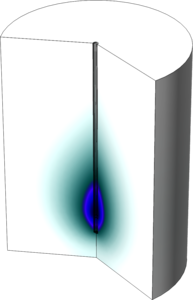
Electromagnetic heating is ideally suited for modeling in COMSOL Multiphysics. This model shows the area of hyperthermic oncology but the modeling issues and techniques are generally applicable to any problem involving electromagnetic heating. The purpose of this model is to compute the ... Read More
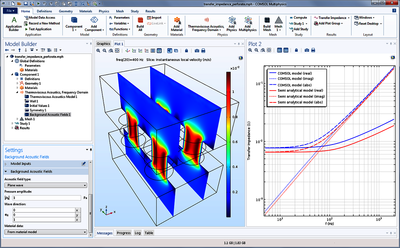
Perforates are plates with a distribution of small perforations or holes. They are used in muffler systems, sound absorbing panels, and in many other places as liners, where it is important to control attenuation precisely. As the perforations become smaller and smaller, viscous and ... Read More
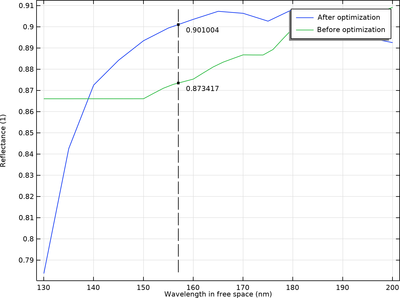
This example demonstrates how to optimize the thickness of a microelectromechanical systems (MEMS) mirror coating material for maximum reflectivity. To reduce the simulation time, a Layered Impedance Boundary Condition is used to model the thin coating material on top of the metallic ... Read More
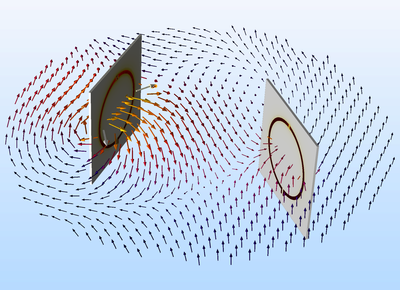
This model addresses the concept of wireless power transfer by studying the energy coupling between two circular loop antennas tuned for UHF RFID frequency whose size is reduced using chip inductors. The circular loop antenna provides inherent inductive coupling by its shape, and it can ... Read More
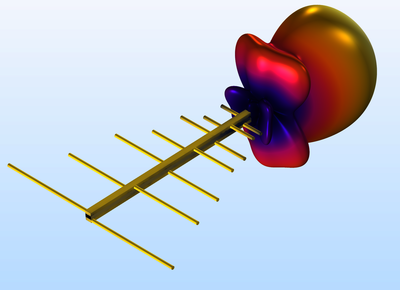
The shape of a log-periodic antenna resembles that of a Yagi-Uda antenna, but is composed of a coplanar array to achieve a wider bandwidth. It is also known as a wideband or frequency-independent antenna. All metallic parts are modeled using the perfect electric conductor (PEC) boundary ... Read More
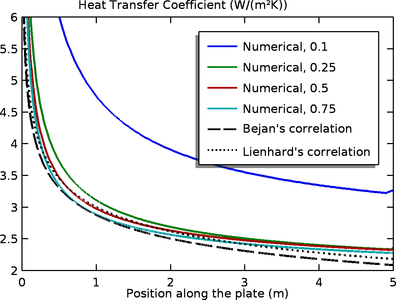
This verification model of nonisothermal turbulent flow over a flat plate compares the heat transfer coefficient obtained from simulation with theoretical values based on Nusselt number correlation functions that can be found in the literature. Read More