
The Application Gallery features COMSOL Multiphysics® tutorial and demo app files pertinent to the electrical, structural, acoustics, fluid, heat, and chemical disciplines. You can use these examples as a starting point for your own simulation work by downloading the tutorial model or demo app file and its accompanying instructions.
Search for tutorials and apps relevant to your area of expertise via the Quick Search feature. Note that many of the examples featured here can also be accessed via the Application Libraries that are built into the COMSOL Multiphysics® software and available from the File menu.
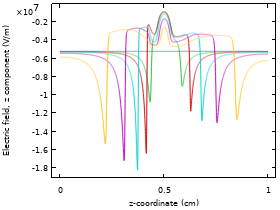
This tutorial model presents a study of a double-headed streamer in nitrogen at atmospheric pressure. An initial seed of electrons is placed between two electrodes which apply an initial electric field of 52 kV/cm to the gas. A negative and positive streamer propagate toward the ... Read More
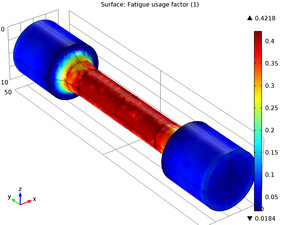
A benchmark model for the fatigue module. A cylindrical test is subjected to non-proportional loading. Three stress based models: Findley, Matake, Normal stress, are compared to analytical values and to each other. The non-smooth behavior of the Matake model is captured and discussed. Read More
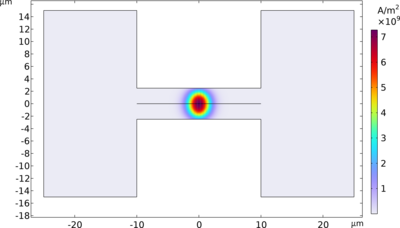
This model uses the Semiconductor and RF modules to describe a photoconductive antenna (PCA). A laser pulse is applied on the surface of undoped LT-GaAs to generate electron-hole-pairs, which move under the influence of an external E-field creating a transient electric current pulse. ... Read More
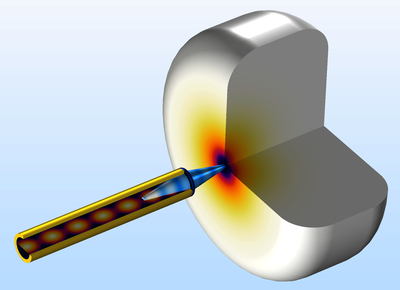
The response of a millimeter wave with frequencies of 35 GHz and 95 GHz is known to be very sensitive to water content. This model utilizes a low-power 35 GHz Ka-band millimeter wave and its reflectivity to moisture for noninvasive cancer diagnosis. Since skin tumors contain more ... Read More
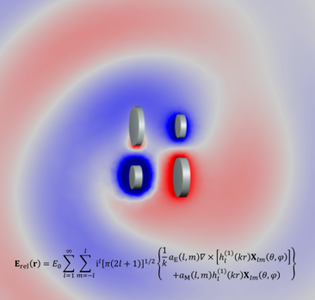
The multipole expansion is a powerful tool for analyzing electromagnetic waves scattered by small objects. In the expansion, the scattered field is represented as a superposition of the fields created by a finite set of point multipoles. Each point multipole is connected to a unique ... Read More
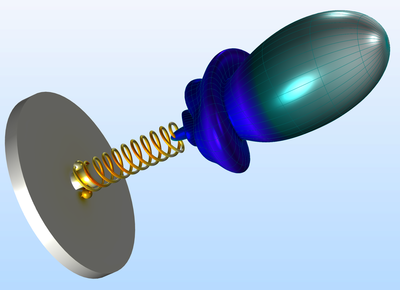
A helical antenna has two major modes. One is normal mode and the other is axial mode. When the helical antenna is operating at the normal mode, its far-field radiation pattern is similar to the torus shaped pattern of a classic dipole antenna. At the axial mode, the helical antenna is ... Read More
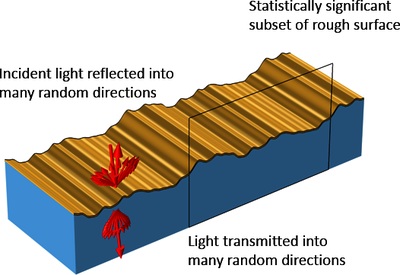
These examples demonstrate how to compute the total reflection, transmission, and absorption of light when a plane wave, at optical wavelengths, is incident upon a dielectric slab with a thin metal coating. Three examples are included that show: An optically flat slab A slab with a ... Read More
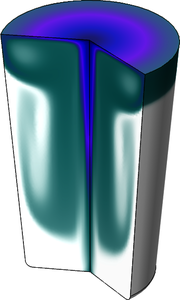
This example shows how to model carbonation, which is a type of sparging. Sparging is a mass transfer process between a gas and a liquid that is common in industry (such as beverage carbonation and photobioreactor applications) and at home (aquarium aeration). In the carbonation model, ... Read More
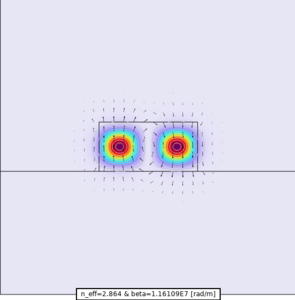
Mode analysis is a basic tool for a wide range of radiofrequency and wave optics calculations because it allows for the investigation of mode characteristics in complex waveguide structures. In this tutorial model, you can find two examples that demonstrate typical settings and best ... Read More
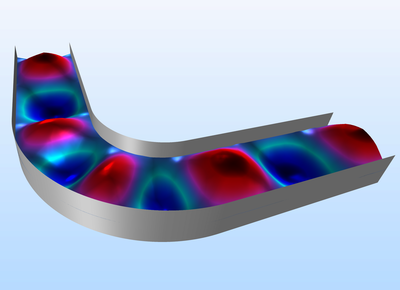
These examples show how to model a rectangular waveguide for microwaves in 2D and 3D. A single hollow waveguide can conduct two kinds of electromagnetic waves: transversal magnetic (TM) or transversal electric (TE) waves. The models examine a TE wave that has no electric field ... Read More