
The Application Gallery features COMSOL Multiphysics® tutorial and demo app files pertinent to the electrical, structural, acoustics, fluid, heat, and chemical disciplines. You can use these examples as a starting point for your own simulation work by downloading the tutorial model or demo app file and its accompanying instructions.
Search for tutorials and apps relevant to your area of expertise via the Quick Search feature. Note that many of the examples featured here can also be accessed via the Application Libraries that are built into the COMSOL Multiphysics® software and available from the File menu.

This tutorial studies the etching of silicon using an inductively coupled plasma reactor with an RF bias in a mixture of CF4/O2. The etching rate is computed along the wafer as a function of the RF bias voltage. Read More
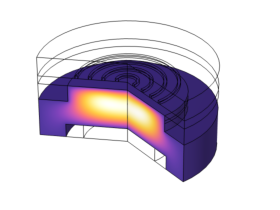
This tutorial model solves for an inductively coupled plasma reactor with RF bias (also known as ICP/CCP reactors) in a mixture of argon/chlorine. The model computes the fluid flow and gas heating. Important aspects and strategies for modeling electronegative discharges are discussed. Read More
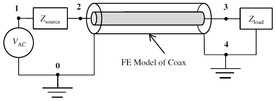
A model built with the RF Module can be connected to an electrical circuit equivalent, if there is some structure outside of the model space that you wish to approximate as a circuit equivalent. In this model, the 3D model of a coaxial cable is connected to a voltage source, in series ... Read More
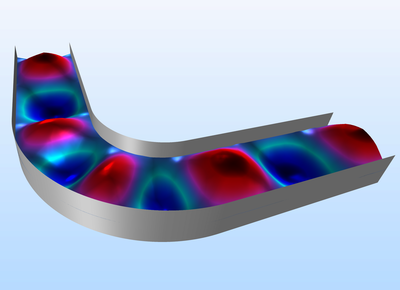
These examples show how to model a rectangular waveguide for microwaves in 2D and 3D. A single hollow waveguide can conduct two kinds of electromagnetic waves: transversal magnetic (TM) or transversal electric (TE) waves. The models examine a TE wave that has no electric field ... Read More
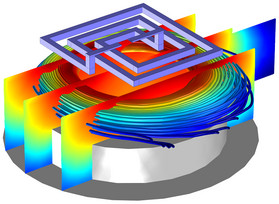
The COMSOL® software includes capabilities for 3D plasma modeling. In this example, a square coil is placed on top of a dielectric window and is electrically excited at 13.56 MHz. A plasma is formed in the chamber beneath the dielectric window, which contains argon gas at low ... Read More

This is a benchmark model for the 2D axisymmetric formulation of the Electromagnetic Waves, Frequency Domain interface that is available with the RF Module. The problem is to find the resonant frequencies and fields inside an axisymmetric cavity with rectangular cross-section and ... Read More
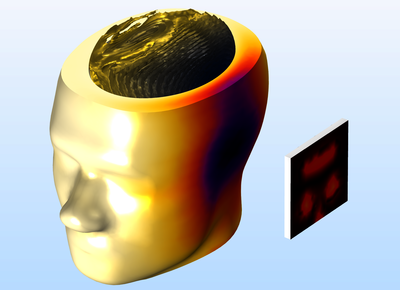
Users of consumer electronics with radiating devices are exposed to radio frequency (RF) emission. The amount of exposure is defined as the specific absorption rate (SAR). That is, the SAR value represents the radio frequency (RF) energy rate absorbed by a body. This model computes local ... Read More
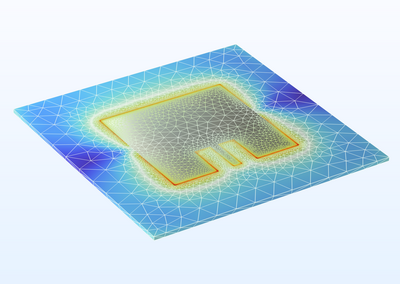
The model utilizes a dedicated mesh refinement study, Frequency Domain RF Adaptive Mesh, which dynamically refines the mesh in the region of interest. For the Application Library model Microstrip Patch Antenna, it increases the mesh resolution around areas with high field variations. The ... Read More
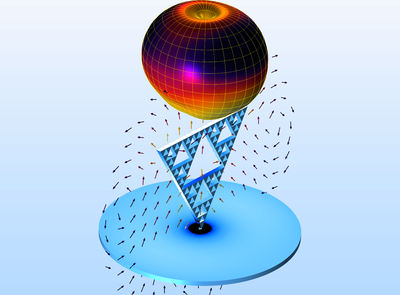
A fractal is a mathematical form showing self-repeating patterns. By virtue of its geometrical properties, a fractal structure can generate multiple resonances in RF applications. This antenna model uses a 3rd order Sierpinski triangle and the calculated S-parameters shows good input ... Read More
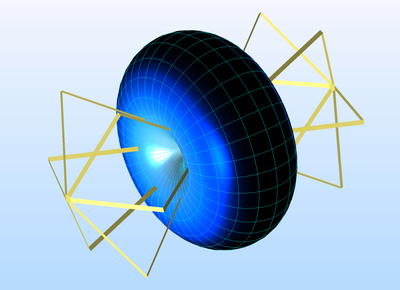
Biconical antennas are popular for very high frequency (VHF) measurement because they support a wide frequency range. They are also useful for electromagnetic compatibility (EMC) testing where the antenna can be used as an RF source in susceptibility or immunity test. This model ... Read More