
The Application Gallery features COMSOL Multiphysics® tutorial and demo app files pertinent to the electrical, structural, acoustics, fluid, heat, and chemical disciplines. You can use these examples as a starting point for your own simulation work by downloading the tutorial model or demo app file and its accompanying instructions.
Search for tutorials and apps relevant to your area of expertise via the Quick Search feature. Note that many of the examples featured here can also be accessed via the Application Libraries that are built into the COMSOL Multiphysics® software and available from the File menu.
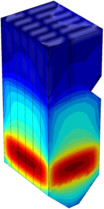
This model uses the discrete-ordinates method (DOM) to analyze the radiative heat transfer in a utility boiler with internal obstacles. DOM is one of the most useful radiation models for prediction of radiative heat fluxes on the furnace walls of a combustion chamber. With this model, ... Read More

This example shows an approximate approach to model a dot-in-well solar cell as described by Asahi et al. in the reference paper. The quantum wells and the layers of quantum dots are each treated as lumped energy levels in the band gap. The authors specify transitions between the dot ... Read More
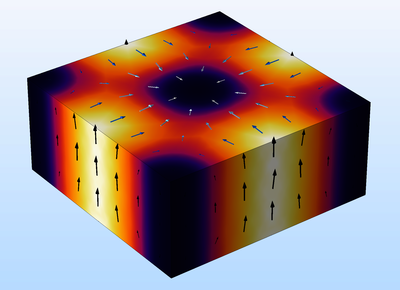
A classic benchmark example in computational electromagnetics is to find the resonant frequency and Q-factor of a cavity with lossy walls. Here, models of rectangular, cylindrical, and spherical cavities are shown to be in agreement with analytic solutions. Read More
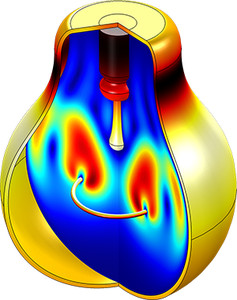
This model treats the free convection of argon gas within a light bulb. It shows the coupling of heat transport (conduction, radiation and convection) to momentum transport (non-isothermal flow) induced by density variations caused by temperature. COMSOL Multiphysics model makes it ... Read More
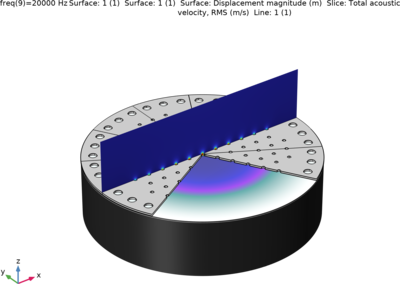
This is a model of a MEMS microphone solved in the frequency domain including the DC prestress effects. The model is set up using the Electromechanics multiphysics interface, Thermoviscous Acoustics, and Pressure Acoustics. The microphone consists of a perforated plate and a prestressed ... Read More
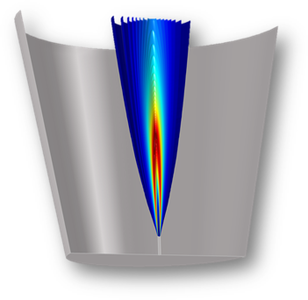
The model simulates non-premixed turbulent combustion of syngas (synthesis gas) in a simple round-jet burner. Syngas is a gas mixture, primarily composed of hydrogen, carbon monoxide and carbon dioxide. The name syngas relates to its use in creating synthetic natural gas. In the model, ... Read More
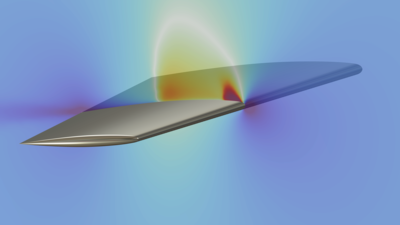
This example demonstrates how to set up the classical external-flow problem of solving for the high-speed, compressible, turbulent flow over the ONERA-M6 wing. The problem involves finding a steady-state solution of the flow field around the 3D, swept wing geometry, immersed in a ... Read More
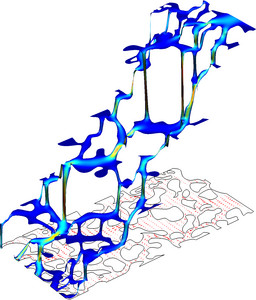
This non-conventional model of porous media flow utilizes creeping (Stokes) flow in the interstices of a porous media. The model comes from the pore-scale flow experiments conducted by Arturo Keller, Maria Auset, and Sanya Sirivithayapakorn of the University of California, Santa Barbara. ... Read More
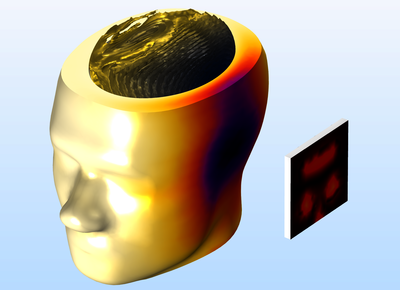
Users of consumer electronics with radiating devices are exposed to radio frequency (RF) emission. The amount of exposure is defined as the specific absorption rate (SAR). That is, the SAR value represents the radio frequency (RF) energy rate absorbed by a body. This model computes local ... Read More
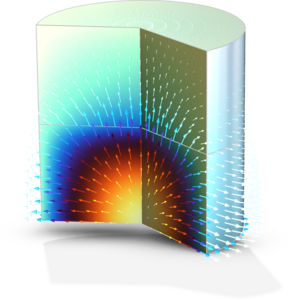
Thermally induced transformations in solids may be modeled by using an Arrhenius law to express the dependence on temperature of the transformation rate. This tutorial model shows how to use the Irreversible Transformation subfeature, available under the Solid feature of the Heat ... Read More