
The Application Gallery features COMSOL Multiphysics® tutorial and demo app files pertinent to the electrical, structural, acoustics, fluid, heat, and chemical disciplines. You can use these examples as a starting point for your own simulation work by downloading the tutorial model or demo app file and its accompanying instructions.
Search for tutorials and apps relevant to your area of expertise via the Quick Search feature. Note that many of the examples featured here can also be accessed via the Application Libraries that are built into the COMSOL Multiphysics® software and available from the File menu.
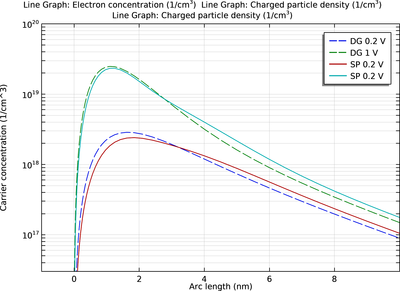
This tutorial demonstrates the use of the density-gradient formulation to include the effect of quantum confinement in the device physics simulation of a silicon inversion layer. This formulation requires only a moderate increase of computational resources as compared to the conventional ... Read More
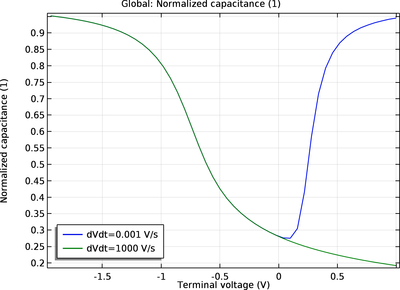
The metal-silicon-oxide (MOS) structure is the fundamental building block for many silicon planar devices. Its capacitance measurements provide a wealth of insight into the working principles of such devices. This tutorial constructs a simple 1D model of a MOS capacitor (MOSCAP). Both ... Read More
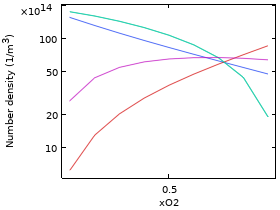
This tutorial model solves for an inductively coupled plasma reactor in a mixture of argon/oxygen. The model computes the fluid flow and gas heating. Important aspects and strategies for modeling electronegative discharges are discussed. Read More
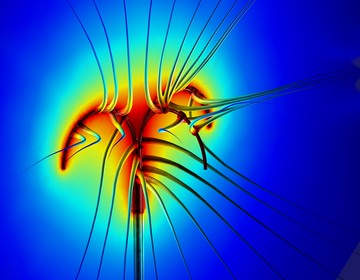
One method for removing cancerous tumors from healthy tissue is to heat the malignant tissue to a critical temperature that kills the cancer cells. This example accomplishes the localized heating by inserting a four-armed electric probe through which an electric current runs. Equations ... Read More
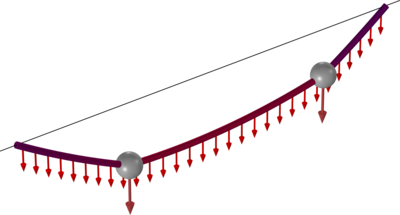
A cable is a structural member which has stiffness only in its tangential direction, but virtually no bending stiffness. When supported only at its two ends it deflects under gravitational load forming a curve known as catenary. This example shows how to model components such as cables, ... Read More
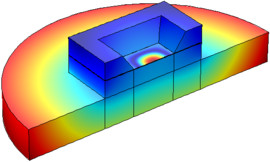
A capacitive pressure sensor is simulated. This model shows how to simulate the response of the pressure sensor to an applied pressure, and also how to analyze the effects of packing induced stresses on the sensor performance. Read More
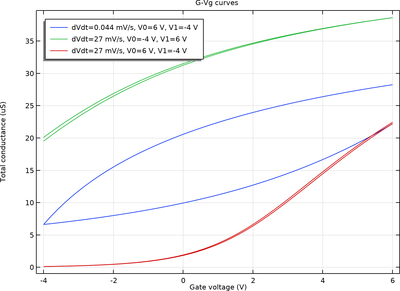
This tutorial analyzes the hysteresis of the conductance-gate-voltage (G-Vg) curves of an InAs nanowire FET, using the density-gradient theory to add the effect of quantum confinement to the conventional drift-diffusion formulation, without a large increase of computational costs. The ... Read More
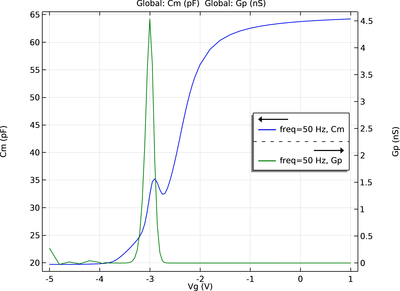
This tutorial compares experimental data from the literature with a COMSOL model of a MOSCAP with interface traps (surface states). The Trap-Assisted Surface Recombination feature is used to simulate the effects of the trap charges and the processes of carrier capturing and emitting by ... Read More
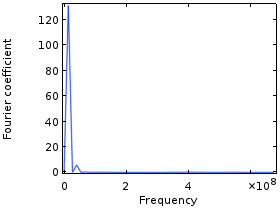
This tutorial model demonstrates how to compute the impedance of a capacitively coupled plasma. The Time Periodic study computes the time periodic solution of the plasma. Subsequently, the solution is transformed to the time domain, after which the fast Fourier transform (FFT) solver is ... Read More
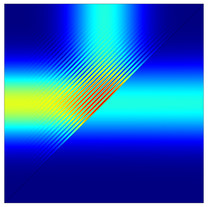
A beam splitter is used to split a single beam of light into two. One way of making a splitter is to deposit a thin layer of metal between two glass prisms. The beam is slightly attenuated within the layer, and split into two paths. In this example, the thin metal layer is modeled using ... Read More


