
The Application Gallery features COMSOL Multiphysics® tutorial and demo app files pertinent to the electrical, structural, acoustics, fluid, heat, and chemical disciplines. You can use these examples as a starting point for your own simulation work by downloading the tutorial model or demo app file and its accompanying instructions.
Search for tutorials and apps relevant to your area of expertise via the Quick Search feature. Note that many of the examples featured here can also be accessed via the Application Libraries that are built into the COMSOL Multiphysics® software and available from the File menu.
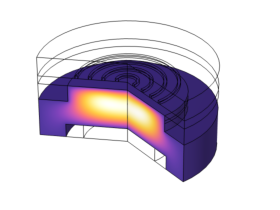
This tutorial model solves for an inductively coupled plasma reactor with RF bias (also known as ICP/CCP reactors) in a mixture of argon/chlorine. The model computes the fluid flow and gas heating. Important aspects and strategies for modeling electronegative discharges are discussed. Read More
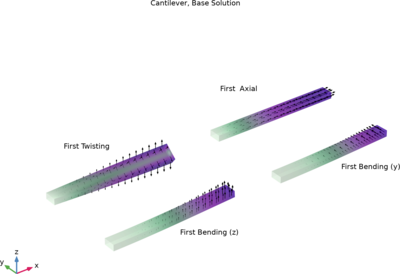
This example explores the shift in natural frequencies caused by changing the temperature. One study investigates a doubly clamped beam where both ends are fixed, while the other study looks at a cantilever beam where only one end is fixed. The following effects are studied: Stress ... Read More
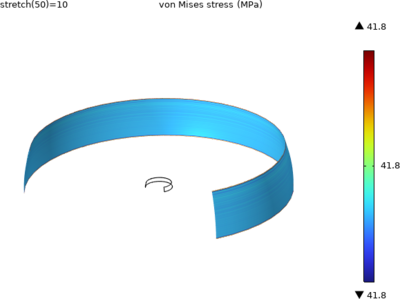
This version of the balloon inflation example demonstrates how the Shell and Membrane interfaces can be used to model thin structures made of hyperelastic materials. The example is identical to the Model Library model 'Inflation of a spherical rubber balloon', except that the Membrane ... Read More
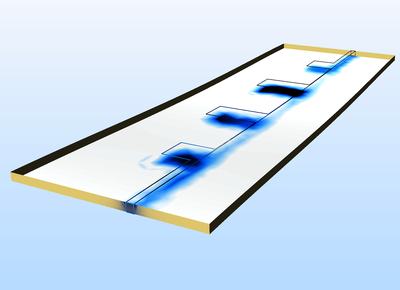
Microstrip filters can be fabricated directly on a printed circuit board (PCB) with a microstrip line going from the input to the output. Along the microstrip line there are a number of stubs of certain lengths and widths. The design of the filter involves choosing the impedance of the ... Read More
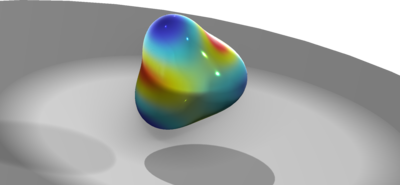
In this tutorial, the eigenmodes and eigenfrequencies of an air bubble in water is modeled and compared with analytical solutions. The effects of surface tension is included and allows to model both the pulsating mode and the surface modes of the bubble. Lastly, the effect of the ... Read More
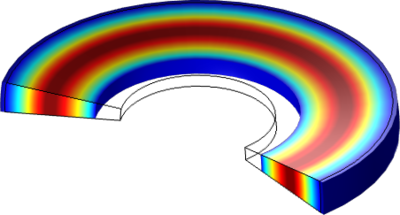
This example illustrates how to combine different Creep material models. Here a Norton–Bailey model (primary creep) is combined with a Norton model (secondary creep). This example is a continuation of the model thermally induced creep. Read More
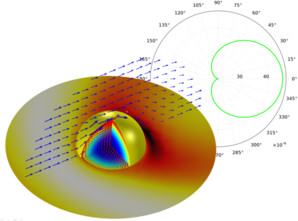
This model demonstrates the simulation of the scattering of a plane wave of light by a gold nanosphere. The scattering is computed for the optical frequency range over which gold can be modeled as a material with negative complex-valued permittivity. The far-field pattern and losses are ... Read More
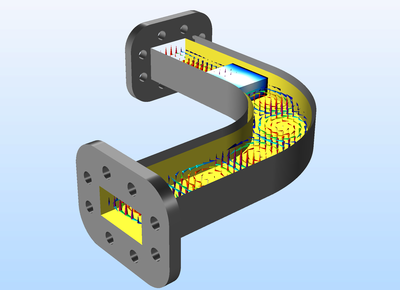
This is a model of an RF waveguide bend with a dielectric block inside. There are electromagnetic losses in the block as well as on the waveguide walls which cause the assembly to heat up over time. The material properties of the block are functions of temperature. The transient thermal ... Read More
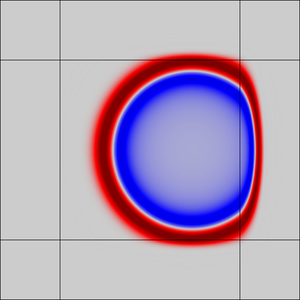
This tutorial simulates a standard test and benchmark model for nonreflecting conditions and sponge layers for linearized Euler-like systems. It involves the propagation of a transient Gaussian pulse in a 2D uniform flow. The Convected Wave Equation, Time Explicit interface solves the ... Read More
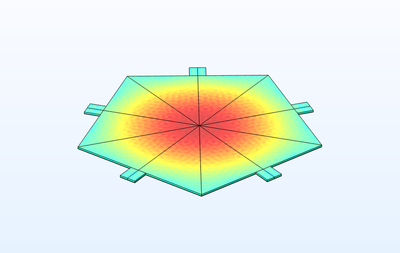
This tutorial demonstrates how an electrical circuit model of a MEMS resonator can be derived using the Parameter Estimation feature. The model is a modified Butterworth-Van Dyke circuit created using the Electrical Circuit interface and represents a Thin-Film Bulk Acoustic Resonator ... Read More