
The Application Gallery features COMSOL Multiphysics® tutorial and demo app files pertinent to the electrical, structural, acoustics, fluid, heat, and chemical disciplines. You can use these examples as a starting point for your own simulation work by downloading the tutorial model or demo app file and its accompanying instructions.
Search for tutorials and apps relevant to your area of expertise via the Quick Search feature. Note that many of the examples featured here can also be accessed via the Application Libraries that are built into the COMSOL Multiphysics® software and available from the File menu.
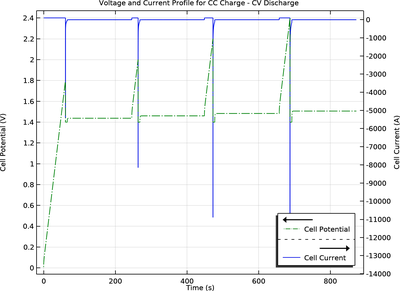
Electrochemical supercapacitors feature relatively higher energy densities than conventional capacitors. With several advantages, such as fast charging, long charge–discharge cycles, and broad operating temperature ranges, electrochemical supercapacitors have found wide applications in ... Read More
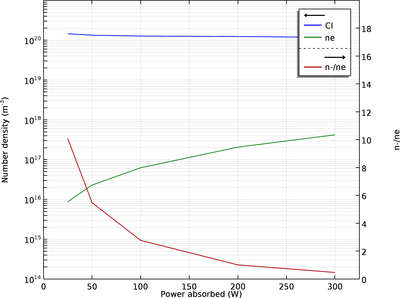
Plasma discharges containing chlorine are commonly used to etch semiconductors and metals in microelectronics fabrication. This tutorial model studies chlorine plasma discharges using a global (volume-averaged) diffusion model. Global diffusion models can run simulations in a fraction ... Read More
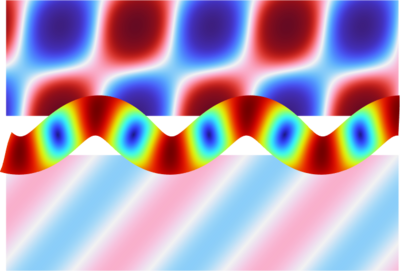
In this model, two fluids are separated by a solid elastic structure. An acoustic pressure wave impacts the structure resulting in a reflected wave and a wave transmitted with a loss through the structure. This model investigates the transmission loss through the structure. The effects ... Read More
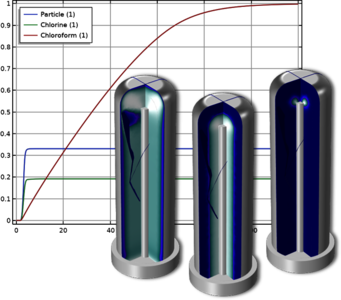
This example illustrates how to model the transport of different contaminants through a ceramic water filter candle with an activated carbon core. These types of water filters can be found in table top gravity filters, as well as attached to the faucet or as part of a larger reverse ... Read More
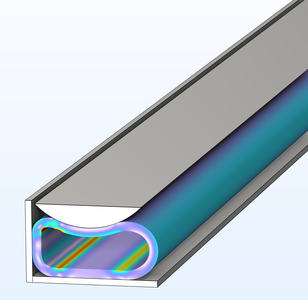
In this model you study the force-deflection relation of a car door seal made from a soft rubber material. The model uses a hyperelastic material model together with formulations that can account for the large deformations and contact conditions. Read More
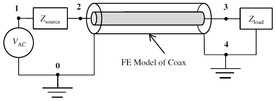
A model built with the RF Module can be connected to an electrical circuit equivalent, if there is some structure outside of the model space that you wish to approximate as a circuit equivalent. In this model, the 3D model of a coaxial cable is connected to a voltage source, in series ... Read More
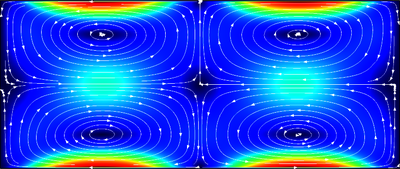
Recent advances in the fabrication of microfluidic systems require handling of live cells and other micro particles as well as mixing. All this can, for example, be achieved using acoustic radiation forces and the viscous drag from the streaming flow. Streaming: Due to the nonlinear ... Read More
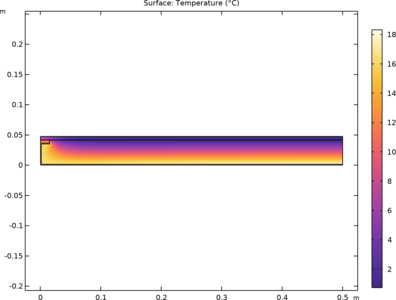
This example studies heat transfer in a composite two-dimensional structure. Four materials with distinct thermal conductivities k compose the structure. The top and bottom boundaries are facing environments respectively at 0°C and 20°C. The temperature distribution and the heat flux ... Read More
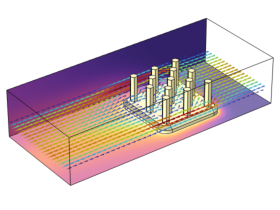
This model is intended as a first introduction to simulations of fluid flow and conjugate heat transfer. It shows you how to: Draw an air box around a device in order to model convective cooling in this box, set a total heat flux on a boundary using automatic area computation, and ... Read More
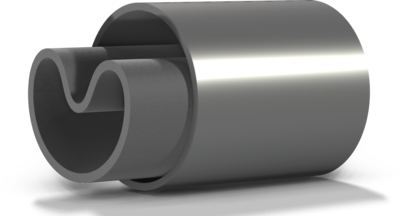
In this example, the Bergstrom–Bischoff material model is used to model the temperature and strain dependent behavior of High Density Polyethylene (HDPE) used, for example, to make liners for damaged pipes in oil and gas applications, or to make type IV hydrogen storage vessels for fuel ... Read More