
The Application Gallery features COMSOL Multiphysics® tutorial and demo app files pertinent to the electrical, structural, acoustics, fluid, heat, and chemical disciplines. You can use these examples as a starting point for your own simulation work by downloading the tutorial model or demo app file and its accompanying instructions.
Search for tutorials and apps relevant to your area of expertise via the Quick Search feature. Note that many of the examples featured here can also be accessed via the Application Libraries that are built into the COMSOL Multiphysics® software and available from the File menu.
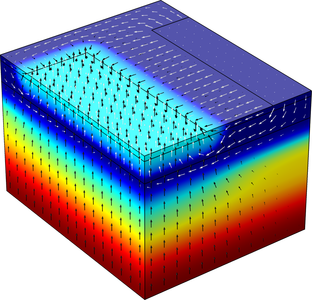
This model shows how to set up a 3D simulation of a n-p-n bipolar transistor. It is a 3D version of the device shown in the Bipolar Transistor model, and demonstrates how to extend semiconductor modeling into 3D using COMSOL Multiphysics. As in the 2D version of this model, the device ... Read More
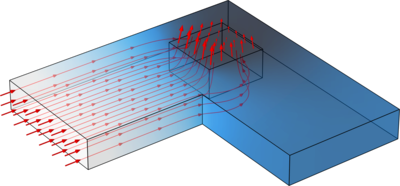
This benchmark example builds two models of a cross-bridge Kelvin resistor used for extracting the specific contact resistivity. The first model simulates the system in 3D, using the contact resistance feature built in the Semiconductor interface. The other model is a 2D approximation of ... Read More
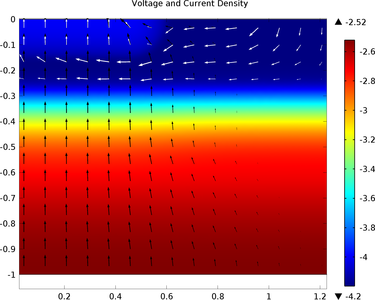
This model shows how to set up a simple Bipolar Transistor model. The output current-voltage characteristics in the common-emitter configuration are computed and the common-emitter current gain is determined. Read More
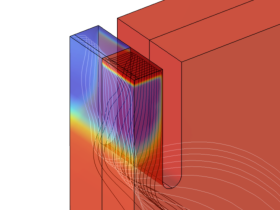
In this second half of a two-part example, a 3D model of a trench-gate IGBT is built by extruding the 2D model from the first half. Unlike the 2D model, now it is possible to arrange the alternating n+ and p+ emitters along the direction of extrusion as in the real device. This more ... Read More
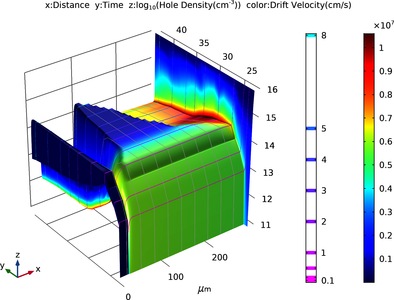
This tutorial performs steady-state and transient analysis of the response of a PIN diode to constant and pulsed radiation, respectively. The effect of radiation is modeled as spatially uniform generation of electron-hole pairs within the device. At high dose rates the separation of the ... Read More
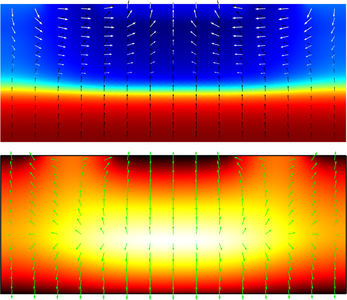
This model demonstrates how to couple the Semiconductor interface to the Heat Transfer in Solids interface. A thermal analysis is performed on the existing bipolar transistor model in the case when the device is operated in the active-forward configuration. The Semiconductor interface ... Read More
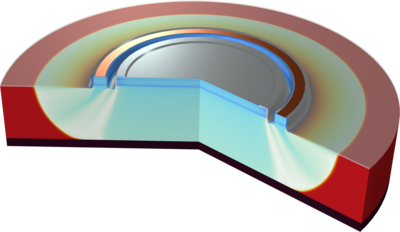
This model shows how to model the avalanche breakdown due to the impact ionization in a Silicon Carbide diode. The current-voltage (I-V) characteristics of the device are presented as well as the electric field distribution plot. Furthermore, the carrier generation term has been computed ... Read More
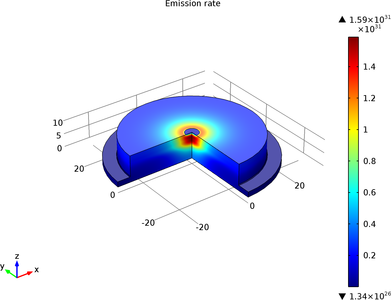
This model simulates an LED that emits in the infrared part of the electromagnetic spectrum. The device structure is made up of a single p-n junction formed by a layer of p-type doping near the top surface of an otherwise n-type wafer. This kind of device geometry is simple and cheap to ... Read More
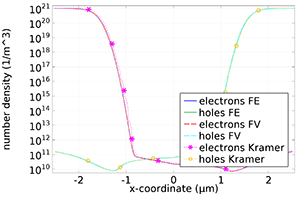
This simple benchmark model computes the potential and carrier concentrations for a one-dimensional p-n junction using both the finite element and finite volume methods. The results are compared with an equivalent device from the book, "Semiconductor Devices: A Simulation Approach," by ... Read More
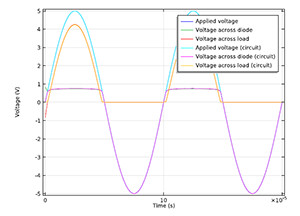
This model extracts spice parameters for a silicon p-n junction diode. The spice parameters are used to create a lumped-element equivalent circuit model of a half-wave rectifier that is compared to a full device level simulation. In this example, a device model is made by connecting a 2D ... Read More


