
See How Modeling and Simulation Is Used Across Industries
Multiphysics modeling and simulation drives innovation across industries and academia — as is evidenced by the many uses showcased in the technical papers and posters presented by engineers, researchers, and scientists at the COMSOL Conference each year.
Draw inspiration from the recent proceedings collected below, or, to find a specific presentation or filter by application area or conference year/location, use the Quick Search tool.
View the COMSOL Conference 2025 Collection
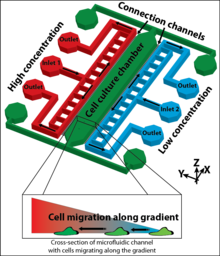
Cell migration of endothelial cells along gradients is an important process in vivo and an interesting target for cancer therapeutics. Microfluidics offer very powerful tools to study such migration processes in detail in the lab. In this study, we describe a model to simulate molecular ... Read More
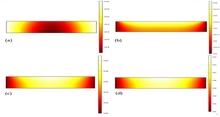
The rapid development of electronic devices leads to more demand for efficient cooling techniques. Porous media represent a convincing passive cooling enhancer due to its large contact surface area to volume ratio and intense mixing of fluid flow. In the present work, numerical studies ... Read More
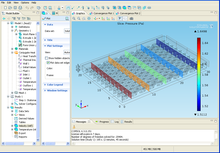
This paper describes the characteristics of MEMS microchannel and various issues of its designing. Here the major parameters are pressure drop and heat transfer rate. Various structures are modeled and optimized to get a minimum pressure drop and maximum heat transfer rate. The ... Read More
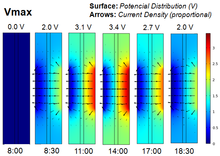
The production of hydrogen from renewable energy surplus is seen as a key strategy for energy storage. Centro Nacional del Hidrógeno works actively in this direction by considering a strategic line in order to achieve a sustainable energy future. Alkaline electrolysis is the main ... Read More

The performance of a homogeneous T-mixer can be enhanced significantly by the stimulation of secondary/ transverse flows in the microchannel. Various mixing mechanisms are reported for enhancing micromixing performance such as grooves at the channel bottom, heterogeneous charge patterns ... Read More

The contrast between hydro-mechanical behavior of the rock matrix and fracture network systems results in flow partitioning between fracture and matrix systems which is affected by the In-situ stress regime. Fracture flow, Darcy law and free and porous media flow physics interfaces of ... Read More

Introduction: Chronic arterial hypertension (HTN) is a pathological condition characterized by prolonged high level of arterial blood pressure causing major damages to several human body apparata. Renal sympathetic denervation (RDN) has been found to effectively reduce systemic blood ... Read More
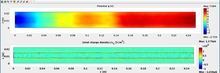
The transport of intense ion beams with reduced beam divergence over reasonable drift distances requires a reliable space charge compensation (SCC). Negative ion beams (required in the Neutral Beam Injectors envisioned for the ITER tokamak) are here discussed. Secondary particles are ... Read More

The study produced a simulated model of natural convection in an inclined rectangular channel open ended with different locations of radiant barrier (RB) along the channel thickness(S). The upper plate is heated by various uniform constant heat fluxes while the inner surface of the lower ... Read More

Seals or gaskets that are compressed between walls of a container are important to many industrial applications. In this paper we present a fluid flow model for predicting the sealing performance of such seals. A computational study using COMSOL Multiphysics® software suggests very ... Read More


