
See How Modeling and Simulation Is Used Across Industries
Multiphysics modeling and simulation drives innovation across industries and academia — as is evidenced by the many uses showcased in the technical papers and posters presented by engineers, researchers, and scientists at the COMSOL Conference each year.
Draw inspiration from the recent proceedings collected below, or, to find a specific presentation or filter by application area or conference year/location, use the Quick Search tool.
View the COMSOL Conference 2025 Collection

Additive manufacturing is attracting more and more interest. Laser Cladding is one of these additive manufacturing processes. As it is a blown powder process, here a melt pool formation & fusion by moving the laser beam, into which powder is blown and molten & surface tension gradient ... Read More
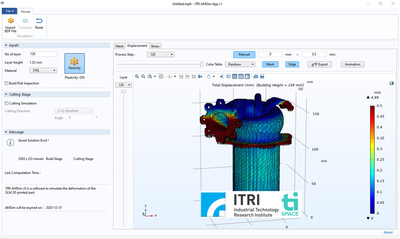
The laser powder bed fusion (LPBF) process involves a highly localized laser heating, resulting in a large thermal gradient that induces residual thermal stress and deformation in the finished build. The excessive residual deformation in the direction normal to in the process plane could ... Read More

Abstract. A Laser Focusing system (LFS) focuses a single laser beam (single Channel) or multiple laser beams (multi - channel) onto a surface (Specimen). The general motive of a LFS is to focus a train of brief pulses or a continuous beam of light onto a Specimen which heats up its ... Read More

In the field of laser applications, surface treatment is highly studied. Two process categories are commonly used. First processes use very short pulses (femto or pico seconds) known to avoid thermal effects and to have high spatial resolutions. Second processes have higher interaction ... Read More

Here we present a simulation for evaluation of novel obscurant candidates under high-energy laser (HEL) illumination. This approach incorporates thermal modeling into obscurant characterization, allowing for evaluation of the temperature increase of the candidate obscurants as well as ... Read More
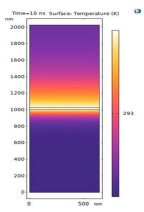
Laser-induced photovoltage in ferromagnetic thin films is often explained by magneto-thermoelectric effects such as the anomalous Nernst effect (ANE). ANE appears when thermal gradients interact with magnetization. While power loss in flat films can be estimated analytically, numerical ... Read More

Whereas the physic models of fluid lubrication should be able to provide quantitative predictions to industrial problems, it is somehow demanding to provide the input data to feed these high-level equation systems. The operating conditions are generally available, and the material ... Read More

Laser technologies such as welding, cutting and metal deposition are widely used in the industry. High quality requirements regarding process products cause that there is often a need to monitor the process. For this purpose, optical sensors integrated with a laser head are often used. ... Read More

A lateral observation of laser-induced keyhole through the quartz window is an easy and cheap experimental method. It opens an interesting perspective for the study of keyhole asymmetry in case of dissimilar metal combinations. To quantify the effect of quartz window on the observed ... Read More

As semiconductor devices continue to shrink and incorporate complex 3D architectures, conventional optical metrology faces limitations in resolving features smaller than the optical wavelength or those hidden beneath opaque layers. Ultrafast photoacoustic spectroscopy provides a ... Read More


