
See How Modeling and Simulation Is Used Across Industries
Multiphysics modeling and simulation drives innovation across industries and academia — as is evidenced by the many uses showcased in the technical papers and posters presented by engineers, researchers, and scientists at the COMSOL Conference each year.
Draw inspiration from the recent proceedings collected below, or, to find a specific presentation or filter by application area or conference year/location, use the Quick Search tool.
View the COMSOL Conference 2025 Collection
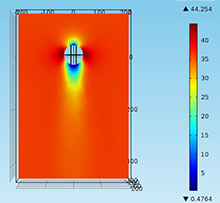
Conventional swing is one phenomenon which a bowler uses to gain an advantage over the batsman. This study involved simulating conventional swing in the CFD Module of COMSOL Multiphysics® software and comparing the simulated results with experimental results of previous researchers. The ... Read More
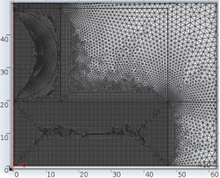
INTRODUCTION The dynamic behavior of droplet impingement on a solid surface is important to many engineering applications, such as rain drops on automobile windshields, inkjet deposition and metal deposition in manufacturing processes, spray cooling of electronics, and spray coating for ... Read More

This paper is an investigation into the effect of blood vessel movement on measurement accuracy of blood flow rate using magnetic flow meters. The investigation used a Finite Element model of the magnetic flowmeter built using COMSOL Multiphysics® software by integrating the modules of ... Read More

Laser welding is often considered to be a superior technique over different conventional welding methods and has been gradually evolved as an efficient manufacturing process. It is a high energy density fabrication process and generally employed for fabricating intricate shapes/contours ... Read More

Laser drilling of titanium and its alloys is widely used in aerospace industry, as it offers selective removal of material at high accuracy and speed. However, laser drilling often inherits defects such as large heat affected zone, micro cracks and recast layer. These defects depend upon ... Read More

The Fibroscan® (Echosens, Paris, France) device based on vibration–controlled transient elastography (VCTE) is used to non– invasively assess liver stiffness correlated to the hepatic fibrosis. Stiffness is quantified by measuring the velocity of a low–frequency shear wave traveling ... Read More

Nanofluids is a new class of fluid consisting of particles in a liquid. Different base liquid has been proposed and the most common one is water. The concentration of these particles can range from 0.1% to 5% or greater. Different numerical models have been proposed to solve this ... Read More

Wear is a complex phenomenon relevant to many problems involving frictional contact, such as mechanical brakes, seals, metal forming, and orthopedic implants. The rate of wear depends on the properties of the contacting materials and operating conditions. One widely used model of wear is ... Read More
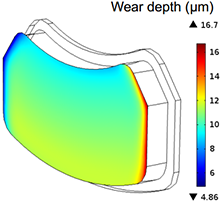
Wear is a complex phenomenon relevant to many problems involving frictional contact, such as mechanical brakes, seals, metal forming, and orthopedic implants. The rate of wear depends on the properties of the contacting materials and operating conditions. One widely used model of wear is ... Read More
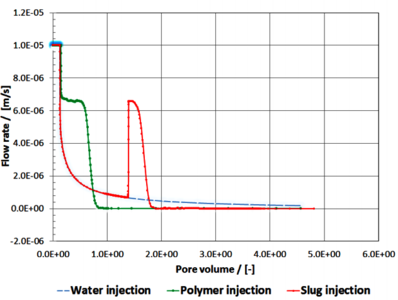
Using a 1-D model of polymer displacement, we analyze the exergy (maximum attainable work) balance of viscosifi ed water, e.g. with Arabic gum. The 1-D model shows the principle how such an analysis can be done. A comparison as to the displacement efficiency is made between three ... Read More


