
Explore the innovative ways multiphysics simulation is being used worldwide to advance research
Multiphysics modeling and simulation drives innovation across industries and academia — as is evidenced by the many uses showcased in the technical papers and posters presented by engineers, researchers, and scientists at the COMSOL Conference each year.
Draw inspiration from the recent proceedings collected below, or, to find a specific presentation or filter by application area or conference year/location, use the Quick Search tool.
View the COMSOL Conference 2026 Collection
It is necessary to understand and control nanopore behavior in order to develop biosensors for a variety of applications including DNA sequencing. The fluidics of nanopore devices we fabricated exhibits a range of interesting phenomena, such as enhanced conductance and current ... Read More
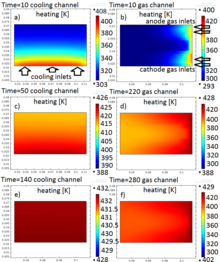
HTPEM fuel cells are considered to be the next generation fuel cells. The electrochemical kinetics for electrode reactions are enhanced by using PBI membrane at an operation temperature between 160-180 °C comparing to LTPEM fuel cells. But starting HTPEM fuel cells from room temperature ... Read More
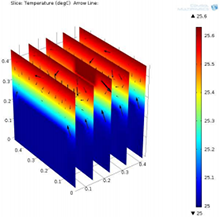
This paper presents a study on the heat generation of Valve-Regulated Lead Acid (VRLA) batteries used in off-grid streetlighting applications from PoleCo, a Halifax based company. One goal of the project was to produce validated COMSOL® models of the enclosure that holds these VRLA ... Read More

The manufacturing of high quality injection molded parts requires a deep understanding of material properties, process parameters and product design. The behavior of a polymer during the injection molding process and the performance of the final part are strongly determined by the ... Read More

We combine the potentiality of COMSOL with Monte Carlo optimization procedures, referred to as Simulated Annealing and Genetic Algorithm, in order to analyze and interpret ground deformation measured in active volcanic areas. Through MATLAB® subroutines, we use FE (Finite Element) ... Read More
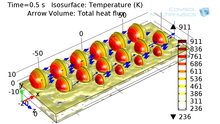
For biocompatible prosthetics, from dental implants up to bone parts, manufacturers have to find the best way to correlate process parameters and the material properties as to meet the unique needs of individuals. Additive manufacturing techniques aim at creating complex biocompatible ... Read More
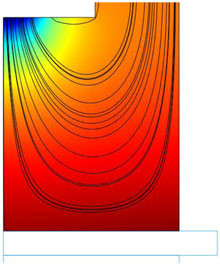
Oxygen transfer through ceramic membranes at high-temperature can substantially reduce costs respect to conventional separation methods. With the aim to improve the determination of the properties of the ceramic materials, a lab-scale permeation set-up was modeled using the Chemical ... Read More

COMSOL Multiphysics® 4.0 was used to study conductive and convective heat transfer from the human eyeball to the surrounding air. Postmortem temperature decay curves were collected in eyeballs of numerous human corpses. Of course, these curves represent only a portion of the complete ... Read More


