
The Application Gallery features COMSOL Multiphysics® tutorial and demo app files pertinent to the electrical, structural, acoustics, fluid, heat, and chemical disciplines. You can use these examples as a starting point for your own simulation work by downloading the tutorial model or demo app file and its accompanying instructions.
Search for tutorials and apps relevant to your area of expertise via the Quick Search feature. Note that many of the examples featured here can also be accessed via the Application Libraries that are built into the COMSOL Multiphysics® software and available from the File menu.
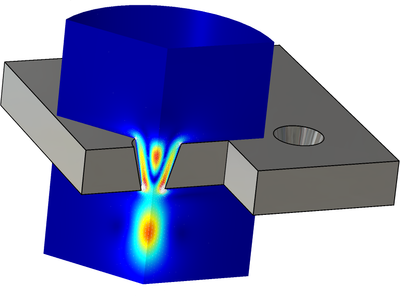
This model analyzes the nonlinear transfer impedance of a tapered orifice that can be part of a perforate or microperforated plate (MPP). The analysis is carried out for various degrees of tapering of the perforate and for a frequency range. A linear analysis is set up in the frequency ... Read More

As integrated circuit (IC) technology advances, with circuits becoming more powerful and compact, it is increasingly important to identify and prevent any cause of circuit failure. One particularly critical factor contributing to circuit failure is electromigration within the ... Read More
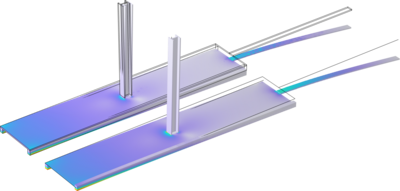
Many engineering structures consist of thin and slender components, where a full solid model will result in extremely many small elements. For such structures, it is much more efficient to use shell or beam elements. In this tutorial and verification model, it is shown how to connect ... Read More
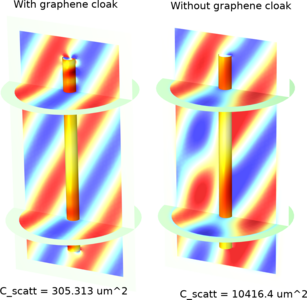
In this model, we introduce a cloaking method using an electrically tuned monolayer of graphene. We will show that when a cylindrical dielectric scatterer is covered in graphene, the scattering cross section is greatly reduced at the designated frequency, making it electromagnetically ... Read More
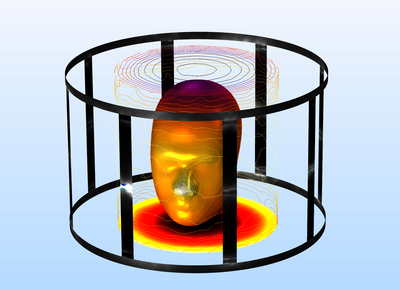
Magnetic resonance imaging (MRI) systems generate a magnetic flux density (B-field) to create images. Providing a homogeneous field distribution within a birdcage coil is a key factor for improving the quality of the scanned data. A homogeneous magnetic field can be found through ... Read More
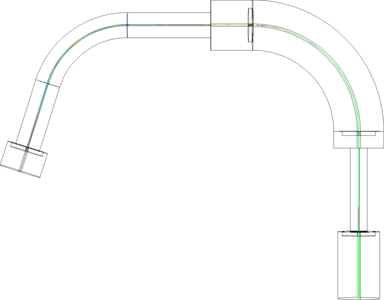
This tutorial utilizes the Particle Beam feature to examine the performance of a high-precision spectrometer. An ion beam is subjected to electric and magnetic forces, and only a fraction of the incoming beam is transmitted to the detector. The Particle Counter feature is used to compute ... Read More
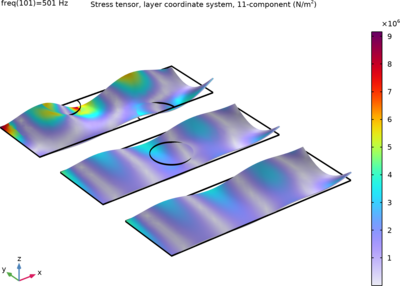
Delamination or the separation of layers is a common failure mode in laminated composite materials. Various factors, including loading, defects in the material, and environmental conditions can trigger the initiation and propagation of layer separation. This leads to degraded structural ... Read More

Shape optimization with respect to fatigue properties is not supported, but fatigue properties are well correlated with the maximum stress. The model demonstrates how optimization with respect to a p-norm of the von Mises stress can be used to improve fatigue properties without ... Read More
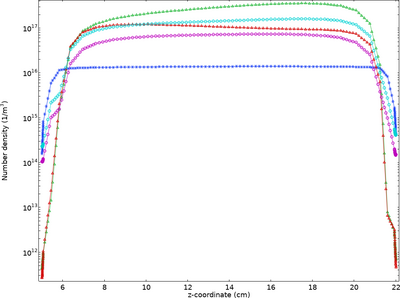
This tutorial model solves for an inductively coupled plasma reactor in a mixture of SF6/argon. The model computes the fluid flow and gas heating. Important aspects and strategies for modeling electronegative discharges are discussed. Read More

For models with acoustic-structure couplings it is necessary to calculate the left eigenvectors to use the Frequency Domain, Modal solver. The model shows the necessary changes to the default settings of the eigenfrequency solver. Read More


