
The Application Gallery features COMSOL Multiphysics® tutorial and demo app files pertinent to the electrical, structural, acoustics, fluid, heat, and chemical disciplines. You can use these examples as a starting point for your own simulation work by downloading the tutorial model or demo app file and its accompanying instructions.
Search for tutorials and apps relevant to your area of expertise via the Quick Search feature. Note that many of the examples featured here can also be accessed via the Application Libraries that are built into the COMSOL Multiphysics® software and available from the File menu.
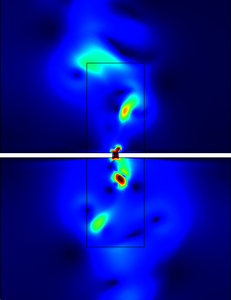
In many applications, acoustic waves interact with surfaces that have small perforations or slits. This can be in muffler systems; in soundproofing structures; in liners for noise suppression in jet engines; or in grilles and meshes in front of, for example, miniature speakers in mobile ... Read More
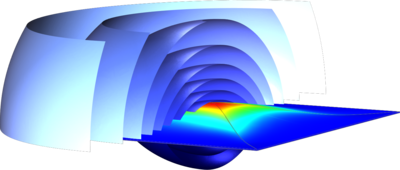
This model analyzes a piezoelectric microelectromechanical system (MEMS) speaker. The speaker, composed of four triangular membranes, uses a layer of lead zirconate titanate (PZT) material with two electrodes on top of a silicon layer as actuators. The triangular membranes are separated ... Read More
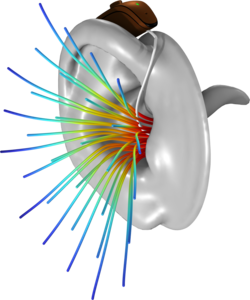
This model demonstrates how to perform a hearing aid acoustic feedback response analysis, including both the in-ear hearing aid and the hearing aid cassette. The hearing aid modeled is a ReSound OMNIA™ device from GN Hearing A/S. The hearing aid is tested on a combined pinna and ear ... Read More
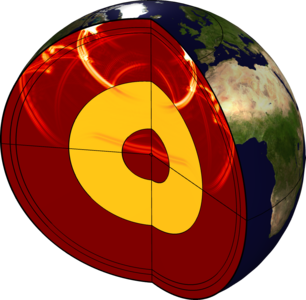
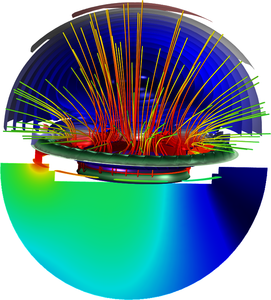
This tutorial model analyzes the propagation of seismic waves through Earth's internal structure. The model uses a 2D axisymmetric geometry to represent the material discontinuities and the variation of properties through the concentric layers of the earth. A simplified earthquake ... Read More
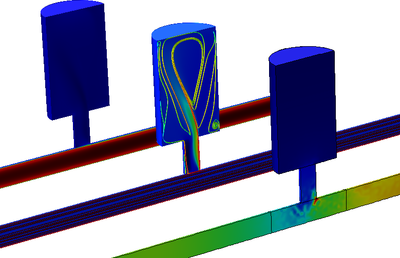
Helmholtz resonators are used in exhaust systems, as they can attenuate a specific narrow frequency band. The presence of a flow in the system alters the acoustic properties of the resonator and the transmission loss of the subsystem. In this tutorial model, a Helmholtz resonator is ... Read More
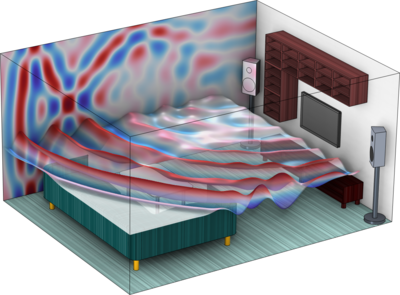
The use of wave-based techniques for room acoustic simulations has spread in the last years due to the increase in computational performance as well as the development of new numerical methods. The challenge of including realistic impedance conditions at walls is traditionally solved in ... Read More
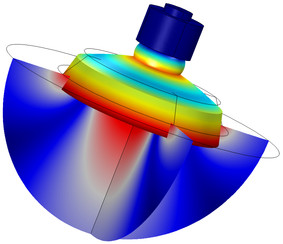
The tonpilz (sound mushroom) piezoelectric transducer is a transducer for relatively low frequency, high power sound emission. The transducer consists of piezoceramic rings stacked between massive ends and pre-stressed by a central bolt. The tail and head mass lower the resonance ... Read More

Headphones are closely coupled to the ear, and so it is not possible to measure their sensitivity in a classical acoustic free-field setup used for loudspeakers. The measurement requires the use of artificial heads and ears to accurately represent the usage conditions. This model shows ... Read More
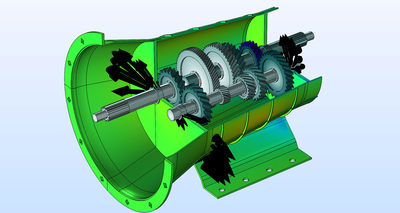
This example extends a model of vibration and noise in a five-speed synchromesh gearbox for a manual transmission vehicle. A detailed roller bearing model is used to represent the bearing dynamics. The gearbox vibration is computed using a time-dependent analysis for a specified engine ... Read More
This model analyzes the electromagnetic, mechanical, and acoustical characteristics of the OWS-1943T-8CP (discontinued) speaker. Beside certain details, the geometry, material properties, and measurements are copyright by Ole Wolff. Starting from the geometry of the speaker, an ... Read More


