
The Application Gallery features COMSOL Multiphysics® tutorial and demo app files pertinent to the electrical, structural, acoustics, fluid, heat, and chemical disciplines. You can use these examples as a starting point for your own simulation work by downloading the tutorial model or demo app file and its accompanying instructions.
Search for tutorials and apps relevant to your area of expertise via the Quick Search feature. Note that many of the examples featured here can also be accessed via the Application Libraries that are built into the COMSOL Multiphysics® software and available from the File menu.
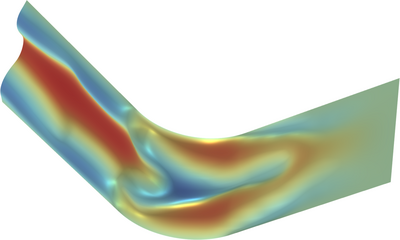
This model demonstrates how to use the Polynomial Shell feature to increase the lowest Eigenfrequency of a shell by deforming its shape. Read More
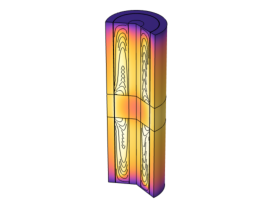
Fluid dampers are used in military devices for shock isolation and in civil structures for suppressing earthquake-induced shaking and wind-induced vibrations, among many other applications. Fluid dampers work by dissipating the mechanical energy into heat. This model shows the phenomenon ... Read More
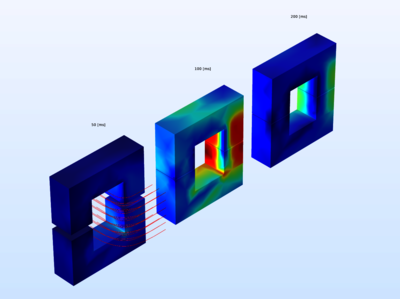
Electrical events, such as an overcurrent or overload, can seriously damage electrical circuits or power lines. To avoid expensive replacements of critical parts, electric switch circuit breakers can be installed. These mechanically interrupt the current flow or surge by moving a plunger ... Read More
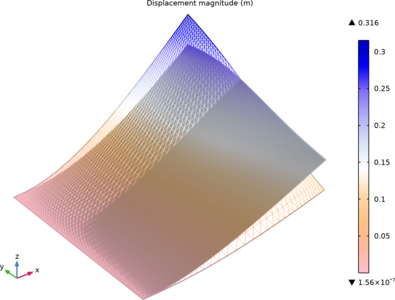
Composite laminates are synthetic structures and there is always a possibility to optimize the design in terms of the number of layers, the material of each layer, the thickness of each layer, and the stacking sequence for the specified loading conditions. Designers need to know how safe ... Read More
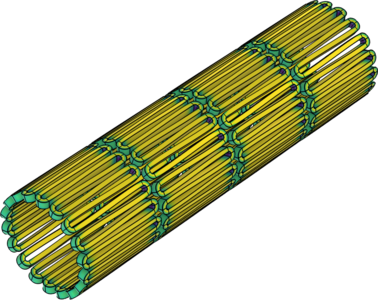
Stents are used in biomedical applications to support the inner wall of veins and arteries. Self-expanding stents made of shape memory alloys work differently from balloon-inflated stents, as these stents are crimped to the artery diameter at low temperature then released while the blood ... Read More
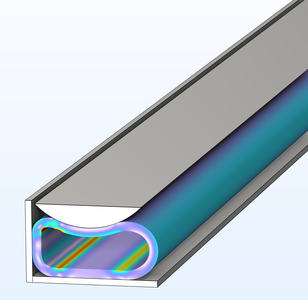
In this model you study the force-deflection relation of a car door seal made from a soft rubber material. The model uses a hyperelastic material model together with formulations that can account for the large deformations and contact conditions. Read More
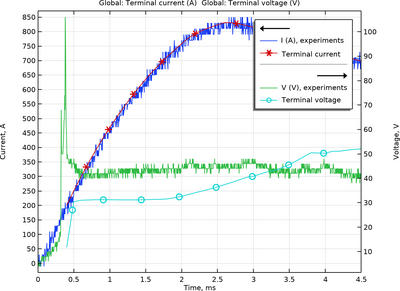
This model presents a 2D simulation of transient arc discharge movement along guided copper rails. While accurately modeling transient arcs typically requires a 3D simulation, the 2D approach offers greater efficiency and remains valuable for initial investigations and demonstration ... Read More
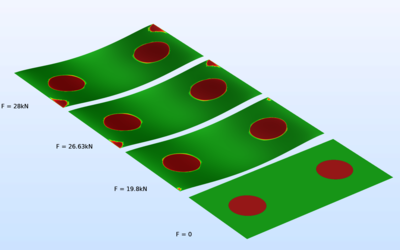
Interfacial failure or delamination in a composite material can be simulated with a cohesive zone model (CZM). A key ingredient of a cohesive zone model is a traction-separation law that describes the softening in the cohesive zone near the delamination tip. This example shows the ... Read More
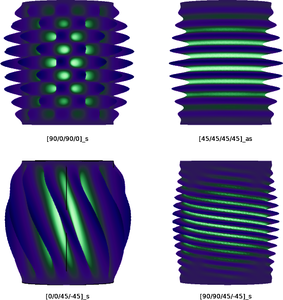
Buckling is a structural instability that can lead to failure of a component even without initial material failure. Computation of the critical buckling loads and mode shapes can therefore be important from a design viewpoint, even though it has previously been determined that the ... Read More
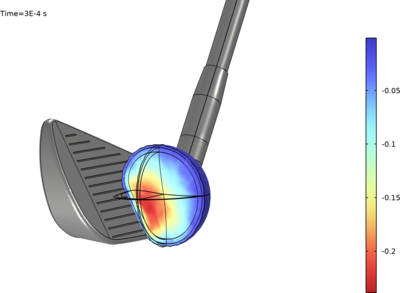
In this example, the mechanical impact of a golf club hitting a golf ball is studied. The contact between the two parts is modeled using a viscous penalty formulation to stabilize the dynamic event. To properly model the large deformation, the golf ball is defined using a hyperelastic ... Read More