
All posts by Bjorn Sjodin
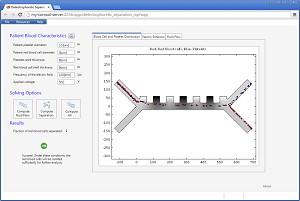
Dielectrophoretic Separation
Dielectrophoresis is a phenomenon in which an electric field is used to control the movement of electrically neutral particles. Learn about how to model this effect in both DC and AC fields.
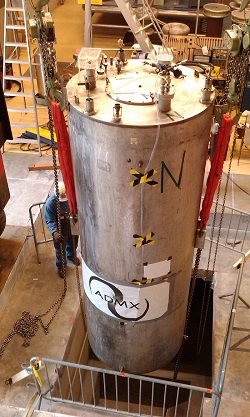
Detecting Dark Matter Axions with a Microwave Cavity
The Axion Dark Matter eXperiment (ADMX) uses a microwave cavity in an attempt to detect dark matter axions. Learn more about this project and how simulation can be applied to it.
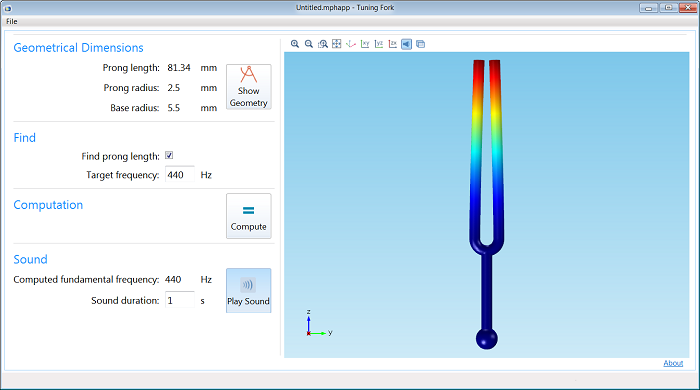
The Tuning Fork Application
Do re mi fa so la ti do! Did you know that the most common standard pitch for a tuning fork is 440 Hz, which forms the note A? See a tuning fork simulation app in action here >>

COMSOL Comes to China, Successful Launch Events for 4.4
In 2014, COMSOL opened two offices in China and introduced users to the powerful tools available in COMSOL Multiphysics® version 4.4. See highlights from the launch events and new release here.
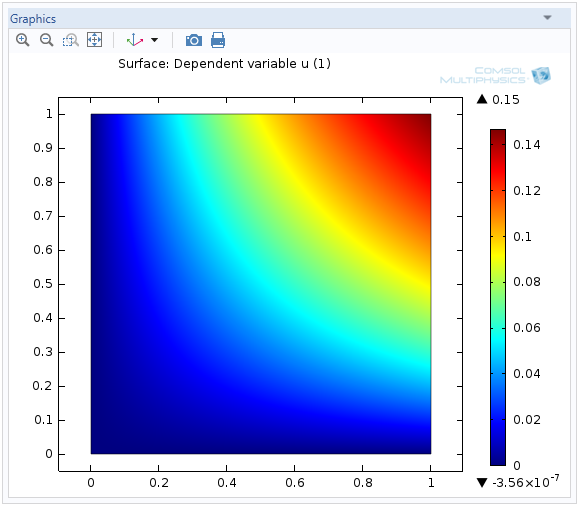
Solving Algebraic Field Equations
COMSOL Multiphysics® is commonly used to solve PDEs, ODEs, and initial value problems. However, did you know that you can also solve algebraic and even transcendental equations?
Food Science Leverages Simulations
As computer hardware becomes more powerful and affordable, simulations are becoming commonplace in new disciplines of science and engineering. Food science engineering is one such area, and there is no shortfall of publications using COMSOL Multiphysics for food-related simulations. Such kinds of analyses pretty much always require several types of physics to be practically relevant.
Using Curvilinear Coordinates
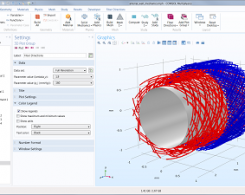
Curvilinear coordinates are a coordinate system where the coordinate lines may be curved. The new user interface for automatic computation of curvilinear coordinates is a very practical addition to version 4.3b for those working with anisotropic materials in free-form CAD designs. If you have a generic bent shape and try to apply the usual coordinate systems like Cartesian, cylindrical, or spherical, you are out of luck. Curvilinear coordinates are needed to smoothly follow the design, which typically has no mathematical […]
Taking Care of Fast Oscillations with the Wave Optics Module
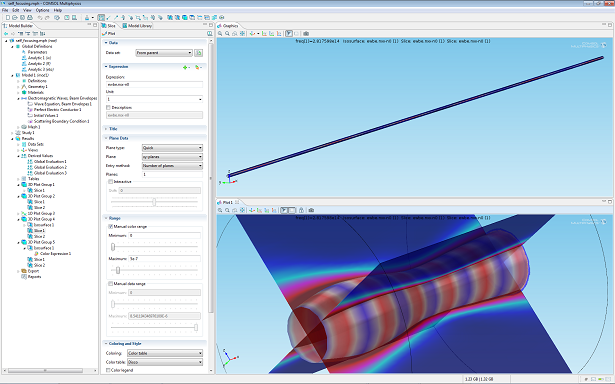
The new COMSOL Multiphysics Wave Optics Module provides engineers with a great set of features for designing their simulations. One of the new capabilities included in this module is the groundbreaking beam envelopes method for electromagnetic full-wave propagation. We hope this feature will become instrumental to the optics community.


