
All posts by Ed Fontes
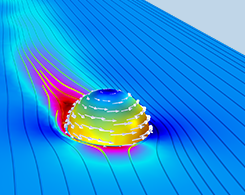
Terminal Velocity, Drag Coefficients, and FIFA World Cup™ Predictions
Is it possible to predict the winners of the FIFA World Cup™? We forgo consulting a psychic and instead analyze the terminal velocity and drag coefficients of different balls with CFD simulation.
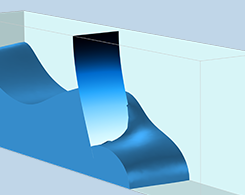
Modeling Free Surfaces in COMSOL Multiphysics® with Moving Mesh
You can model free liquid surfaces that do not undergo topology changes using moving mesh functionality in the COMSOL® software. Here’s a thorough guide on how to do so.
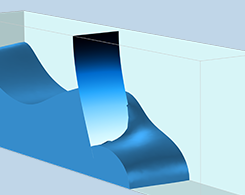
Two Methods for Modeling Free Surfaces in COMSOL Multiphysics®
We take you through 2 methods for modeling free surfaces in the COMSOL® software: the level set and phase field methods. Learn how to use each method and their benefits.
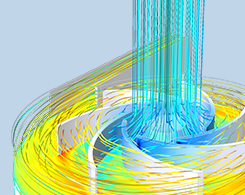
Using the Algebraic Multigrid (AMG) Method for Large CFD Simulations
There’s an ideal method for solving large CFD simulations that involve complex geometries. It’s called the algebraic multigrid (AMG) method, and you can learn all about it here.
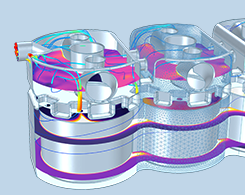
Calculating Thermodynamic Properties for Liquids and Gases
The Chemical Reaction Engineering Module includes a built-in database of over a dozen thermodynamic properties, making it easier to set up your transport and reaction models. Details here.

Why Should I Use Automatic Wall Treatment for My CFD Modeling?
The automatic wall treatment functionality enables you to use low Reynolds number models for a wider range of CFD problems, but there are some factors to consider before implementing the feature.
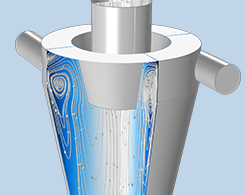
How to Use the v2-f Turbulence Model in the CFD Module
The v2-f turbulence model is an effective option for simulating highly nonlinear turbulent flow problems with both the accuracy and robustness of other, more limiting methods.
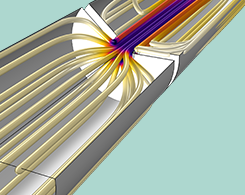
Fat-Washing Cocktails on an Industrial Scale
Bacon-flavored vodka? Pecan-infused bourbon? The fat-washing process extracts the flavors from fat and dissolves it into alcohol, and it can even be scaled up to an industrial level.


