
Computational Fluid Dynamics (CFD) Blog Posts

Keynote Video: EPFL Uses Simulation to Design a Hyperloop Pod
The EPFLoop team used multiphysics simulation to design the aeroshell, pressure vessel, and braking system of their hyperloop pod for the SpaceX 2018 competition. Get an inside look here.
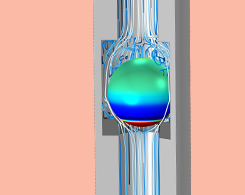
Simulating Fluid-Structure Interaction in a Ball Check Valve
Simulate FSI in a ball check valve to find the flow rate, fluid pressure, and fluid velocity. The COMSOL® software includes a predefined multiphysics coupling that makes it simple.

2 Mesh Adaptation Methods: Enabling More Efficient Computations
Why adapt your mesh? For one thing, it helps you solve your computational problems more efficiently. Here, we show you 2 methods for adapting your mesh in COMSOL Multiphysics®.

Evaluating a Fire-Resistant Overpack for Nuclear Waste
Confinement system overpacks are used to safely store radioactive waste. Sogin uses heat transfer modeling to design safe and reliable overpacks that are resistant to fire.
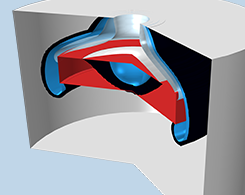
Simulating Multiphase Flow in Porous Media with a Low Permeable Lens
Modeling phase transport helps you study the multiphase flow through a porous medium (such as groundwater through soil).

Studying Shock Wave Phenomena with a Shock Tube Application
Shock waves used to be a theoretical problem only. Then, shock tubes enabled experimentation, but it was costly and inefficient. Enter numerical modeling applications.
Keynote Video: Designing Improved Heart Pumps with Simulation
Abbott Laboratories designed “the most complex machine ever implanted into a human being” — an LVAD for heart failure patients — using multiphysics modeling. The result? Saved lives.
FEM vs. FVM
Finite element methods, finite volume methods, or a hybrid approach: Which is the best choice for CFD? It depends on the fluid flow problem you’re trying to solve.


