
The Colorado School of Mines Uses Simulation to Track Fluid Movement
A. Haas, H. Mahardika, M. Karaoulis, and A. Revil
Colorado School of Mines, USA
Combining acoustic and electromagnetic analyses helps scientists to more efficiently measure and survey subterranean regions. Acoustic waves can travel long distances, but have limitations when it comes to providing details about formation properties, and cannot be used to identify the liquids flowing through them. Electromagnetic waves do not propagate as far as acoustic waves, but can identify and track the flow of pore water. Combining these methods makes the process easier in particular for scientists who track fracking fluids underground.
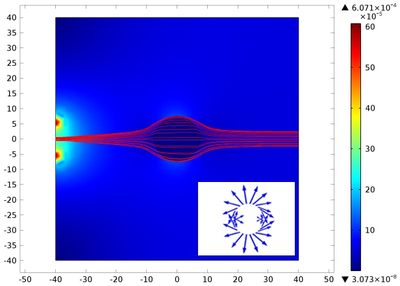
The Colorado School of Mines has created a system for locating fracking fluids by finding subsurface electromagnetic disturbances that occur based on the kinds of formations the water passes through. They wanted to simulate fracking events and produce synthetic seismograms and electrograms with the help of simulation. By linking COMSOL Multiphysics and MATLAB®, they designed a laboratory experiment in which they repeatedly hydraulically-fractured a porous cement cube by pumping in saline water under high pressure.
Suggested Stories
Man-Made Stars: Evaluating Structural Integrity in High-Performance Nuclear Fusion Machines for Power Generation
For over 50 years, power generation through nuclear fusion has been the focus of international research efforts to ...
Invisible Connections Will Unveil our 5G Future
The impending evolution of ultrafast 5G networks from concept to reality will entail significant effort into the ...
Revving up Electrohydraulic Power Steering with Virtual Prototyping
In the automobile industry, the only thing faster than the cars that are produced is their design cycle. Validation ...
Patterning Cells with the Flip of a Switch for Bioengineering Applications
Dielectrophoresis (DEP) is a method of patterning cells and particles used in medical, electronics, and energy ...


