
All posts by Bridget Cunningham
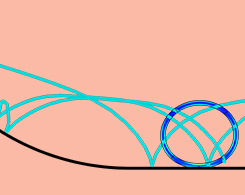
Modeling a Transient Contact Problem with Stick-Slip Friction Transition
Stick-slip friction transition is a phenomenon relevant to many transient mechanical contact problems. You can use structural analysis to evaluate these effects.
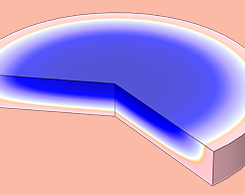
Analyzing Heat and Mass Transfer During Cake Baking with Simulation
As you bake a cake, there are many complex heat and mass transport processes taking place behind the oven door. Take a closer look at the art and science involved in the cake baking process…
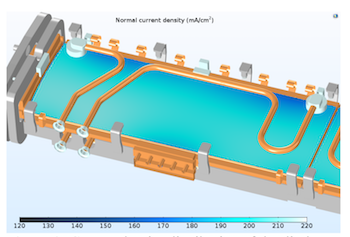
A Multilevel Approach to Modeling Planar Discharge in CO2 Lasers
Check out the multilevel approach to plasma modeling used by a researcher in the laser industry, who used the flexibility and functionality of COMSOL Multiphysics® to optimize a gas laser design.
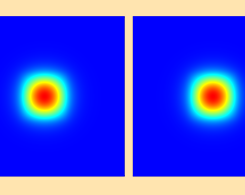
Analyzing the Design of a New Generation of Midinfrared Fiber Optics
Semiconductor simulation software is a promising method for advancing the design of midinfrared fiber optics because it can be used to measure propagation losses in the optical fibers.
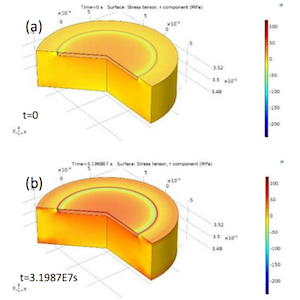
Studying the Influence of Concrete Phenomena on Sensor Performance
Some concrete structures use embedded sensors to monitor their stability, but the concrete itself can interfere with the sensors’ performance. Researchers used simulation to address this issue.
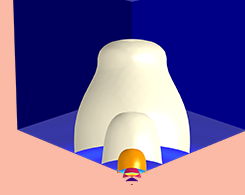
Using Low-Reflecting Boundary Conditions to Model Wave Propagation
Modeling wave propagation can be challenging. You need to balance the size of the computational domain with reflection at the surface boundaries. Low-reflecting boundary conditions can help.
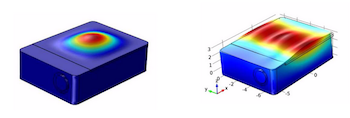
Designing a Sensor Package for a High-G Accelerometer via Simulation
To design a piezoresistive sensor package for a high-G accelerometer, researchers turned to multiphysics analysis. They then verified the simulation results with experimental data.

Happy Birthday, Wilhelm Röntgen
Wilhelm Röntgen, a German physicist, is best known for discovering X-rays. Fun fact: The first X-ray ever taken is of the hand of his wife, Anna Bertha.
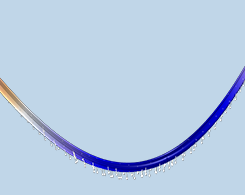
Understand Phenomena in the Viscous Catenary Problem via Simulation
The viscous catenary problem is theoretically and experimentally significant in many industries due to the complex phenomena it entails. Simulation can help us understand this problem.
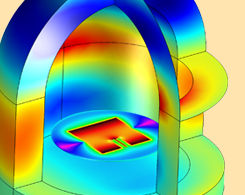
Assessing a Radome Design’s Ability to Improve Antenna Directivity
Bad weather and harsh environmental conditions can negatively effect antenna directivity, and in turn, wireless communication. Using simulation, you can design radomes that improve this quality.

Designing CSRR-Based Sensors to Monitor Chronic Kidney Disease
Chronic kidney disease can be effectively diagnosed, prevented, and treated through the use of noninvasive CSRR-based sensors. Researchers optimized the design of these sensors with simulation.
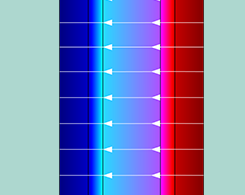
Analyzing Reverse Electrodialysis Units with Multiphysics Modeling
Pass the salt…for a clean energy solution. Salinity gradient power relies on osmosis between fresh- and saltwater to generate power, and simulation can help analyze and optimize such systems.


