
All posts by Temesgen Kindo

Nonstandard Constraints and the Power of Weak Contributions
For a flexible and physics-independent way to extend the applicability of the COMSOL Multiphysics® software, you can implement nonstandard constraints using the so-called weak contributions.
Image Denoising and Other Multidimensional Variational Problems
Learn how to solve variational problems featuring multiple dimensions, higher-order derivatives, and multiple unknowns with a fun example: image denoising in a grainy photograph.
Methods for Enforcing Inequality Constraints
Learn 2 methods for enforcing inequality constraints in your variational problems, the Lagrange Multiplier method and Augmented Lagrangian method, as well as the theory behind them.
Methods for Dealing with Numerical Issues in Constraint Enforcement
This post is helpful if you use equation-based modeling: Learn a variety of different methods for dealing with numerical issues when enforcing constraints in variational problems.
Specifying Boundary Conditions and Constraints in Variational Problems
In part 2 of a blog series on solving variational problems in COMSOL Multiphysics®, we discuss how to specify general boundary conditions and constraints.
Introduction to Modeling Soap Films and Other Variational Problems
In this introduction to a 5-part series, learn how to solve variational problems using equation-based modeling, which is useful for modeling soap films, catenary cables, light beams, and more.
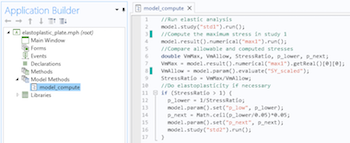
How to Automate Physics Choices and Studies Using Model Methods
The ability to create and use methods in COMSOL Multiphysics® is useful for automating your modeling processes, such as choosing physics and studies.
How to Add Stop Conditions to Solvers in COMSOL Multiphysics®
Learn how to implement stop conditions for time-dependent and parametric solvers in COMSOL Multiphysics®, as well as scenarios for when and why you should.
Exploiting Maximum Principles to Save Time and Resources
By exploiting maximum principles in large and complex models, you will save time and computational resources without having to buy a bigger computer or leave your model to solve overnight.
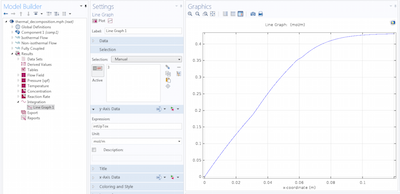
Integrals with Moving Limits and Solving Integro-Differential Equations
Learn how to analyze spatial integrals over variable limits, whether they are prescribed explicitly or defined implicitly. (Part 2 of 2)
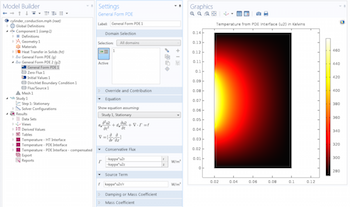
Guidelines for Equation-Based Modeling in Axisymmetric Components
Here’s your comprehensive guide to equation-based modeling for problems with cylindrical coordinates and axisymmetric components.
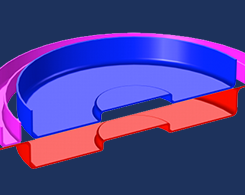
How to Reuse a Deformed Shape as a Geometry Input
Let’s say you deform a shape in your model (say, by applying a mechanical load to a thin piece of metal) and want to use this deformed object as part of a new geometry construction. How?
How to Integrate External Data Files with Your COMSOL® App
Have you ever wanted to integrate your simulation apps, built with the Application Builder in COMSOL Multiphysics®, with external data files? In this blog post, we show you how…
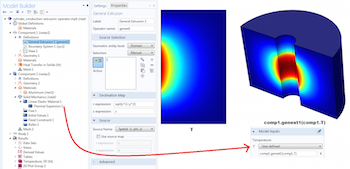
Part 2: Mapping Variables with General Extrusion Operators
Learn how to use the General Extrusion operators, which are designed to handle nonlinear mappings and the mapping of variables between geometric entities of different dimensions. Part 2 of 2.
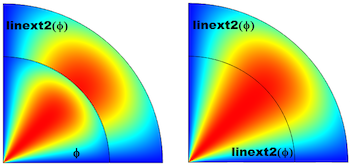
Accessing Nonlocal Variables with Linear Extrusion Operators
In some modeling scenarios, you may need to transfer variables from one region of a computational domain (the source) to another (the destination). This can be done with an extrusion operator.
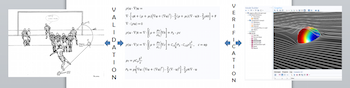
Verify Simulations with the Method of Manufactured Solutions
The Method of Manufactured Solutions involves assuming a solution, obtaining source terms, solving the problem, and comparing the results with the assumed solution. Use it to verify your models.
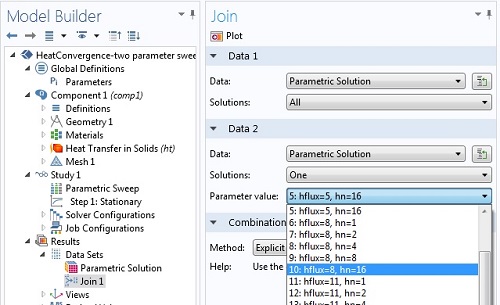
Solution Joining for Parametric, Eigenfrequency, and Time-Dependent Problems
In a follow-up to a previous blog post, we demonstrate how to use the Join feature in the context of 4 types of problems: parametric, eigenfrequency, frequency domain, and time dependent.
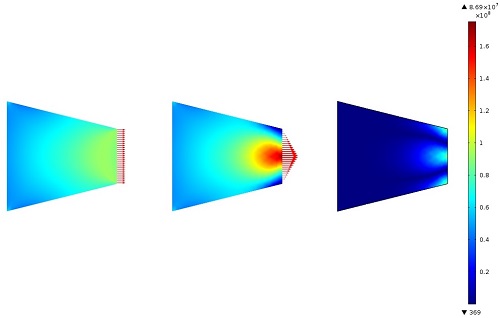
How to Join Solutions in COMSOL Multiphysics
In certain modeling scenarios, you will need access to more than one dataset. Read this blog post to see how to do so in COMSOL Multiphysics® by joining solutions.


