
Semiconductor Devices Blog Posts

Learning Quantum Mechanics Concepts with Double-Barrier Structures
Quantum mechanics is a notoriously difficult subject to learn — and teach. Modeling a double-barrier structure is an effective way to teach quantum mechanics concepts to physics students.
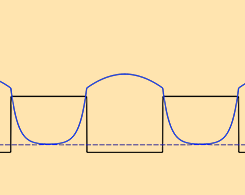
Computing the Band Gap in Superlattices with the Schrödinger Equation
You can easily compute the effective band gap for a superlattice structure by using a predefined Schrödinger Equation interface and building a simulation application.

Analyzing a Silicon Solar Cell Design with the Semiconductor Module
You can model a solar (or photovoltaic) cell consisting of a 1D Si p-n junction using the Semiconductor Module add-on. We feature a tutorial model to provide more details.
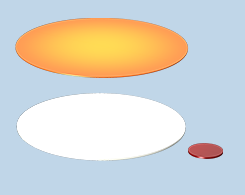
Study Sensor Performance in Rapid Thermal Annealing with Simulation
Rapid thermal annealing (RTA) is one step in the process of producing semiconductors. You can optimize RTA conditions by studying the phenomena involved via modeling.

Simulation Paves the Way for More Efficient OLED Devices
To study light loss in organic light-emitting diodes (OLEDs), researchers from Konica Minolta Laboratory turned to COMSOL Multiphysics®. Get the full story.
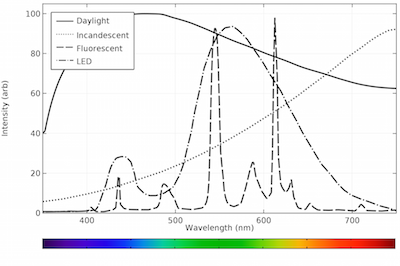
Calculating the Emission Spectra from Common Light Sources
We use COMSOL Multiphysics® to calculate the emission spectra of 4 common light sources: natural daylight, incandescent light bulbs, fluorescent light bulbs, and LED bulbs.
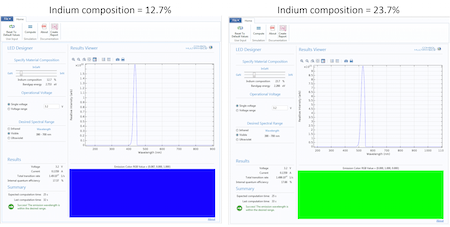
Creating a Wavelength Tunable LED Simulation App
Learn how to turn a model of an LED device into a user-friendly simulation app, which can then be used to assess the impact of different designs on the LED’s emission characteristics.
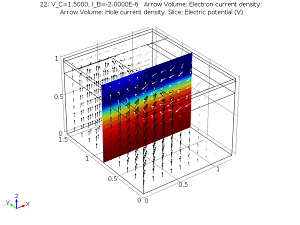
How to Perform a 3D Analysis of a Semiconductor Device
Open for a comprehensive introduction to performing 3D analyses of semiconductor devices in COMSOL Multiphysics®. We demonstrate with a bipolar transistor example.


