
Equation-Based Modeling Blog Posts
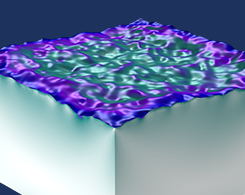
How to Generate Random Surfaces in COMSOL Multiphysics®
Get a comprehensive background and step-by-step guide to generating random surfaces in COMSOL Multiphysics®, such as rough surfaces and microstructures.
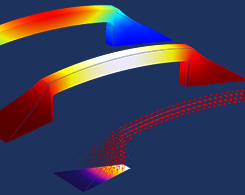
Exploiting Maximum Principles to Save Time and Resources
By exploiting maximum principles in large and complex models, you will save time and computational resources without having to buy a bigger computer or leave your model to solve overnight.
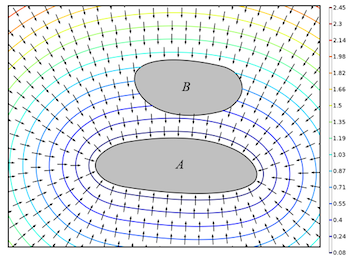
How to Compute Distances Between Objects in COMSOL Multiphysics®
Compute the distance between two deforming objects in the COMSOL Multiphysics® software. Here’s how…

Solving Shallow Water Equations with Equation-Based Modeling
Shallow water equations are an example of equation-based modeling. You can define expressions in COMSOL Multiphysics® to solve a shallow water equation for coastal erosion analyses.
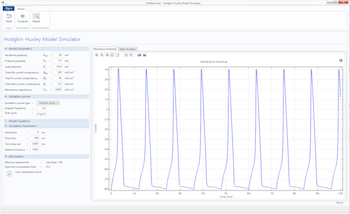
Analyze the Hodgkin-Huxley Model with a Computational App
The Hodgkin-Huxley model is an advanced model for simulating action potential. We also go over how to use a computational app to streamline this type of analysis.

Understand the Dynamics of the FitzHugh-Nagumo Model with an App
In 1961, R. Fitzhugh and J. Nagumo proposed a model for emulating the current signal observed in a living organism’s excitable cells. This became known as the FitzHugh–Nagumo model.
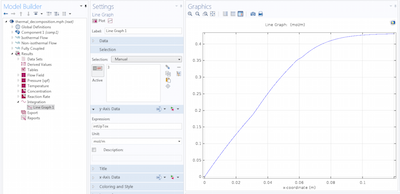
Integrals with Moving Limits and Solving Integro-Differential Equations
Learn how to analyze spatial integrals over variable limits, whether they are prescribed explicitly or defined implicitly. (Part 2 of 2)
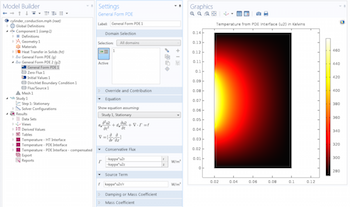
Guidelines for Equation-Based Modeling in Axisymmetric Components
Here’s your comprehensive guide to equation-based modeling for problems with cylindrical coordinates and axisymmetric components.


