
Equation-Based Modeling Blog Posts
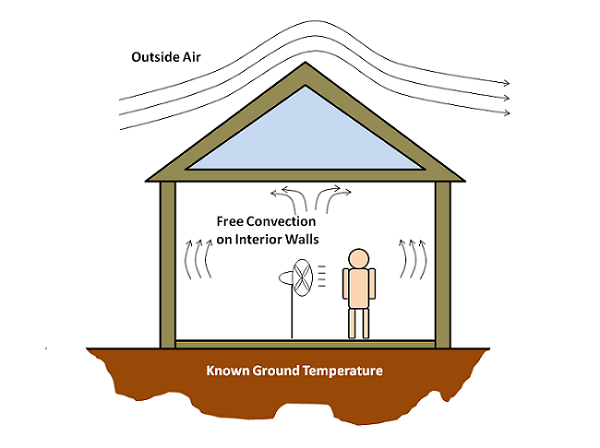
Using Global Equations: Modeling Room Air Temperature in a House
An interesting question came up the other day that I felt would make an excellent blog post since it allows us to discuss one of the very powerful, and often underutilized, features of COMSOL Multiphysics: the Global Equation. In this post, we will look at using global equations to introduce an additional degree of freedom to a model. This additional degree of freedom will represent something we do not want to model explicitly.
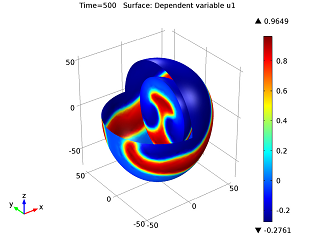
Equation-Based Modeling, a Custom Model of a Beating Heart
Equation-based modeling is one of the great strengths of COMSOL Multiphysics. The ability for you to easily access the equations describing the physics you are working with, and adding or manipulating them as you see fit, dramatically opens up the realm of possibilities that you can achieve through modeling and simulation. This is exemplified by the following custom model of a beating heart.
Equations: Who Needs Them?
Most of us take mathematical modeling for granted. After all, we’re taught physics and calculus almost hand-in-hand. But we owe a lot to the early pioneers like Isaac Newton, who demonstrated and strongly promoted interpreting natural phenomena through equations. Differential equations are especially useful since most things change as time marches on. Since we live in 3D space, partial differential equations (i.e., equations that express change in more than one “direction”) arise as the prominent tool to express continuum level […]


