
General Blog Posts

Is Meshing Run in Parallel in COMSOL Multiphysics®?
Meshing, an integral part of modeling in COMSOL Multiphysics®, can take up a lot of time and resources. Parallelized meshing speeds things up by distributing the meshing of domains on more cores.

Introduction to Numerical Integration and Gauss Points
In this comprehensive blog post, we go over the theory behind numerical integration, Gaussian quadrature, Gauss points, weak contributions, and much more.
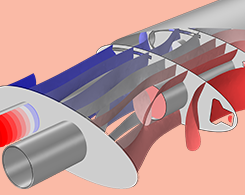
Using the Port Boundary Condition in Acoustic Waveguide Models
By combining several Port boundary conditions, you can easily compute the transmission and insertion loss in exhaust and muffler systems. See more benefits of this feature for acoustics modeling.
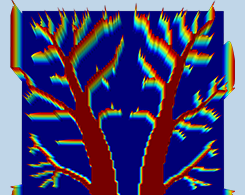
Comparing Optimization Methods for a Heat Sink Design for 3D Printing
When designing a heat sink, is it better to use parametric or topology optimization? When manufacturing said design, does 3D printing produce the best result, or a conventional method?
Comparing 2 Model Files in the COMSOL Multiphysics® Software
Why compare 2 model files? You can identify and correct errors in your current model, document and check differences between two versions of a model under development, and more…
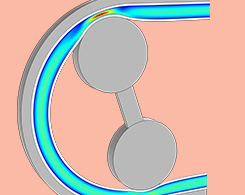
Veryst Combines Material Testing and Simulation for Reliable Results
Simulation helps companies develop the best designs. Understanding material behavior plays a key role in generating accurate simulations. Here’s how Veryst combines testing and FSI simulation.

Simulation Applications Enable Digitalization at ABB Traction Motors
Here’s a real-world example of optimizing R&D processes with COMSOL Server™: At ABB Traction Motors, engineers use simulation applications to analyze CFD and heat in electric motor designs.
Using Geometry Parts and Part Libraries in COMSOL Multiphysics®
If you’re working with a model that contains complex geometries, you can use geometry parts and the part libraries to streamline and simplify your model setup.

Digital Twins and Model-Based Battery Design
By combining high-fidelity multiphysics models with lightweight models and measured data, engineers can create digital twins to understand, predict, optimize, and control real-world systems.
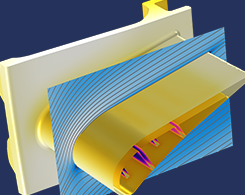
Digital Twins: Not Just Hype
The term “digital twin” has been called everything from just hype to a revolutionary concept. We use a jet engine example to explain the concept of digital twins and how simulation fits in.
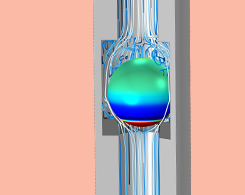
Simulating Fluid-Structure Interaction in a Ball Check Valve
Simulate FSI in a ball check valve to find the flow rate, fluid pressure, and fluid velocity. The COMSOL® software includes a predefined multiphysics coupling that makes it simple.
2 Mesh Adaptation Methods: Enabling More Efficient Computations
Why adapt your mesh? For one thing, it helps you solve your computational problems more efficiently. Here, we show you 2 methods for adapting your mesh in COMSOL Multiphysics®.
Keynote Video: Enhancing STEM Education with Simulation
Ivana Milanovic uses simulation to teach undergraduate students in her science, technology, engineering, and math (STEM) courses, as she explains in her COMSOL Conference 2018 presentation.
A Guide to Publishing and Licensing Simulation Applications
Interested in protecting the proprietary rights of the simulation applications you create and distribute? We walk you through 2 ways to set up licensing terms and conditions.
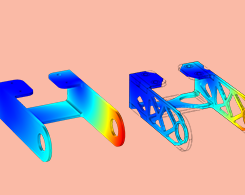
Performing Topology Optimization with the Density Method
The density method simplifies the process of topology optimization. Get an overview of how to use a special density feature for topology optimization in the COMSOL® software.
How to Create Custom Reports Using Report Templates
You can document and showcase your simulation setups and results with reports. To make this process more efficient, COMSOL Multiphysics® includes tools for creating easy-to-use report templates.
Keynote Video: Improving Synchrotron Light Sources with Applications
For synchrotron light sources, brighter is better: RadiaSoft LLC creates and deploys wave optics simulation applications to design improved vacuum chambers for a synchrotron upgrade project.

Studying Shock Wave Phenomena with a Shock Tube Application
Shock waves used to be a theoretical problem only. Then, shock tubes enabled experimentation, but it was costly and inefficient. Enter numerical modeling applications.
FEM vs. FVM
Finite element methods, finite volume methods, or a hybrid approach: Which is the best choice for CFD? It depends on the fluid flow problem you’re trying to solve.
Using Discontinuous Meshes for Conjugate Heat Transfer Modeling
You can use different discontinuous meshes in neighboring domains in COMSOL Multiphysics®. This capability comes in handy, particularly when modeling conjugate heat transfer problems.
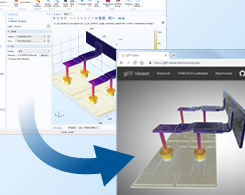
How to Export (and Share) Your 3D Result Plots as glTF™ Files
Wow your project stakeholders by sharing your 3D COMSOL Multiphysics® results as glTF™ files. We show you how to export plots and share them in third-party graphics viewers.

How to Activate Material in Simulations of Manufacturing Processes
Do you model manufacturing processes such as welding or additive manufacturing? You can activate or deactivate a material in a material deposition simulation using specialized functionality.
Course: Defining Multiphysics Models
There are 3 approaches to setting up a multiphysics model in the COMSOL® software: Fully automatic, manual with predefined couplings, and manual with user-defined couplings. Here, we discuss #1.
3 Approaches to Modeling Moving Loads and Constraints in COMSOL®
Learn 3 ways to model moving loads and constraints in COMSOL Multiphysics®: using variables, interpolation functions, and paths imported from CAD geometries.


