
Search Results

How Large of a Model Can You Solve with COMSOL®?
Ever wonder how large of a model you can solve in COMSOL Multiphysics®? It depends on memory requirements, model size, and the dimension of your finite element problem.
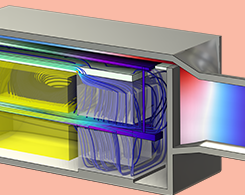
Modeling Speaker Drivers: Which Coupling Feature to Use
Explore how to model 4 different speaker drivers, including moving-coil transducers, balanced armature receivers, piezoelectric drivers, and electrostatic drivers.
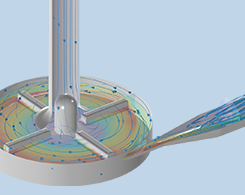
FDA Benchmark: CFD Modeling of a Centrifugal Blood Pump
CFD modeling is increasingly being used in medical device development to analyze device safety and effectiveness, accelerate the development cycle, and reduce costs. See 1 example here.
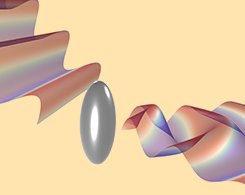
Electromagnetic Scattering in 2D Axisymmetric Models
You can save computational time and memory by performing electromagnetic scattering in 2D axisymmetric models rather than 3D. Learn more here.

A Novel Technique for Producing Ultrastrong 2D Polymers
A group of materials science researchers have developed a new polymerization technique for producing strong and lightweight 2D polymers (a creation that was thought to be impossible!)
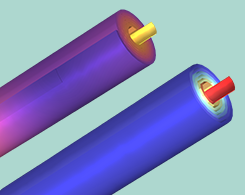
Improving Tabbing Design in Cylindrical Batteries
A major electric vehicle and battery manufacturer announced a new “tabless” design concept for cylindrical lithium-ion batteries. In this blog post, we explore this concept with simulation.
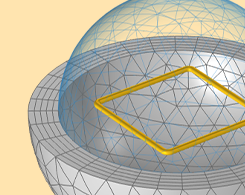
Computing and Using Partial Inductance with COMSOL®
COMSOL Multiphysics® version 6.0 brings new functionality for computing total and partial inductances and AC resistances. Get an overview here.
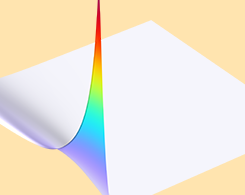
The Boltzmann Equation, Two-Term Approximation Interface
When modeling plasma, you sometimes want to define the electron transport properties as a function of the electron energy. The Boltzmann Equation, Two-Term Approximation interface does just that.