
Blog Posts Tagged Technical Content
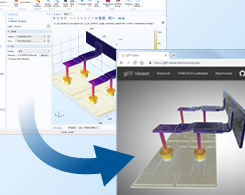
How to Export (and Share) Your 3D Result Plots as glTF™ Files
Wow your project stakeholders by sharing your 3D COMSOL Multiphysics® results as glTF™ files. We show you how to export plots and share them in third-party graphics viewers.
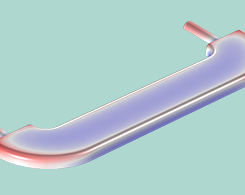
The Art and Science of Electrochemical Plating
Electrochemical plating, a surface finishing technique used in the automotive, electronics, corrosion protection, aerospace, and defense industries, is both an art and a science. Let us explain.

How to Activate Material in Simulations of Manufacturing Processes
Do you model manufacturing processes such as welding or additive manufacturing? You can activate or deactivate a material in a material deposition simulation using specialized functionality.

Course: Defining Multiphysics Models
There are 3 approaches to setting up a multiphysics model in the COMSOL® software: Fully automatic, manual with predefined couplings, and manual with user-defined couplings. Here, we discuss #1.
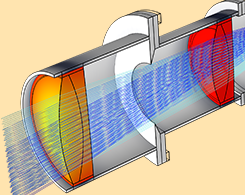
How to Perform a STOP Analysis with COMSOL Multiphysics®
Interested in structural-thermal-optical performance (STOP) analysis? We go over the theory, background, and how to perform such an analysis in the Ray Optics Module.
Understanding Classical Gray Body Radiation Theory
Imagine how efficient an incandescent lamp with an infrared suppressing black body filament would be. Alas, classical gray body radiation theory tell us this “dream lamp” is an impossibility…

Simulating the Tunneling Current Across a Graded Heterojunction
Interested in semiconductor design? Get an intro to the theory behind quantum tunneling as well as a demonstration of simulating the tunneling current across a graded heterojunction.
3 Approaches to Modeling Moving Loads and Constraints in COMSOL®
Learn 3 ways to model moving loads and constraints in COMSOL Multiphysics®: using variables, interpolation functions, and paths imported from CAD geometries.


