

“Geothermal is hot” captures the renewed energy across the industry, and that momentum was clearly reflected at the 51st Stanford Geothermal Workshop. With record attendance and more than 200 technical papers presented, the message was clear: Geothermal is entering a new phase of operational maturity, defined by integration and measurable performance.
This transition is especially visible in enhanced geothermal systems (EGS). The question is no longer whether engineered geothermal reservoirs can work, but how to optimize them for scalable, long-term performance.
From Niche Resource to Multiuse Subsurface Platform
The growth of the workshop mirrors a broader global trend. Geothermal energy is increasingly being recognized for its potential to provide reliable baseload power with a relatively small land footprint compared to solar and wind. But the real transformation lies in the shift from conventional hydrothermal systems, limited to specific geologic settings, toward “geothermal anywhere”.
EGS enable this shift by creating engineered reservoirs in hot, dry rock deep underground. By hydraulically fracturing these rocks and circulating water through the system, EGS turn previously inaccessible heat into usable energy.
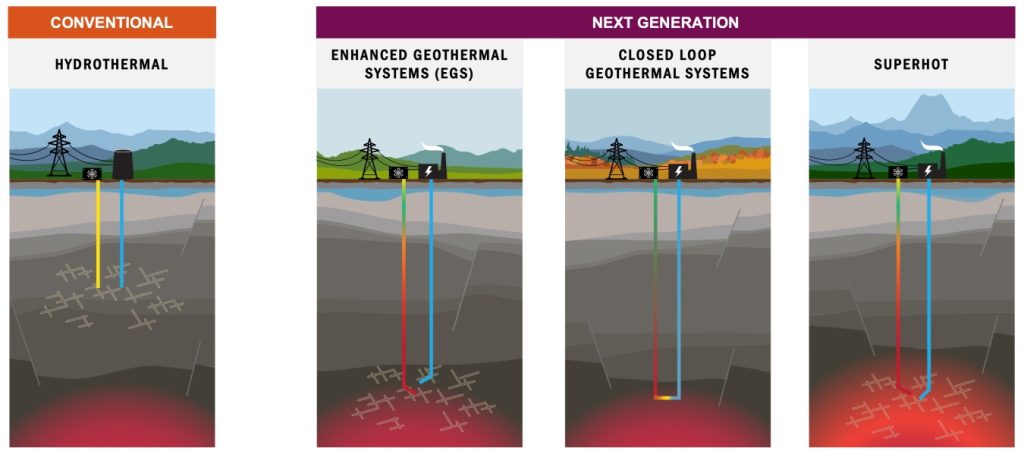 Conceptual evolution of geothermal technologies from conventional hydrothermal to next-generation EGS and superhot systems. Image source: U.S. Department of Energy.
At the workshop, keynote talks highlighted that the industry is moving beyond EGS proof of concept toward efficient execution by refining well placement, stimulation design, and multiwell connectivity, improving performance and repeatability of this method.
Furthermore, geothermal is evolving beyond standalone power generation. Several sessions at the event explored opportunities for critical minerals and lithium coproduction, subsurface thermal energy storage, and geological hydrogen pathways. Increasingly, geothermal sites are turning into multiresource platforms.
Superhot Rock: The Next Frontier
One of the most ambitious directions discussed was superhot rock (SHR) — the industry’s moonshot, targeting temperatures above 400°C at depths greater than 10 kilometers. Under these conditions, water enters a supercritical phase, carrying significantly more energy than conventional steam.
Under optimal conditions, a single supercritical well could produce vastly more power than today’s standard geothermal well, but accessing that potential introduces new engineering challenges the industry is racing to address: Materials behave differently at extreme temperatures, well integrity becomes more complex, and brittle rock shifts to a ductile state under higher pressure and heat.
Recent field progress suggests that this frontier is closer than many anticipated. At the workshop, Mazama Energy reported reaching 331°C in Oregon. Fervo Energy demonstrated rapid drilling performance in a 290°C sedimentary basin well using an AI-enabled drilling system, showing that EGS are not confined to crystalline rock. Quaise Energy shared progress on millimeter-wave drilling technology aimed at reaching greater depths.
As geothermal pushes into extreme environments, tighter integration across disciplines becomes essential — a recurring theme throughout the workshop.
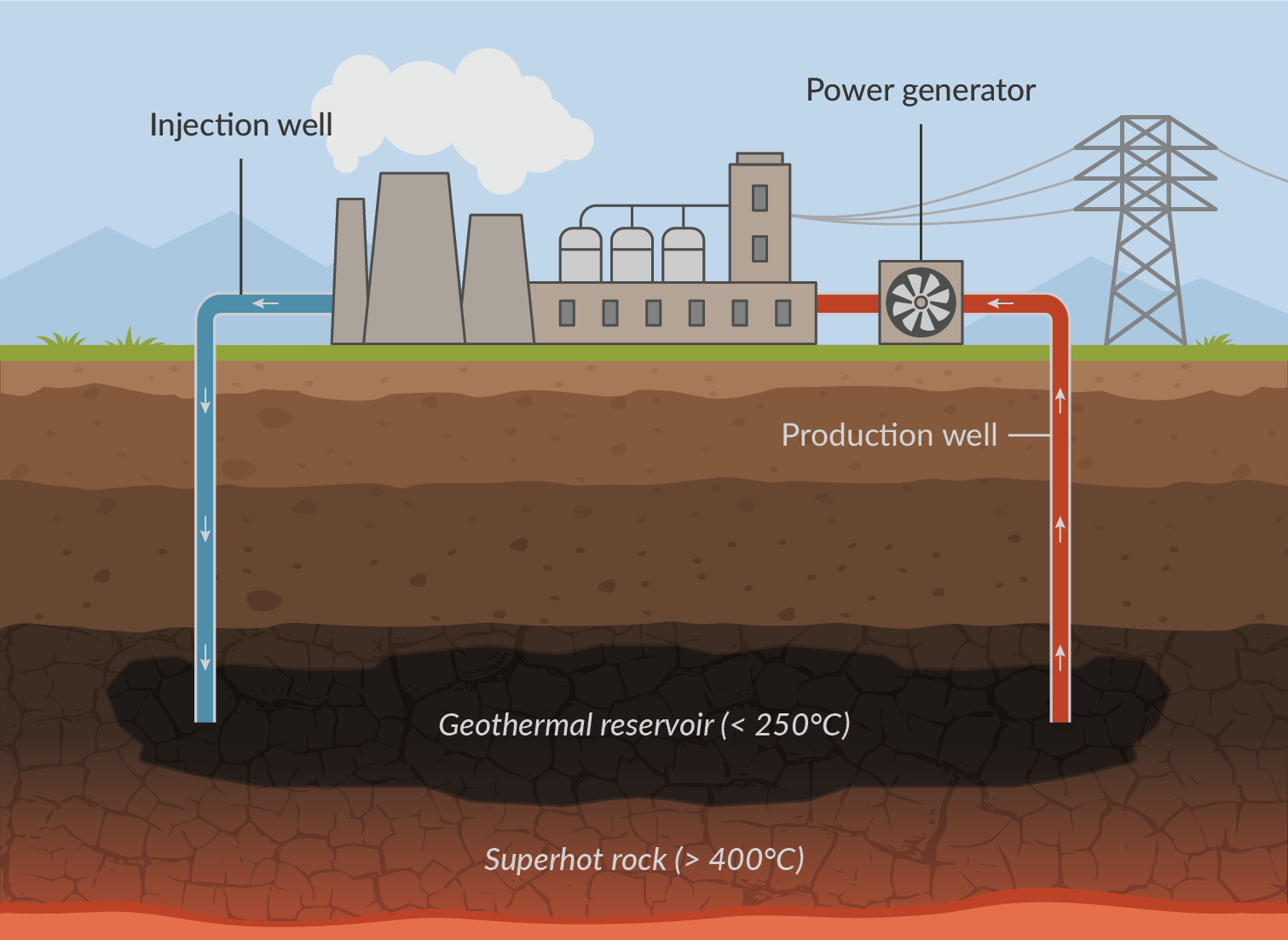 Conceptual geothermal system showing heat extraction from a geothermal reservoir (< 250°C) and the deeper superhot rock zone (> 400°C). Conventional systems typically operate at shallower depths, while superhot resources target depths of several kilometers (> 5 km), where higher temperatures increase energy density and can enable up to ~10× greater power output per well compared to conventional geothermal systems.
The Future of Geothermal Depends on Coupled Systems
In the discussion of moving the industry forward, something the presenters emphasized was optimizing the “3 Cs”:
- Connectivity (well communication)
- Conductivity (heat uptake)
- Conformance (uniform flow)
Achieving optimization depends on understanding how these factors evolve together over time.
Today’s EGS projects already involve fracture creation, heat extraction, fluid flow, and chemical transport. Temperature influences stress. Stress alters permeability. Permeability reshapes flow paths and heat recovery, while chemical processes modify fracture performance. This interconnected behavior — thermal–hydraulic–mechanical–chemical (THMC) coupling — is central to long-term geothermal performance, and moving toward 400°C increases that interdependence.
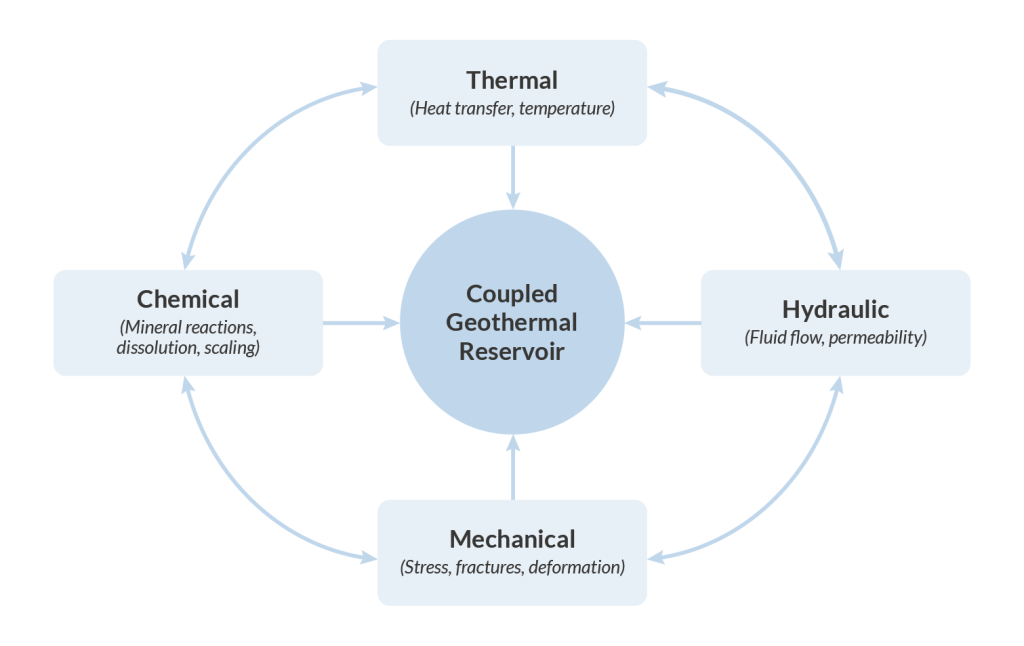 The thermal–hydraulic–mechanical–chemical (THMC) framework for geothermal systems. Reservoir performance depends on the continuous interaction of heat transfer, fluid flow, mechanical deformation, and chemical processes.
In that sense, the geothermal industry increasingly requires a fourth C: coupled modeling, or the ability to evaluate interacting physical processes. Modeling multiphysics within a unified framework can reduce uncertainty and support scalable development.
Geothermal is not just getting hotter; it’s becoming more integrated and data-driven, with multiphysics thinking at the core of system design. The projects that succeed will connect diagnostics, optimization, and coupled physics into repeatable strategies.
Further Reading
Learn more about how multiphysics simulation can be used within the geothermal industry by checking out these blog posts:




Comments (0)