
Search Results
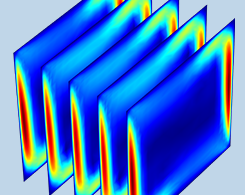
Simulating Natural Convection in Air with COMSOL Multiphysics®
From small electronic components to large buildings, natural convection is a transport phenomena found in engineering disciplines of all sizes. Here’s an example of natural convection in air.
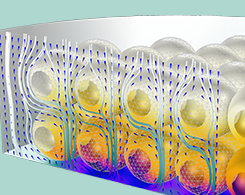
Modeling Adsorption at Surfaces in COMSOL Multiphysics®
What is adsorption? Learn the theory behind this chemical engineering phenomenon as well as how to model the process at surfaces in the COMSOL® software.
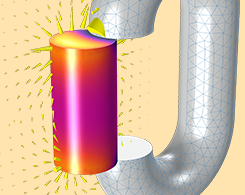
Modeling Ferromagnetic Materials in COMSOL Multiphysics®
Get a comprehensive guide to modeling ferromagnetic materials in COMSOL Multiphysics®, including an introduction to the theory and a series of useful animations.

Applying and Interpreting Saint-Venant’s Principle
Saint-Venant’s principle is found in most structural engineering textbooks, but what is its exact meaning? We go over its history, definition, and relevance to mechanical analyses.

Predicting Solute Transport in Groundwater Using Simulation
In order for groundwater to be useful for irrigation and drinking, we need to understand how its various solutes move through the water. The Subsurface Flow Module includes features for this.

Model Deforming Objects with the Arbitrary Lagrangian-Eulerian Method
The combined efforts of Leonhard Euler and Joseph-Louis Lagrange inspired the arbitrary Lagrangian-Eulerian (ALE) method, which we can use to model deforming objects.

Studying the Safety of Tattoos with Mass Spectrometry and X-Rays
When you get a tattoo, what happens to the ink once it enters your skin? In an attempt to answer these questions, researchers turned to mass spectrometry and X-ray fluorescence.
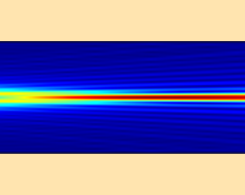
How to Use the Beam Envelope Method for Wave Optics Simulations
In order to simulate optically large optical systems, you need to solve for Maxwell’s equations, which requires a fine mesh and a lot of computational energy. Enter the beam envelope method.