
Blog Posts Tagged Technical Content
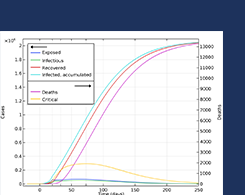
Modeling the Spread of COVID-19 with COMSOL Multiphysics®
From susceptible to exposed and infected to recovered: See how numerical modeling can help us understand the dynamics of the COVID-19 pandemic and how it spreads.
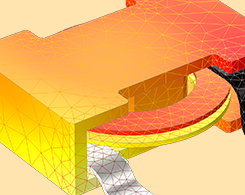
How Do I Use Gauge Fixing in COMSOL Multiphysics®?
Here’s your guide to using gauge fixing in your electromagnetics simulations in COMSOL Multiphysics®, from determining if it is necessary to imposing current conservation.
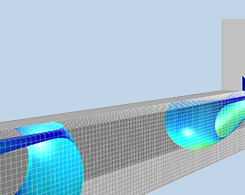
Modeling and Simulation of Multiphase Flow in COMSOL®: Part 1
Multiphase flow can be modeled on scales ranging from fractions of microns to tens of meters. Get an overview of the dispersed and separated multiphase flow models for different types of flow.
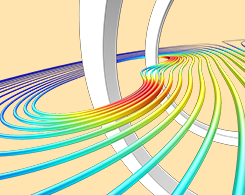
What Is Gauge Fixing? A Theoretical Introduction
Investigate the consequences of Helmholtz’s theorem when applied to Maxwell’s equations, and when using scalar and vector potentials to represent physical fields.
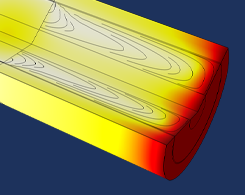
Strategies to Counter Small Automatic Time Steps
When solving a model, you may encounter a varying time step and discretization order, or NLfail or Tfail could be greater than 0. Use these strategies to improve the efficiency of the simulation.
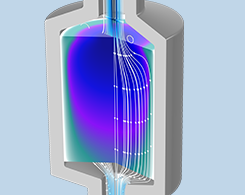
Thermal Equilibrium and Nonequilibrium Heat Transfer in Porous Media
Heat transfer in porous media can occur under thermal equilibrium, such as a rock consisting of different minerals or trapped fluids, or nonequilibrium, like a thermal energy storage (TES) unit.
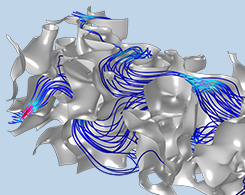
Modeling Darcian and Non-Darcian Flow in Porous Media
Get an introduction to the theory behind modeling flow in porous media, including the Kozeny–Carman, Forchheimer, Ergun, Burke–Plummer, and Navier–Stokes equations.
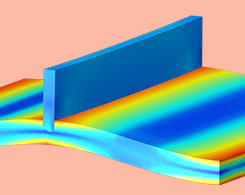
How to Predict the Fatigue Life of Welds
After an introduction to the welding process and weld geometries, we compare the nominal stress method, notch stress method, and hot spot stress methods for predicting the fatigue life of welds.


