

Have you ever come across a superellipse? I first encountered the word about 50 years ago in conjunction with the superellipse-shaped fountain (shown in the photo below) that is located at the very center of Stockholm, only a 10-minute walk from COMSOL’s Sweden office. Recently, it occurred to me that it would be interesting to study the stress pattern around a superelliptic hole in a plate. In this blog post, I will share the results.
What is a Superellipse?
An ordinary ellipse is commonly described by the equation
where a and b are called the semiaxes of the ellipse. When a = b, the equation of a circle with radius a is recovered.
The superellipse is a generalization, where an exponent other than 2 is used, so that
The fountain in the center of Stockholm uses n = 2.5 and the shape factor a/b = 6/5.
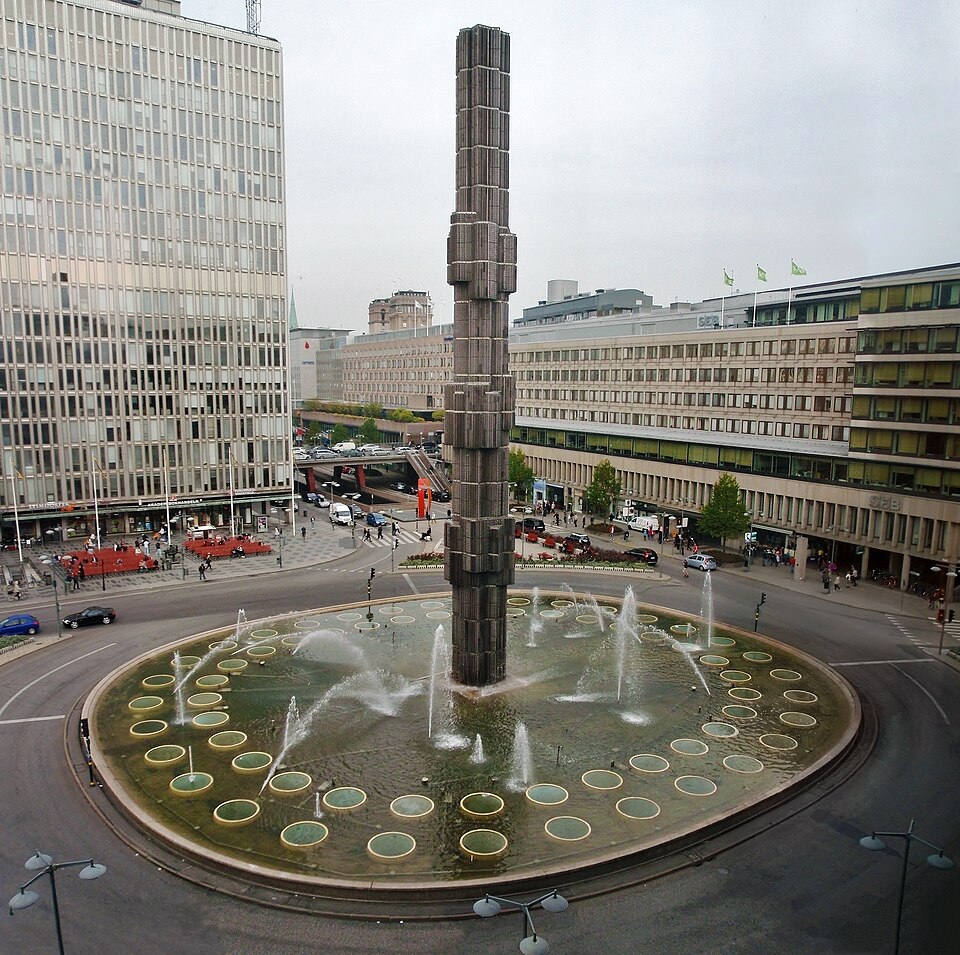
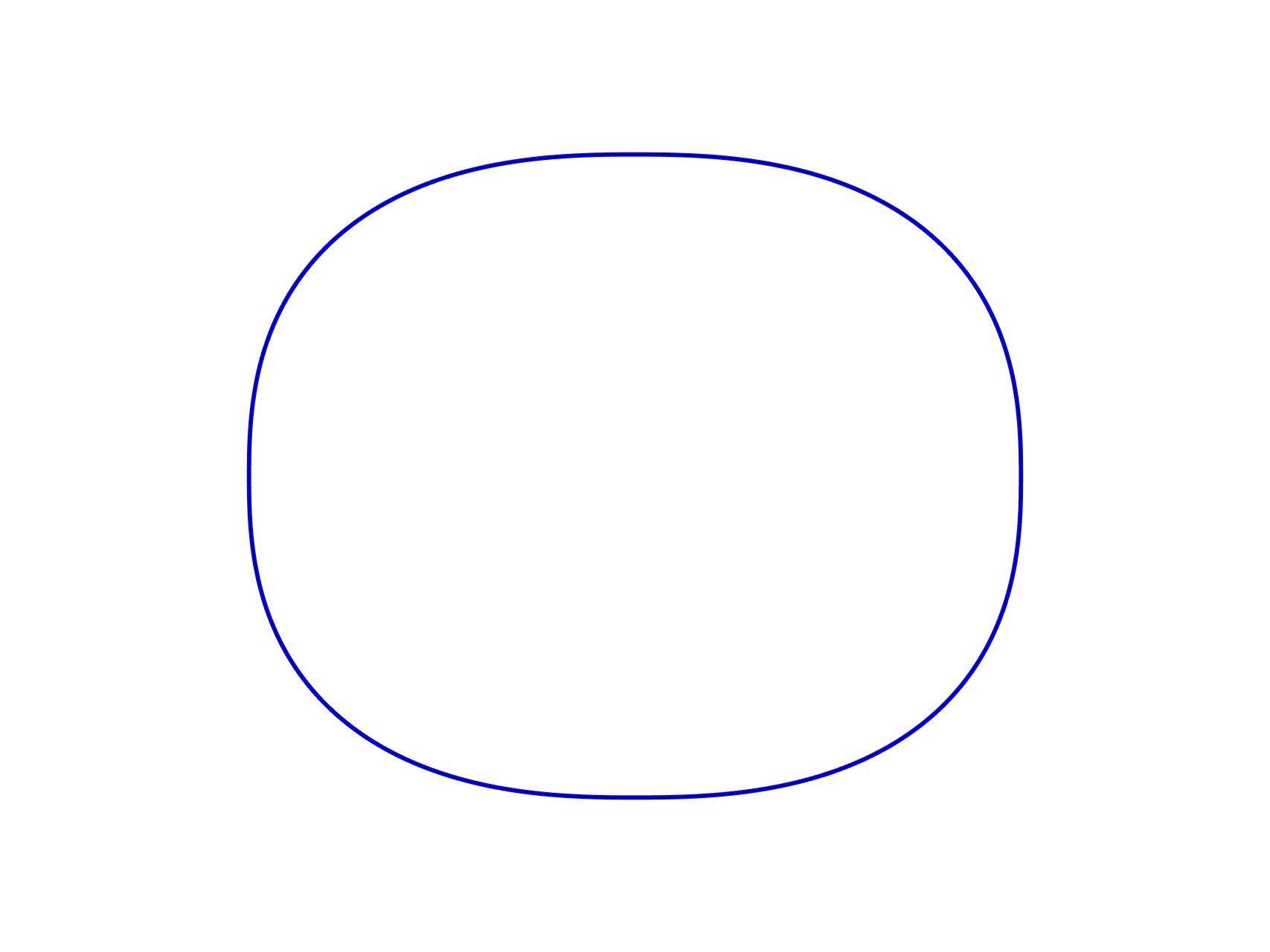
The fountain at Sergels Torg (left) and an outline of its shape (right).
Examples of other superellipses are shown below.
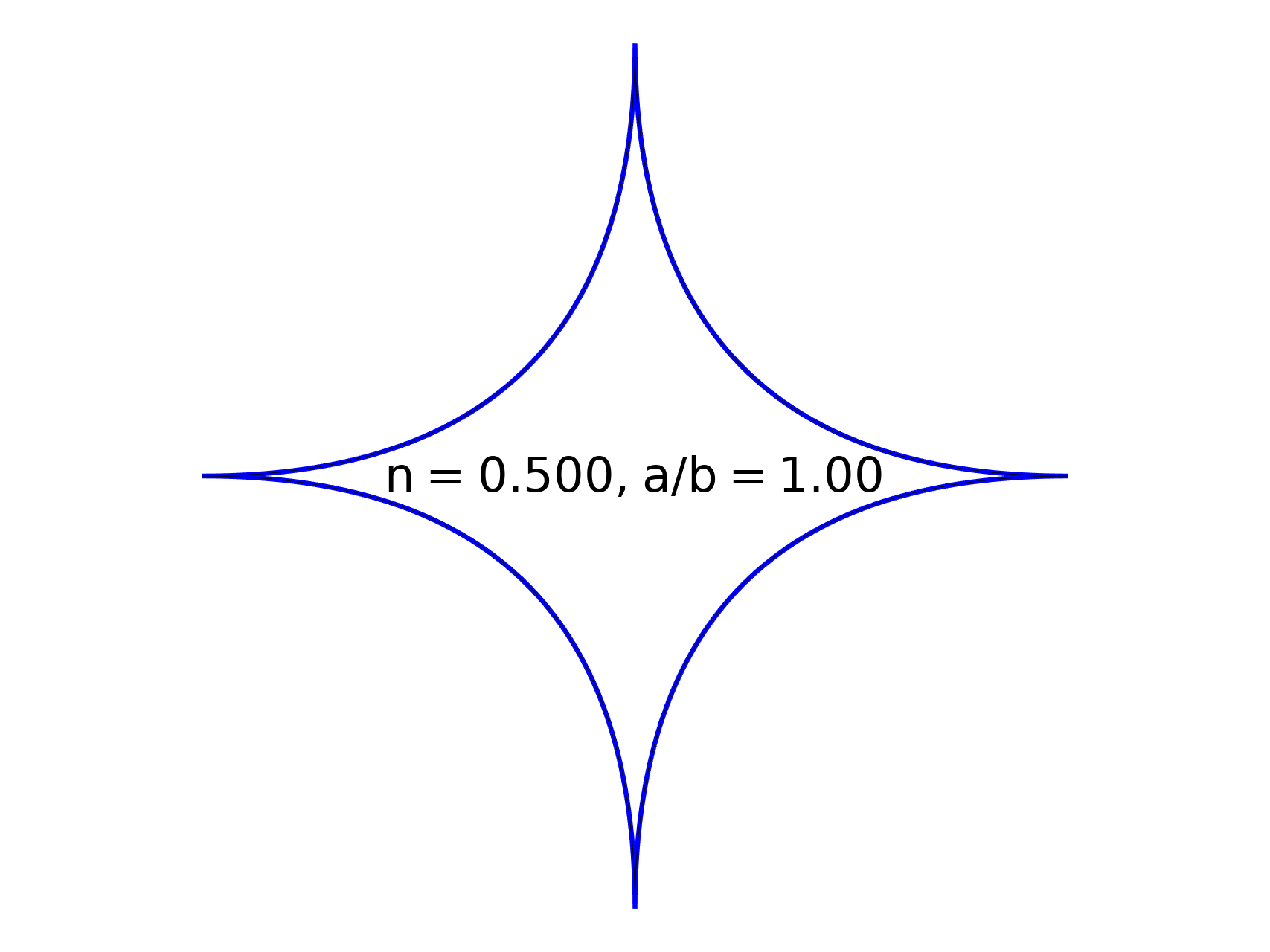
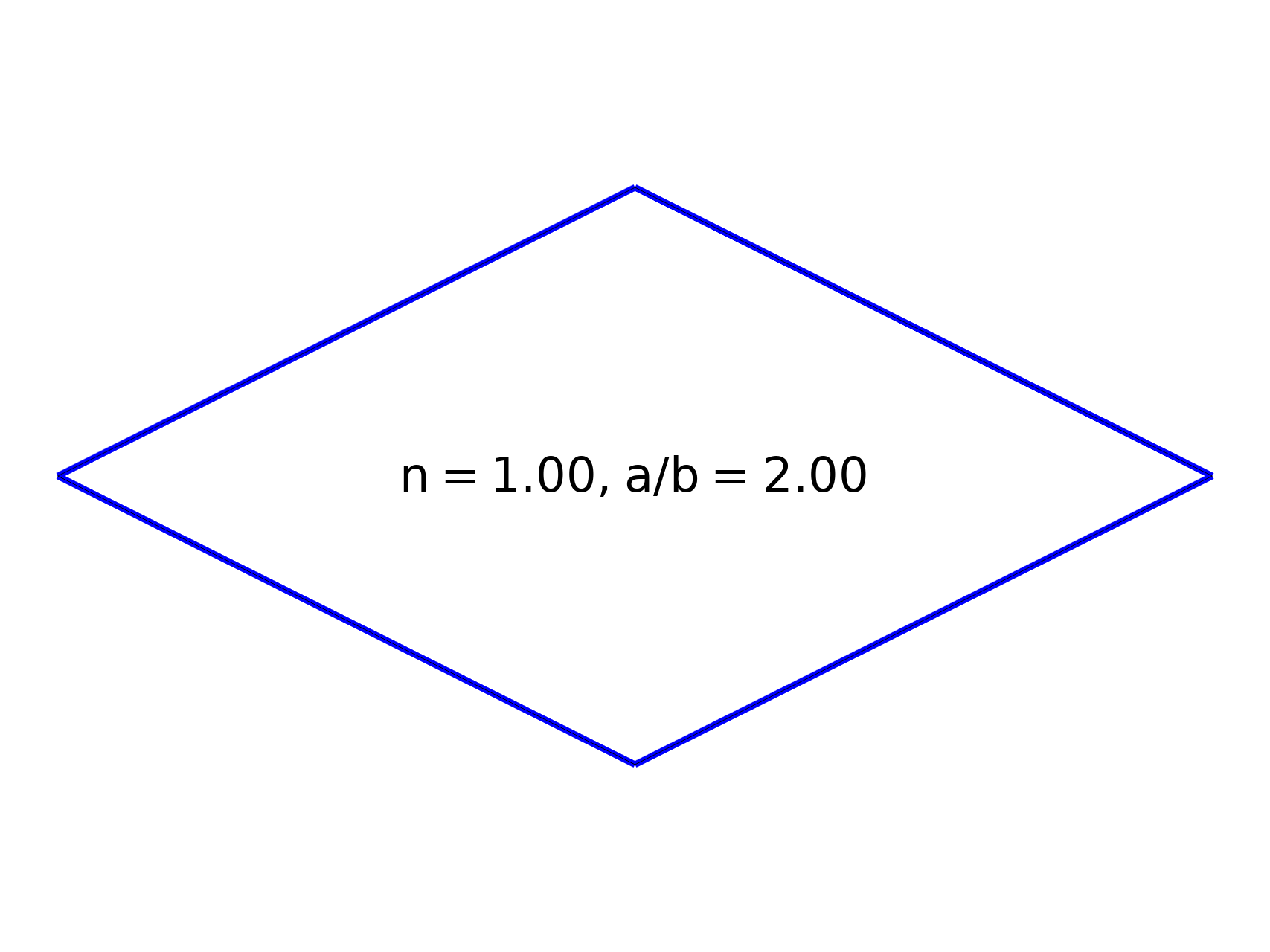
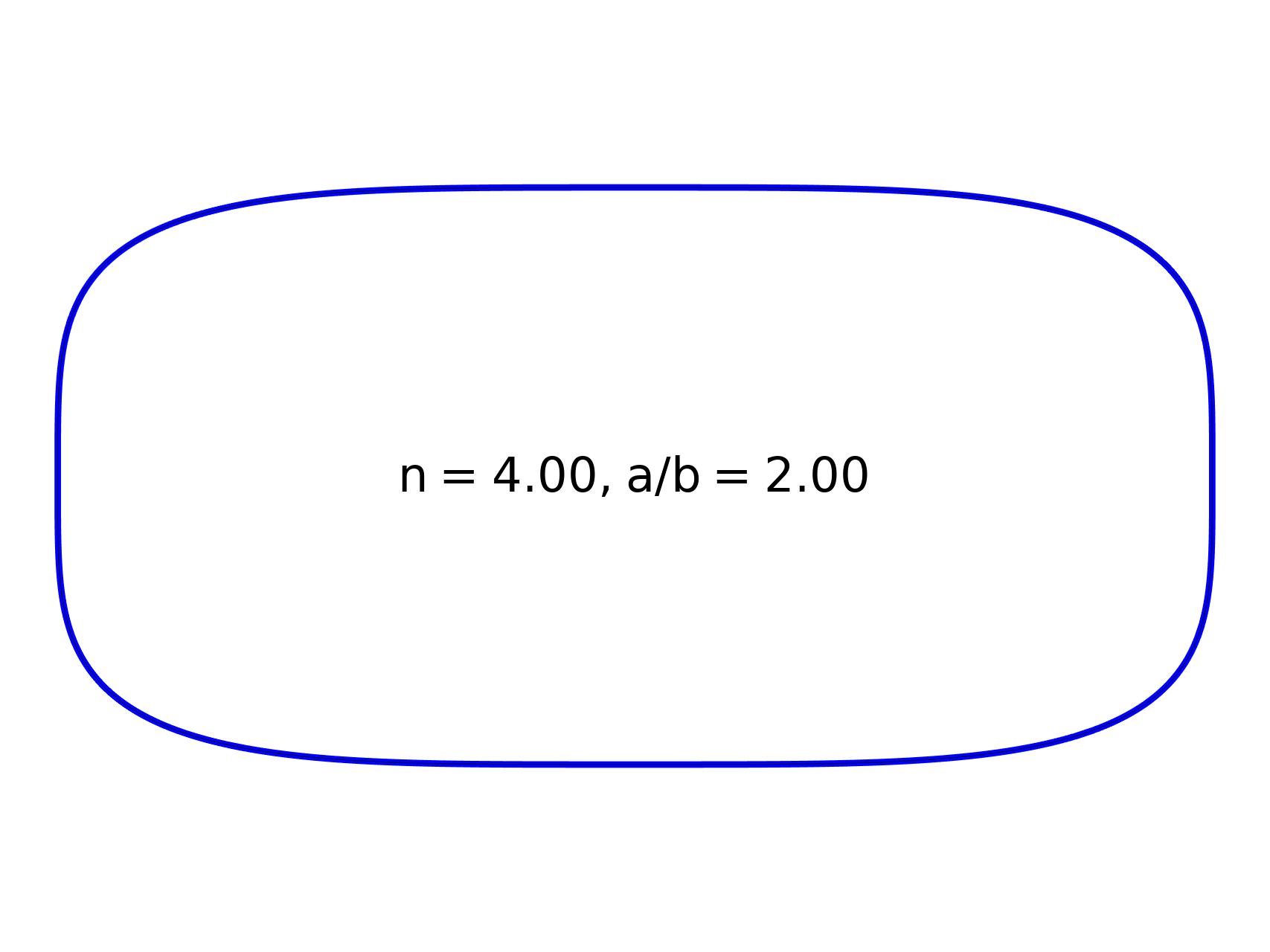
You can find more details about the mathematics of superellipses here.
Stress Concentration Factor
The stress concentration factor, Kt, is an important concept in solid mechanics. It is used to describe the increase in stress around a geometric discontinuity in a structure. Kt relates the maximum stress to a suitably defined nominal stress (stress without the geometrical discontinuity) through
Traditionally, stress concentration factors for common cases have been tabulated in handbooks. With today’s easy-to-use finite element (FE) programs, computing a stress concentration factor is often faster and more accurate than looking it up in a graph or table.
The most well-known result is likely that Kt = 3 for a circular hole in a uniaxially loaded large plate.
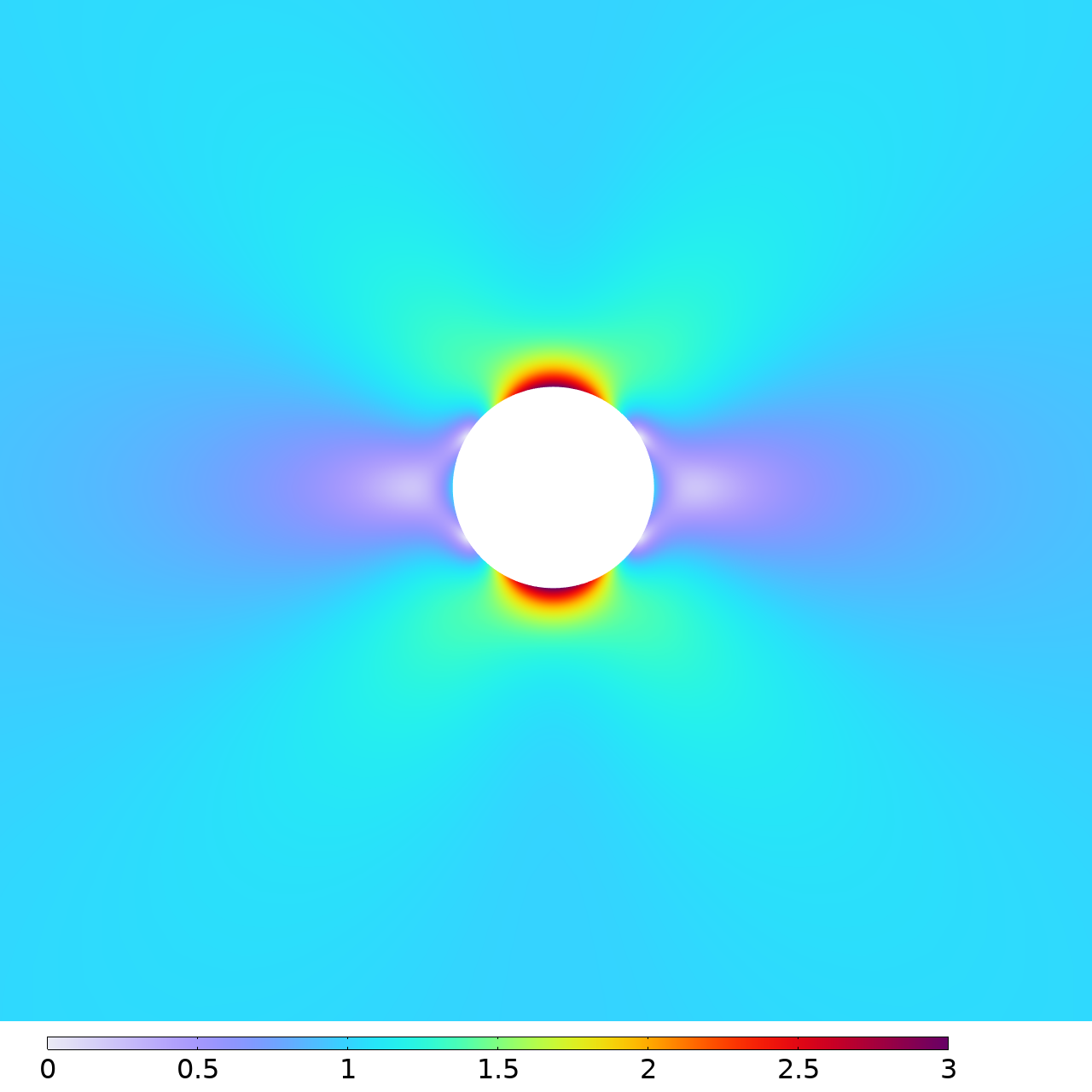 A model in COMSOL Multiphysics® of von Mises equivalent stress around a circular hole in a plate subjected to a unit axial stress in the horizontal direction.
Another analytical result is the stress concentration factor for an elliptic hole in a large plate:
Here, the semiaxis with length b is the one perpendicular to the stress field so that the stress concentration increases with the ratio b/a.
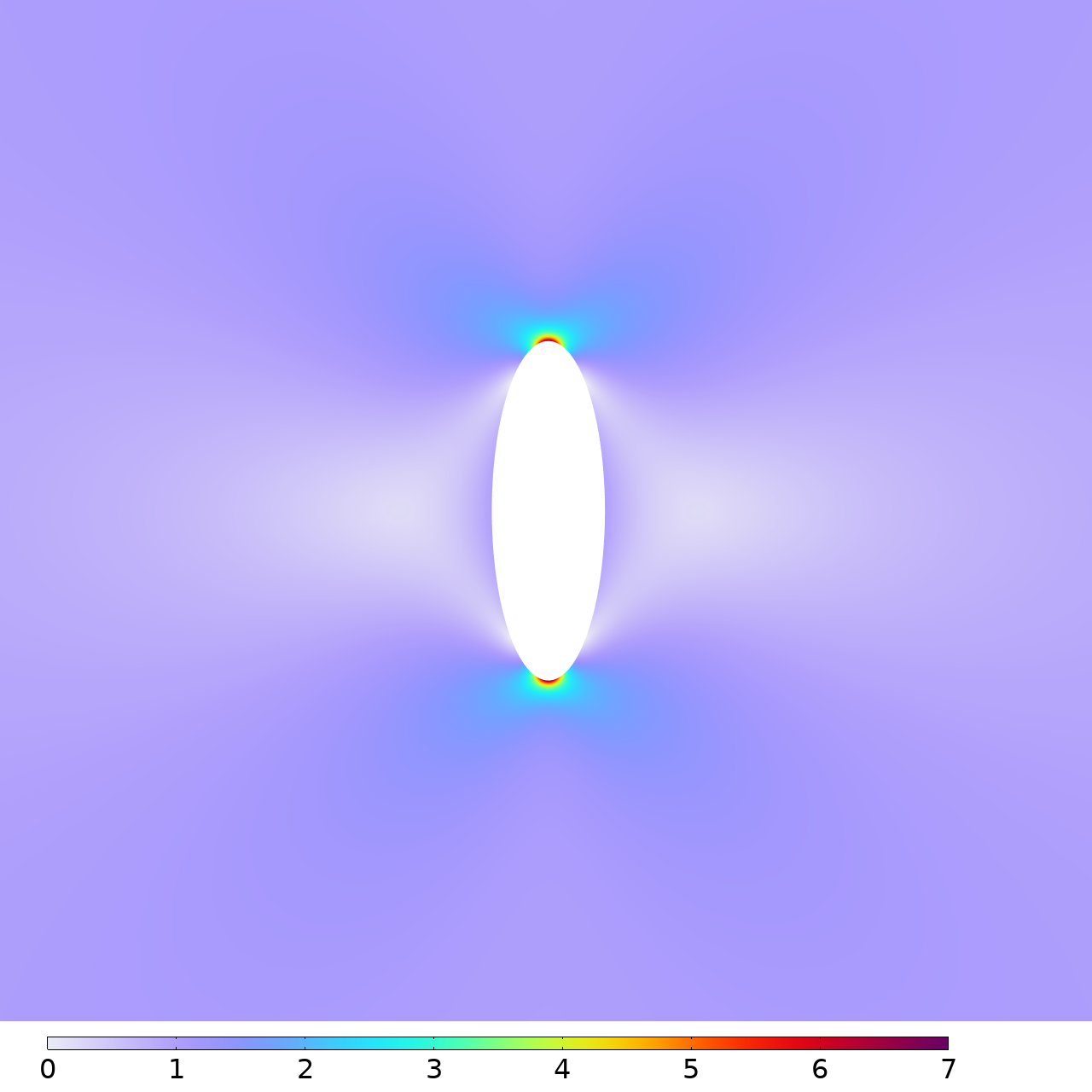 A model of von Mises equivalent stress around an elliptical hole with b/a = 3 in a plate subjected to a unit axial stress in the horizontal direction.
Stress Analysis of the Superelliptic Hole
A superelliptic curve can easily be constructed in the COMSOL® software using the Parametric Curve feature.
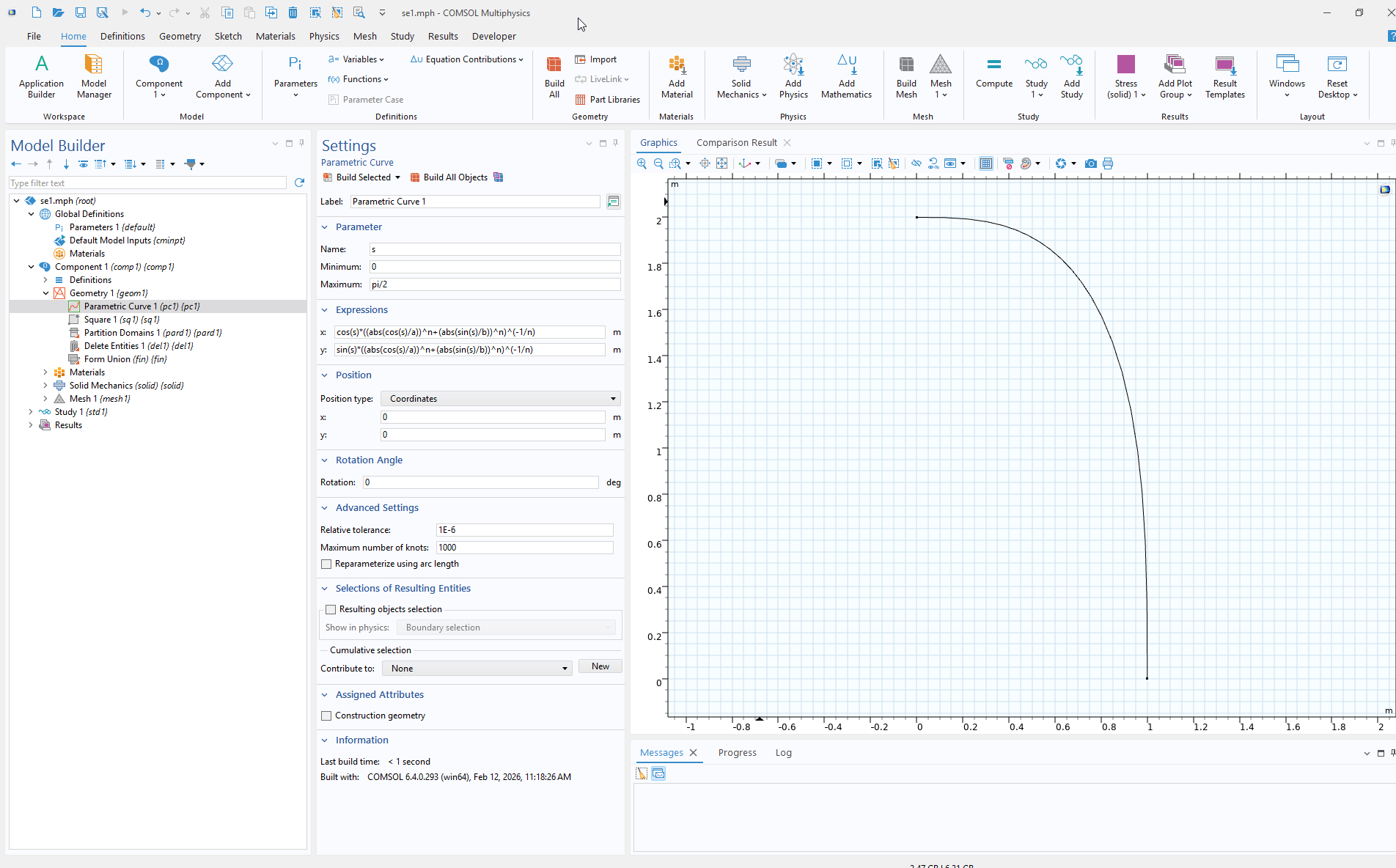 A superelliptic curve in the Model Builder made using the Parametric Curve feature settings.
Here, a representation of the superellipse in polar coordinates is used for the parameterization. It would also be possible to use a simpler parameterization based on the original equation expressed in x and y, but it becomes less accurate, since the relation between yand x is highly nonlinear.
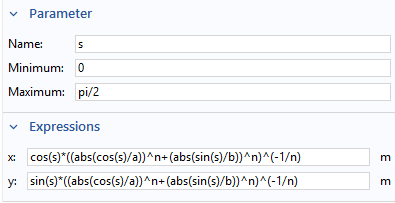
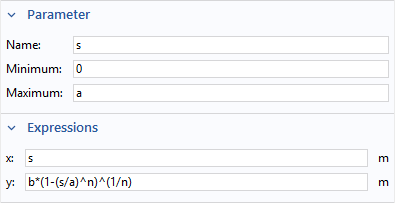
The parameterization used (left), and an alternative, simpler but less efficient, parameterization (right).
First, let’s take a look at the results for a hole with a geometry similar to the aforementioned fountain. The peak stress depends on the orientation of the larger semiaxis, but in both cases the stress concentration factor is lower than the value of 3 for a circular hole.
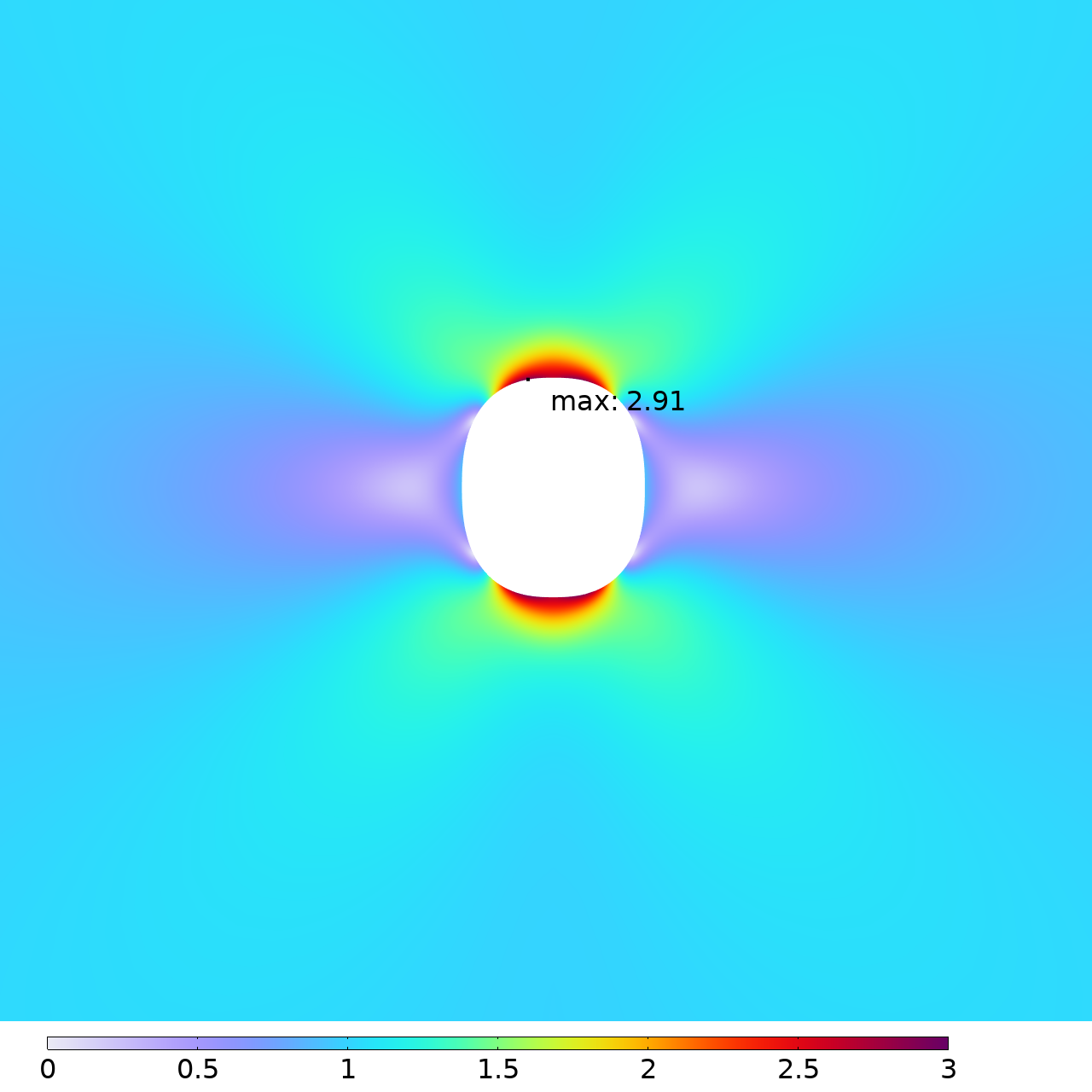
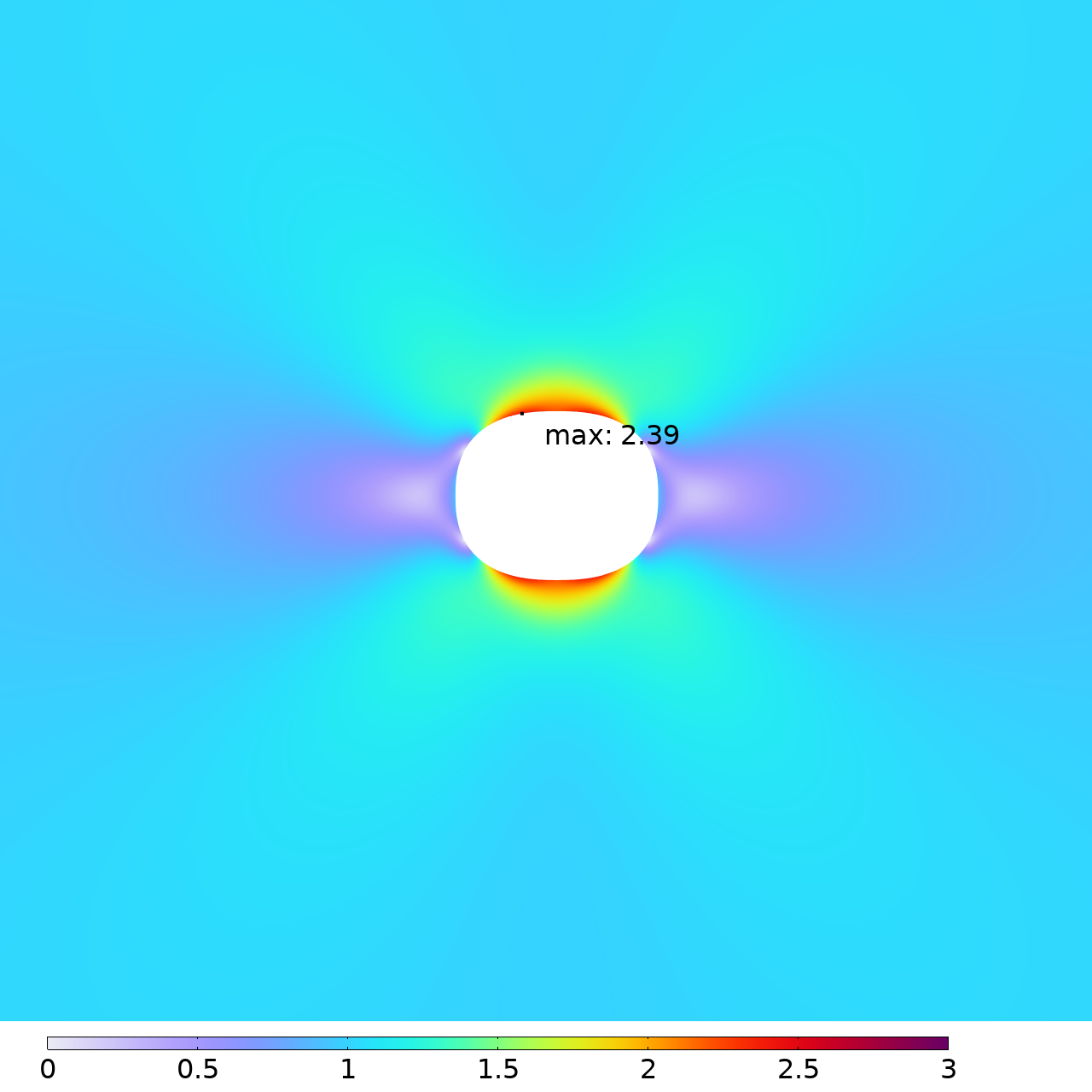
Models of von Mises equivalent stress in a plate with a superelliptic hole having n = 2.5 and a/b = 6/5.
This looks promising. From here on, it is easy to set up a parametric sweep and study the stress pattern for many different shapes.
For any value of the superellipse exponent n less than 2, there will be sharp corners on the hole edge. That would cause stress singularities. Such cases are not of interest in this context. Thus, n is kept in the range 2–8. At the highest values, the hole is almost rectangular with corner fillets. For the axis ratio b/a, values ranging from 0.2 to 5 are tested. The computed stress concentration factors are shown in the diagram below.
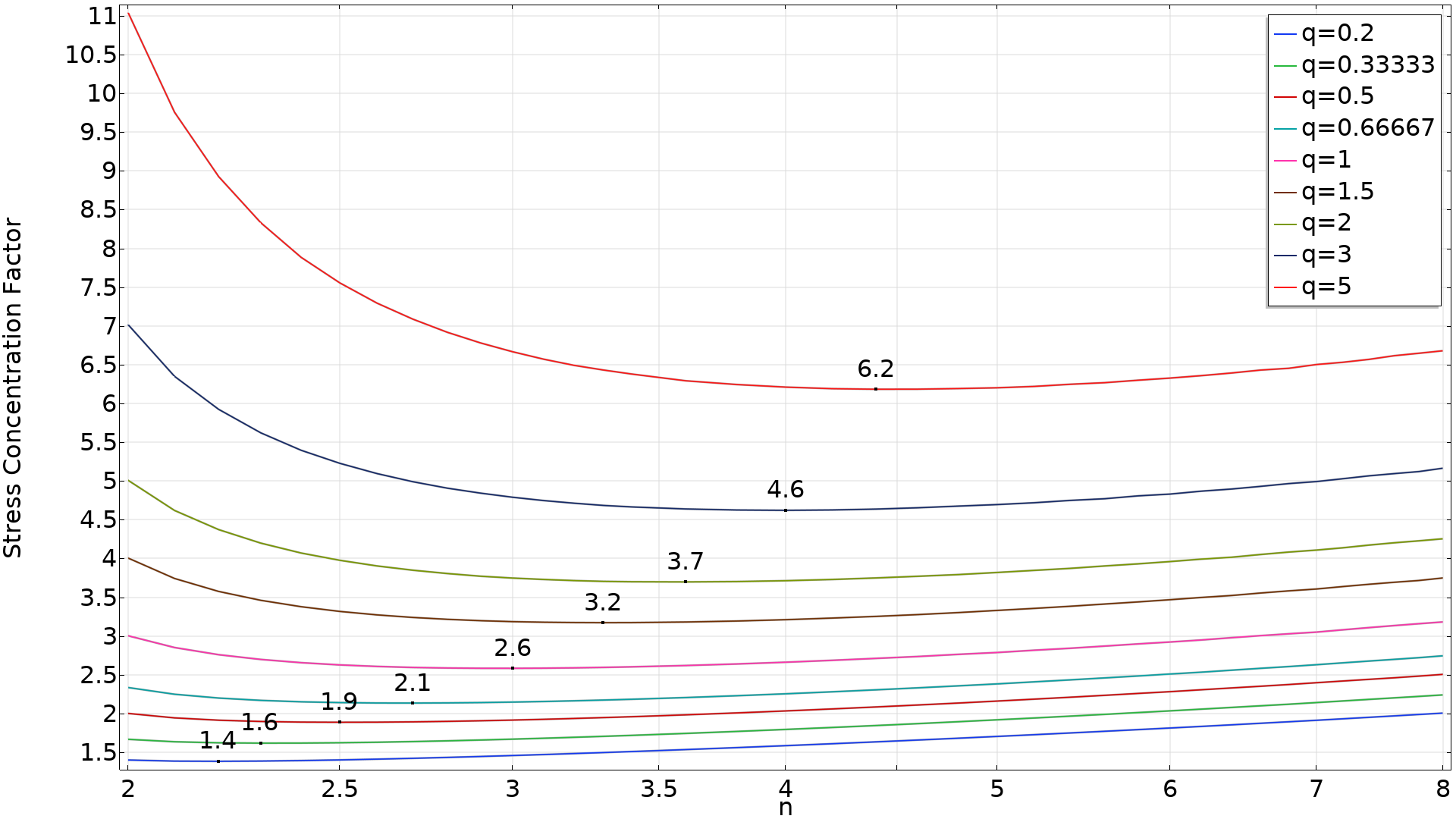 Stress concentration factors for superelliptical holes for a range of exponents n and axis ratios q = b/a. The markers on the curves show the minimum values.
For n = 2, it can be seen that the values are as expected for an ellipse: \displaystyle K_{\mathrm t} = 1+ 2 \frac{b}{a}
If the curves are normalized using this factor, we can see how a superellipse differs from an ordinary ellipse having the same axis ratio:
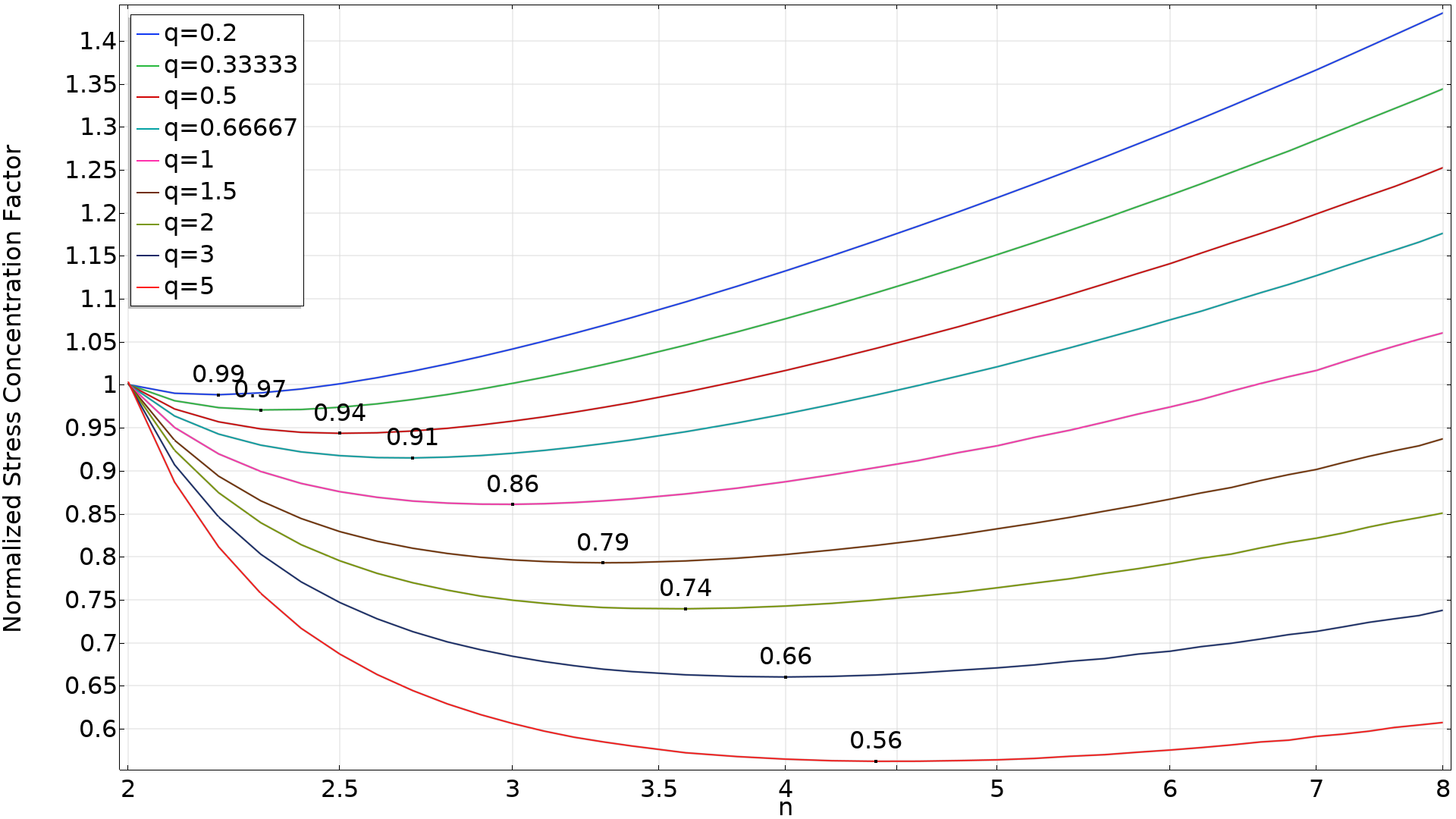 Normalized stress concentration factors for superelliptical holes.
As can be seen, there is always a superellipse with the same axis ratio as a certain ellipse that will give a smaller stress concentration factor. In particular, if we replace a circle with the best possible symmetric superellipse (q = 1), then it is possible to reduce the stress concentration factor by 14% using n = 3. This is quite a significant improvement. Such a decrease in stress could improve the fatigue life by a factor of 2.
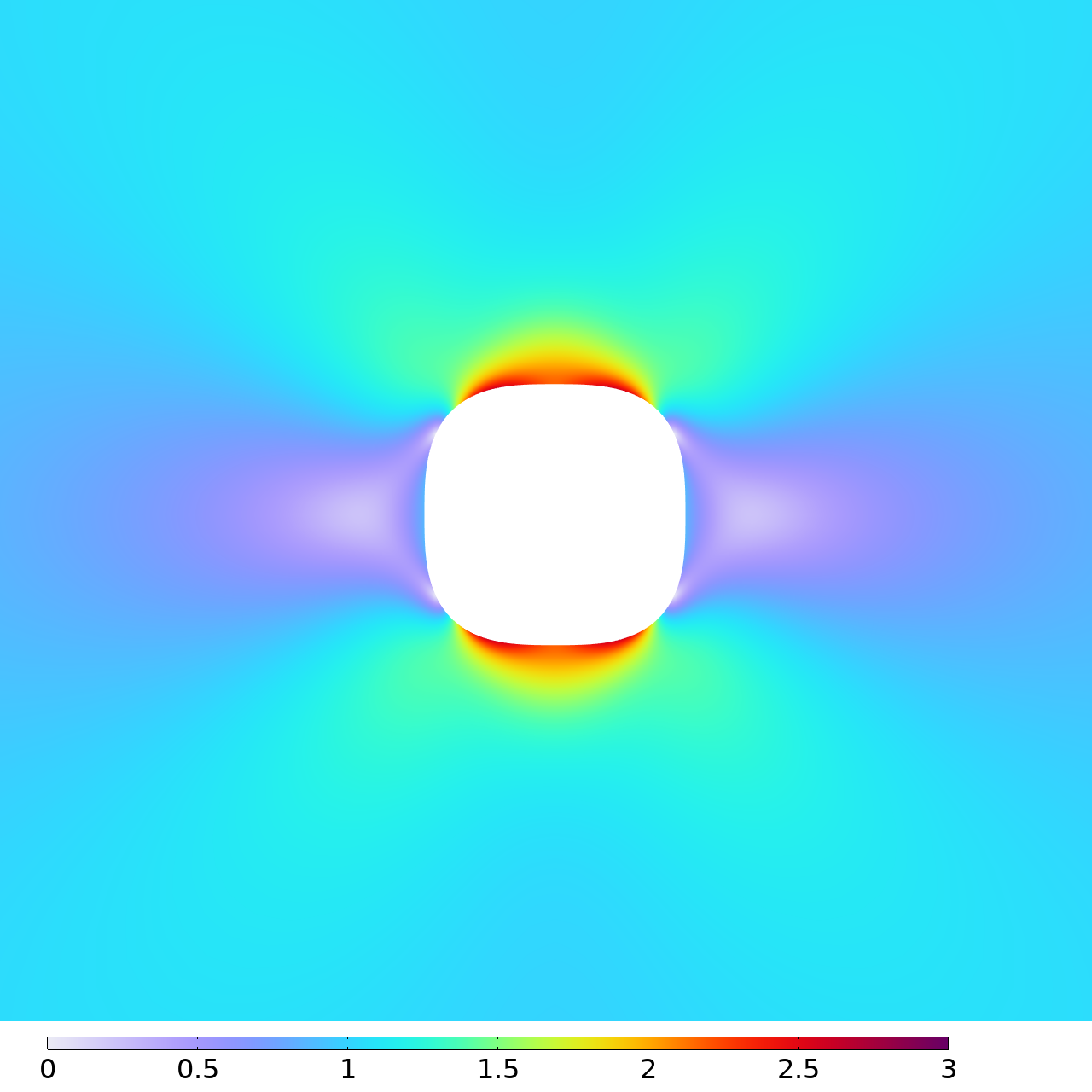 The optimal replacement for a circular hole.
Strengthening Structures While Increasing Hole Area
The area enclosed by a superellipse can be expressed as
where Γ is the gamma function.
For comparison, the area of an ordinary ellipse is
This means that the relation between the area of a superellipse and an ordinary ellipse having the same semiaxes is independent of the axis ratio and can be expressed as
In the plot below, the function \psi(n) is shown.
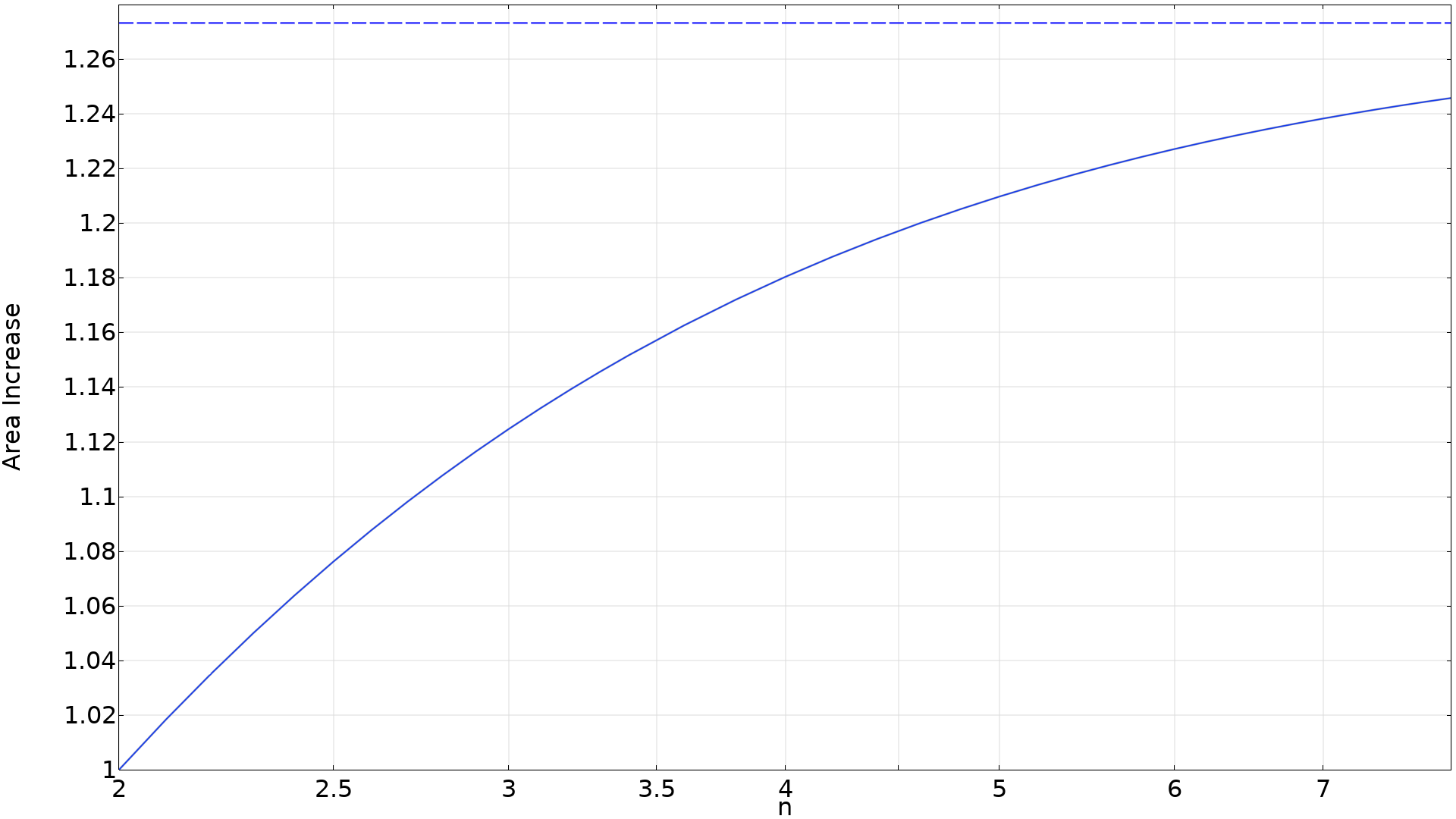 Relative area increase as a function of n when compared to an ellipse. The asymptotic value 4/π is indicated by the dashed line.
It can be seen that the area of any superellipse with n > 2 is always larger than that of the ellipse with the same semiaxes. Somewhat surprisingly, this means that it is always possible to lower the stress concentration factor by changing a circular or elliptic hole to a superelliptic one that has a larger area, that is, by removing material. In my previous blog post, Making Structures Stronger by Removing Material, some other cases where material removal is beneficial are presented.
It should, however, be noted that we have only investigated uniaxial stress states that are aligned with one of the semiaxes of the hole. For some other stress states, a stress reduction effect cannot be obtained. The reduced radii of the corners of the superellipse will instead raise the stresses.
Real-World Applications of Superellipses
This is, of course, mainly a fun theoretical discussion. In practice, it is often much easier to drill circular holes. But if, for example, additive manufacturing or casting is used, then it can be beneficial to choose other shapes.
The approach of using a superelliptic shape is not only applicable to holes. The same idea can be used to reduce stress concentrations at fillets.
You can download the model used in the examples above by clicking the button below.





Comments (1)
Jay Puckett
August 7, 2026Henrik – what a nice article. I have a teaching and learning app on my workbench using ellipse, but the super ellipse has more flexibility. Jay