
All posts by Chien Liu
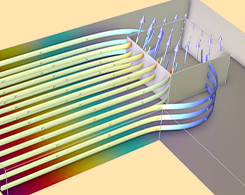
Extracting Specific Contact Resistivity with a Benchmark Model
You can now add contact resistance to metal contacts using the Semiconductor Module. In this blog post, we’ll explore a benchmark model that takes advantage of this new functionality.
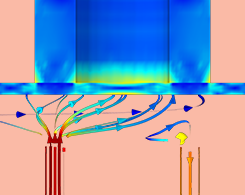
How to Simulate a Piezoelectric Micropump
Learn how to combine piezoelectric materials with fluid-structure interaction effects, use a velocity-dependent formula, and set up disconnected mesh between the solid and fluid domains.
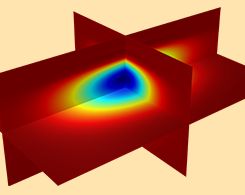
Simulating a Silicon Quantum Dot in a Uniform Magnetic Field
Solar cells, LEDs, displays, photodetectors, and quantum computing are all potential applications of quantum dots, an essential aspect in the field of nanotechnology.
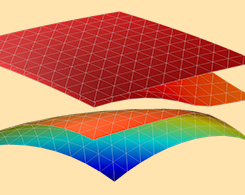
k • p Method for Strained Wurtzite GaN Band Structure
Model a wide range of semiconductor systems, such as particles with spins and strained wurtzite crystals, using multicomponent wave function functionality in the Schrödinger Equation interface.
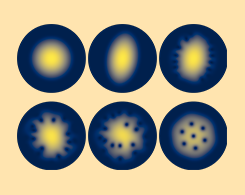
Model Vortex Lattice Formation in a Bose–Einstein Condensate
Bose–Einstein condensation can cause superfluidity, superconductivity, lasers, and trapped dilute cold atoms. When such systems are subjected to rotating perturbation, it forms a vortex lattice.
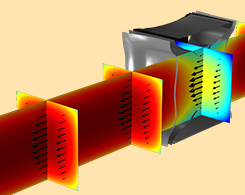
Three Semiconductor Device Models Using the Density-Gradient Theory
You can use the density-gradient theory to model semiconductor devices. Here are 3 examples: a Si inversion layer, Si nanowire MOSFET, and InSb p-channel FET.
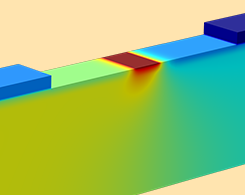
Intro to Density-Gradient Theory for Semiconductor Device Simulation
The density-gradient theory is a computationally efficient way to include quantum confinement in the conventional drift-diffusion formulation commonly used for simulating semiconductor devices.
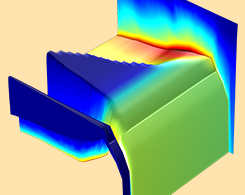
Simulating Radiation Effects in Semiconductor Devices
Analyzing radiation effects in semiconductor devices is an important capability for consumer electronics, medical imaging, nuclear engineering, aerospace, and a wide range of other industries.

How to Simulate the Carrier Dynamics in Semiconductor Devices
Learn how to simulate carrier dynamics in semiconductor devices with 2 examples: reverse recovery and forward recovery PIN rectifier models.
How to Model the Interface Trapping Effects of a MOSCAP
Looking to analyze interface trapping effects in a MOSCAP? Learn how to use a feature in the Semiconductor Module that enables you to add charging and carrier capture/release effects to a model.
Simulating the Tunneling Current Across a Graded Heterojunction
Interested in semiconductor design? Get an intro to the theory behind quantum tunneling as well as a demonstration of simulating the tunneling current across a graded heterojunction.
Self-Consistent Schrödinger-Poisson Results for a Nanowire Benchmark
This benchmark model of a GaAs nanowire validates the Schrödinger-Poisson Equation multiphysics interface, which is useful for modeling systems with quantum-confined charge carriers.
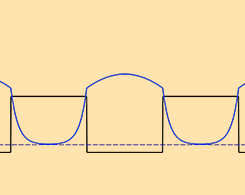
Computing the Band Gap in Superlattices with the Schrödinger Equation
You can easily compute the effective band gap for a superlattice structure by using a predefined Schrödinger Equation interface and building a simulation application.
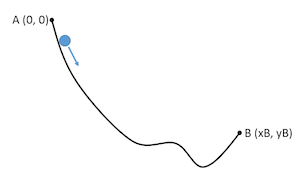
How to Solve for the Brachistochrone Curve Between Points
See how to use built-in mathematical expressions, the Optimization Module, and COMSOL Multiphysics® to solve for the brachistochrone curve.
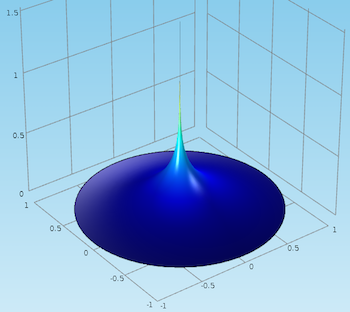
How to Implement a Point Source with the Weak Form
Learn how to implement a point source with the weak form in the COMSOL® software. Part 2 of a blog series discussing the weak formulation.
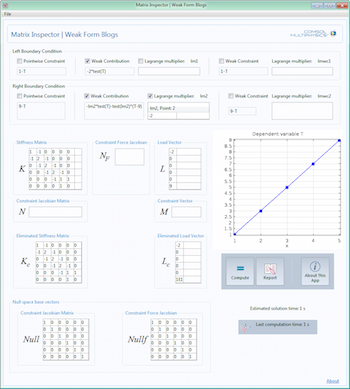
Implementing the Weak Form with a COMSOL App
First we implement the weak form equation and examine its matrices. Then we create a simulation app that displays all relevant matrices at once, arranged logically on one screen.
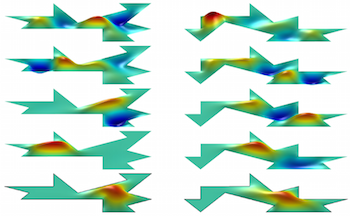
Can We Hear the Shape of a Drum?
Over half a century ago, Mark Kac gave an interesting lecture on a question that he had heard from Professor Bochner ten years earlier: “Can one hear the shape of a drum?”
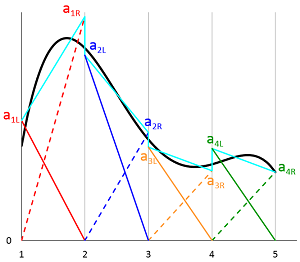
Discretizing the Weak Form Equations
In another installment of our blog series on the weak form equations, get an overview of how these equations are discretized and solved numerically in the COMSOL® software.
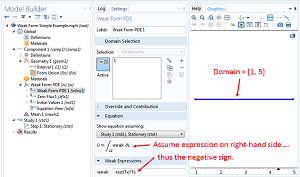
Implementing the Weak Form in COMSOL Multiphysics
In Part 2 of our series on the weak form equations, we demonstrate how to implement and solve these equations numerically using COMSOL Multiphysics®.
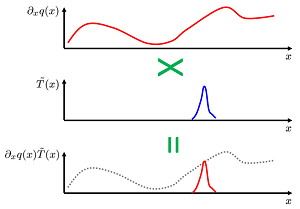
A Brief Introduction to the Weak Form
Whether or not you use finite element analysis and vector calculus in your daily life, you’ll appreciate this introduction to the weak form equations.


