Ray Optics Module
Ray Optics Module
Software for Ray Tracing Simulations in Optically Large Systems
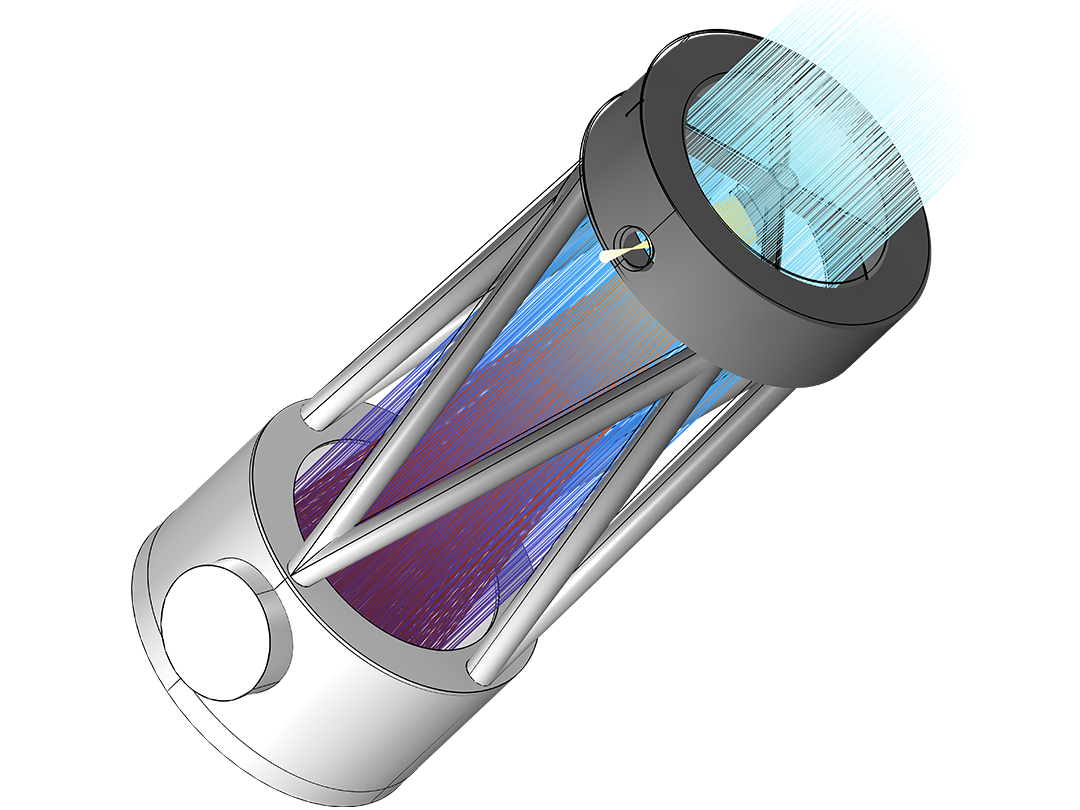
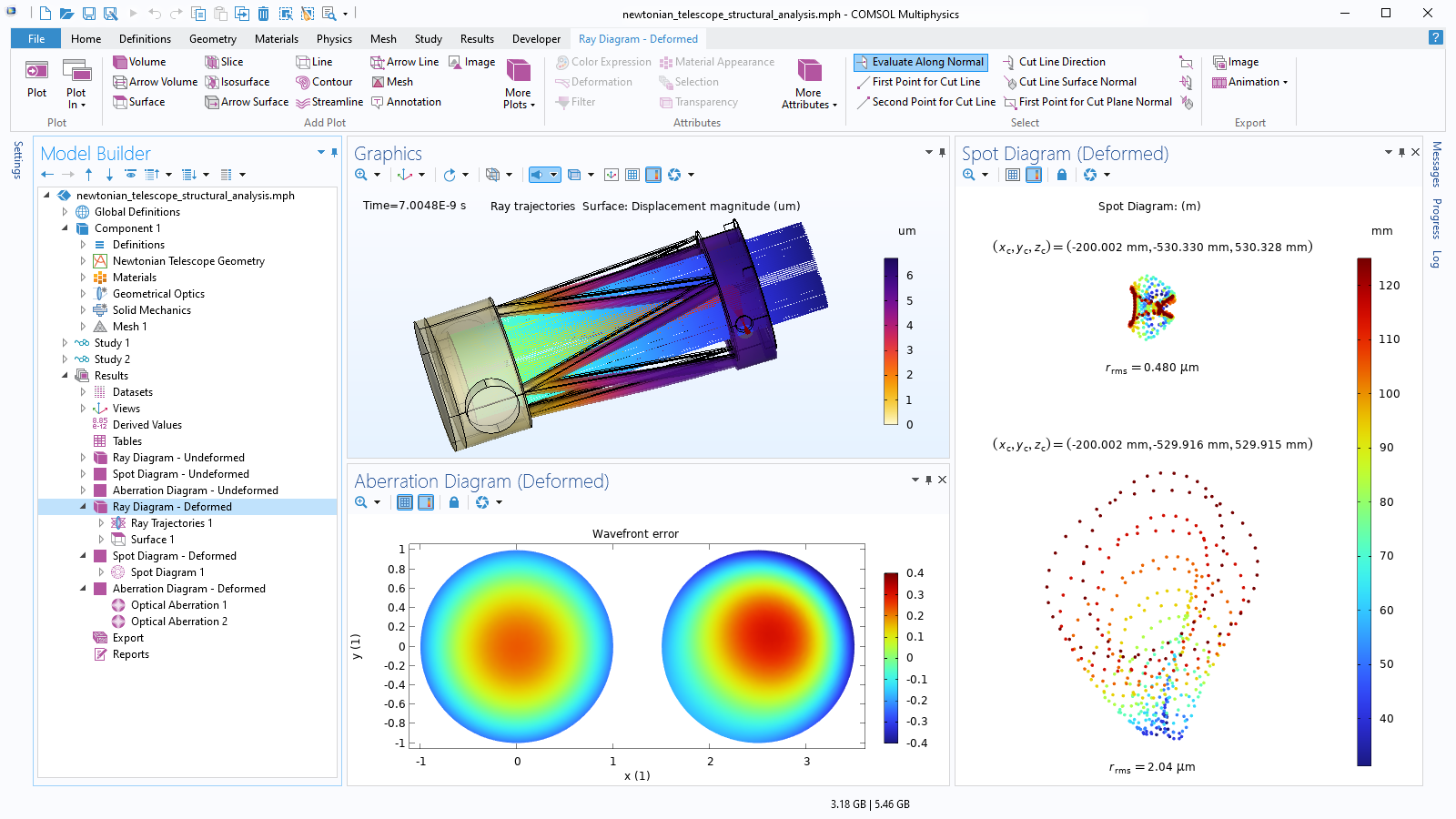
This tutorial model shows how to trace rays of unpolarized light through a Newtonian telescope system. The incoming light is reflected off a parabolic mirror onto a flat secondary mirror, which reflects the light into the focal plane. This type of telescope was first invented by Newton in 1668 and is still made today due to its low cost of assembly.
Effective and Versatile Calculation of Ray Trajectories
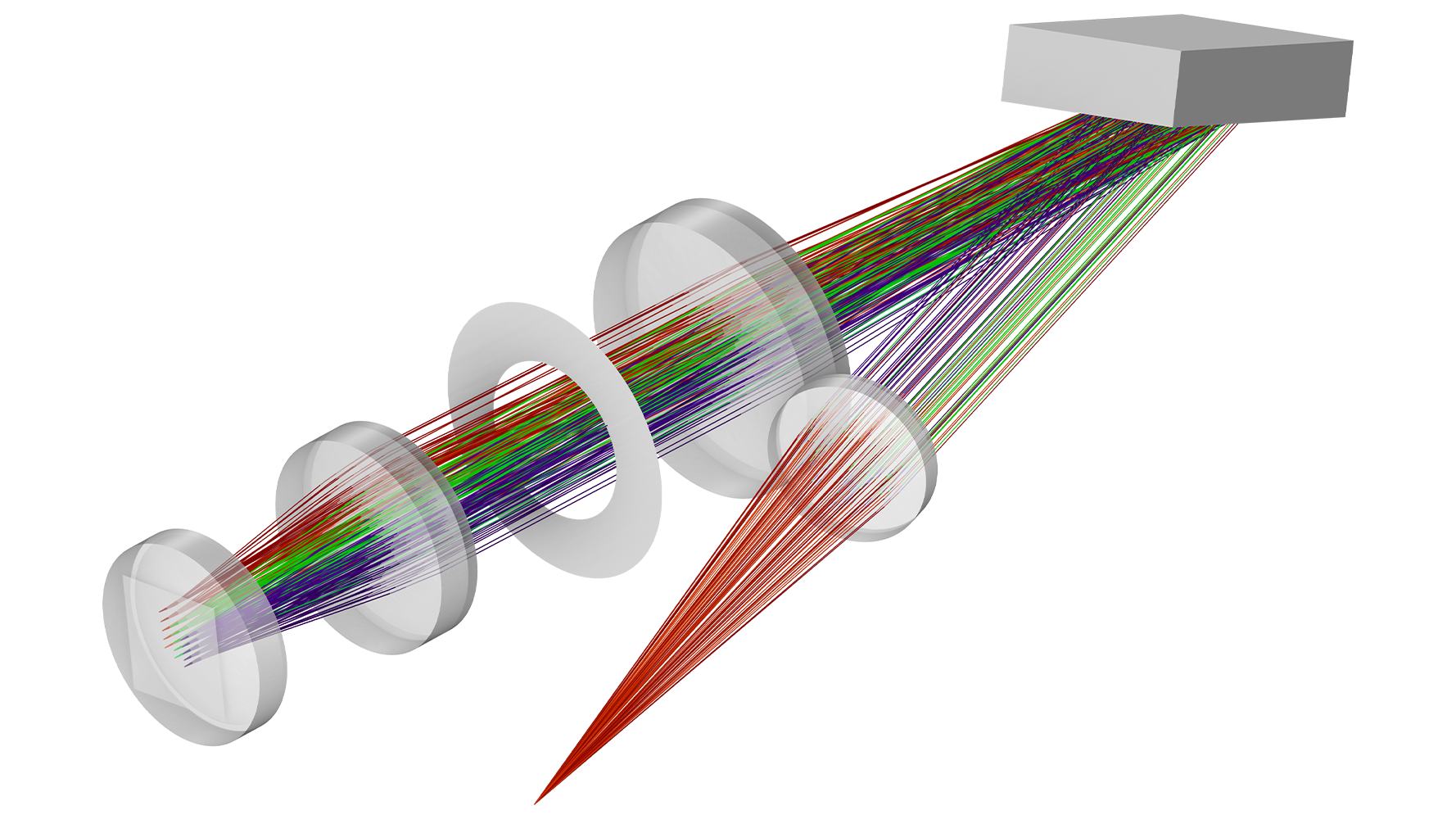
The Ray Optics Module can be used to model electromagnetic wave propagation in systems in which the wavelength is much smaller than the smallest geometric detail in the model. The electromagnetic waves are treated as rays that can propagate through homogeneous or graded media. Because it is not necessary to resolve the wavelength with a finite element mesh, ray trajectories can be computed over long distances at a low computational cost. Rays can also undergo reflection and refraction at boundaries between different media.
Easy Set-Up of Ray Optics Models
The Ray Optics Module contains a variety of boundary conditions, including combinations of specular and diffuse reflection. Rays can be released from within domains, from boundaries, or at a uniform grid of points. Specialized release features are also available for modeling solar radiation and for releasing reflected or refracted rays from an illuminated surface. Dedicated postprocessing tools offer you many ways to analyze ray trajectories, evaluate expressions over many rays, and even visualize interference patterns and monochromatic aberrations.
Additional Images:
-
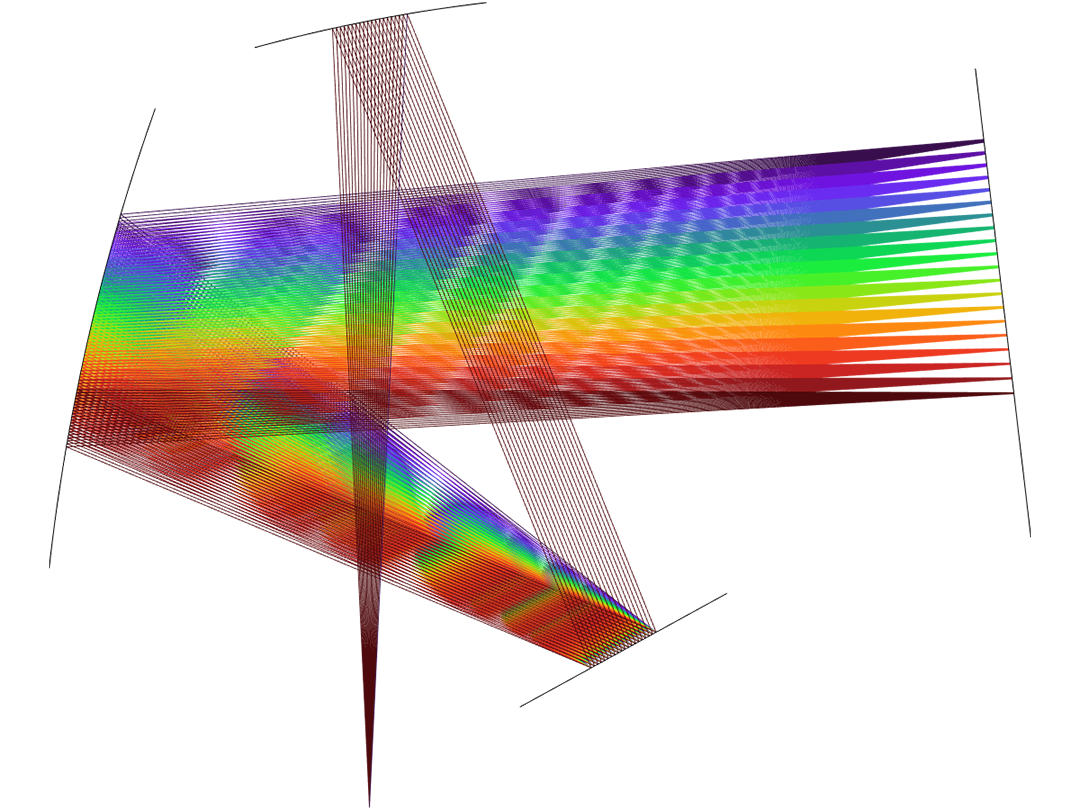
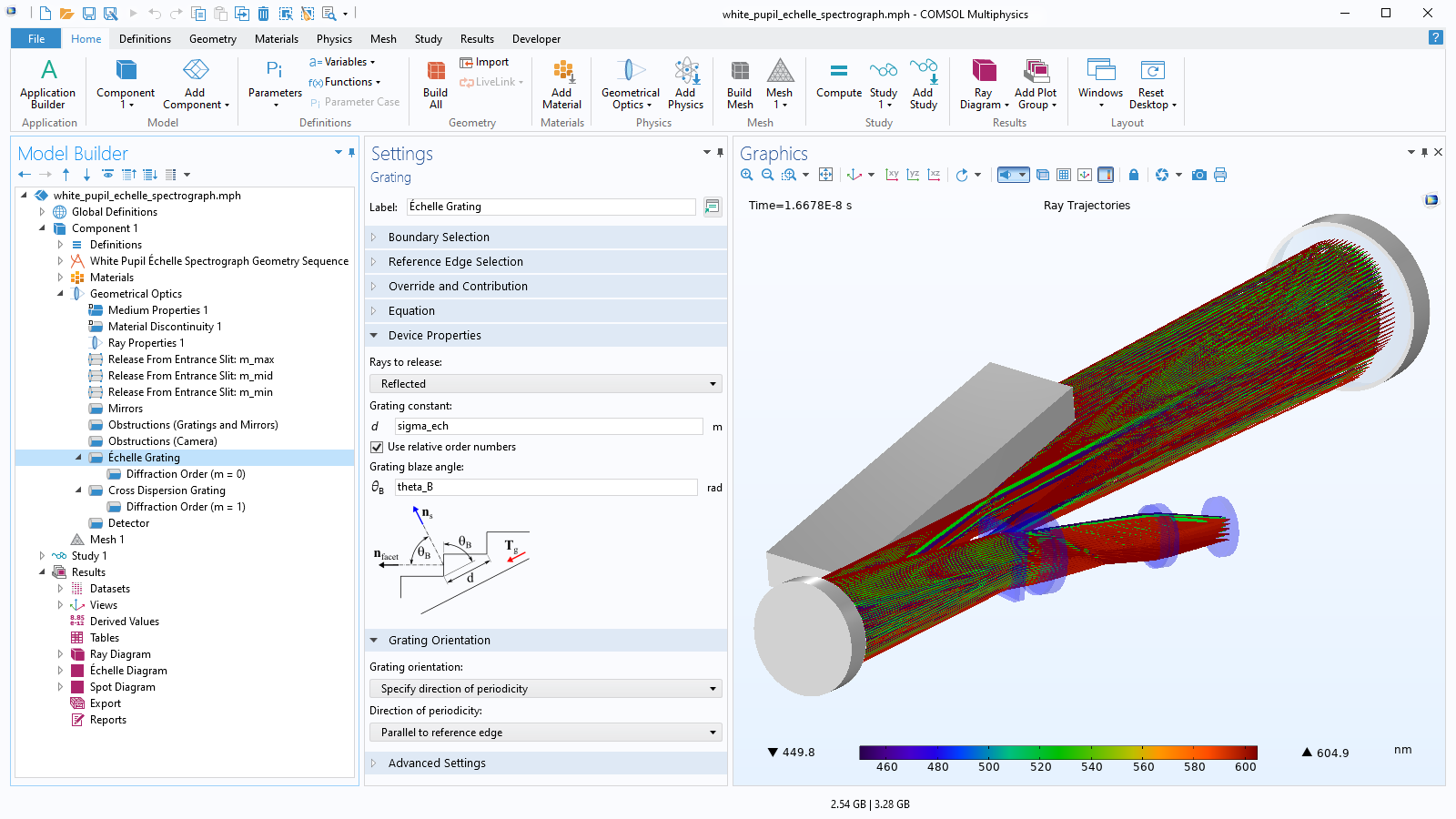
A Czerny-Turner monochromator spatially separates polychromatic light into a series of monochromatic rays. This model simulates a crossed Czerny-Turner configuration that consists of a spherical collimating mirror, a planar diffraction grating, a spherical imaging mirror, and an array charge coupled device (CCD) detector. The model uses the Geometrical Optics interface to compute the positions of incident rays on the detector plane, from which the device's resolution can be derived. -
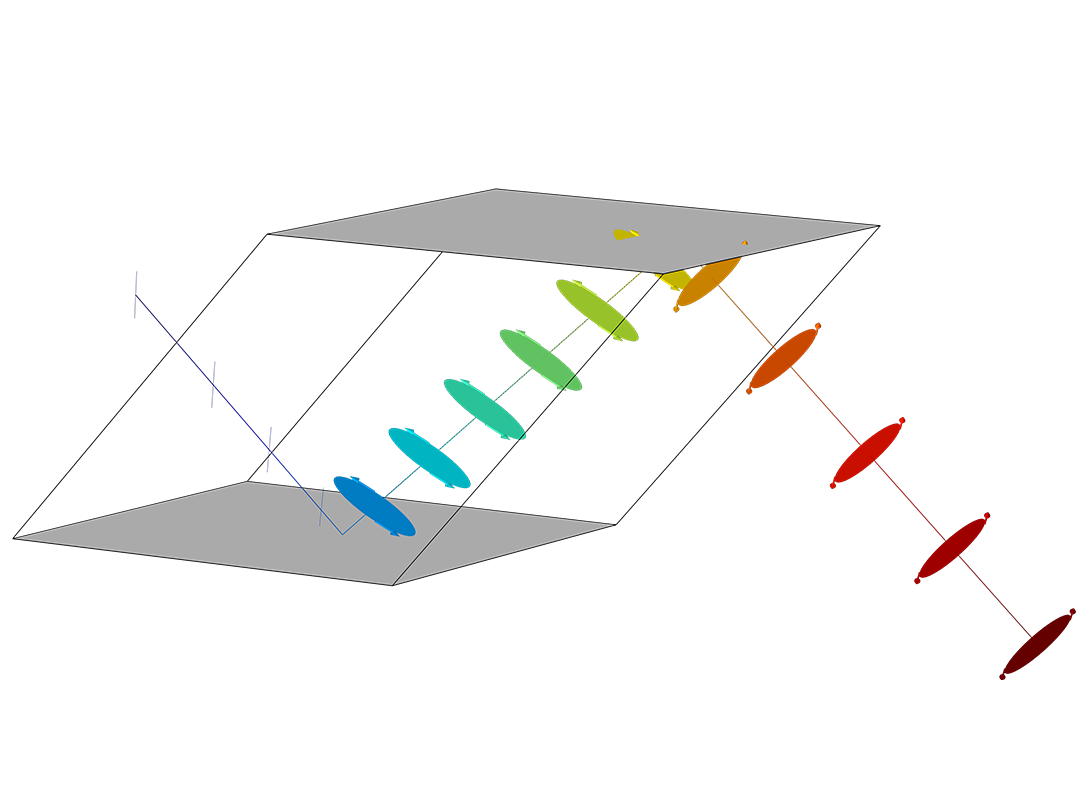
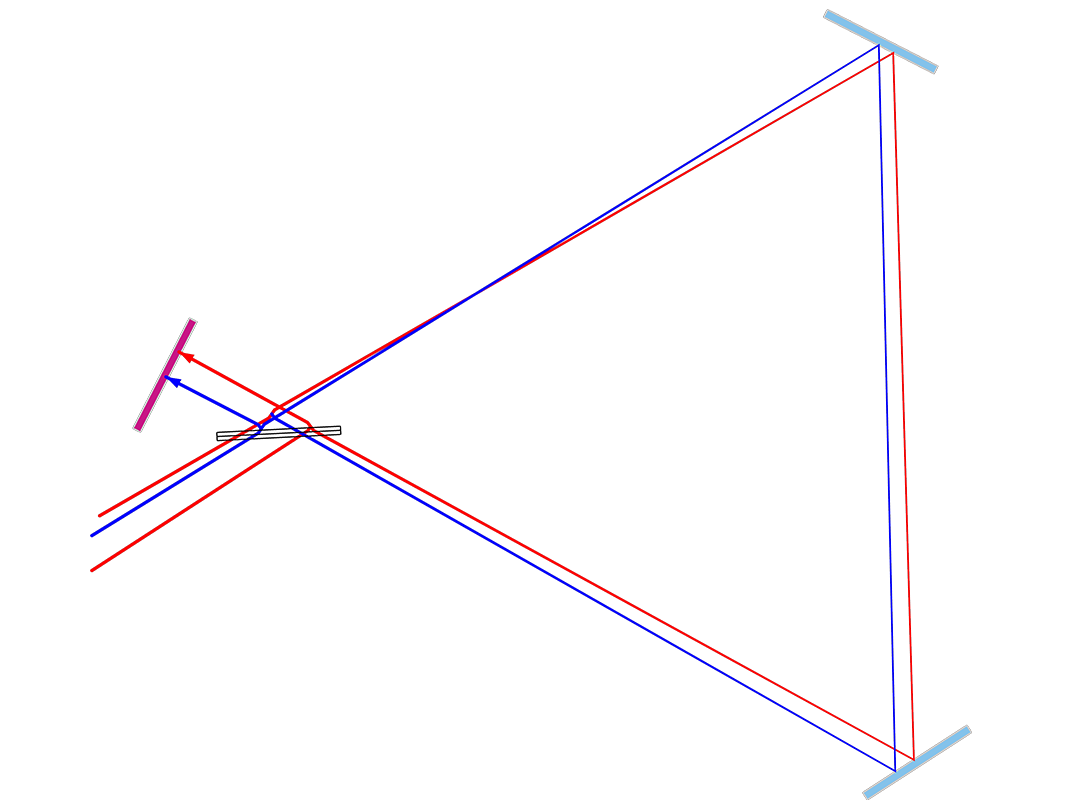
Combinations of optical devices such as polarizers and wave retarders can be used to control the intensity and polarization of transmitted radiation. In this model, two linear polarizers with orthogonal transmission axes are used to reduce the intensity of a ray to zero. Then, the intensity and polarization of the transmitted ray are analyzed when a quarter-wave or half-wave retarder is placed between the two polarizers. -
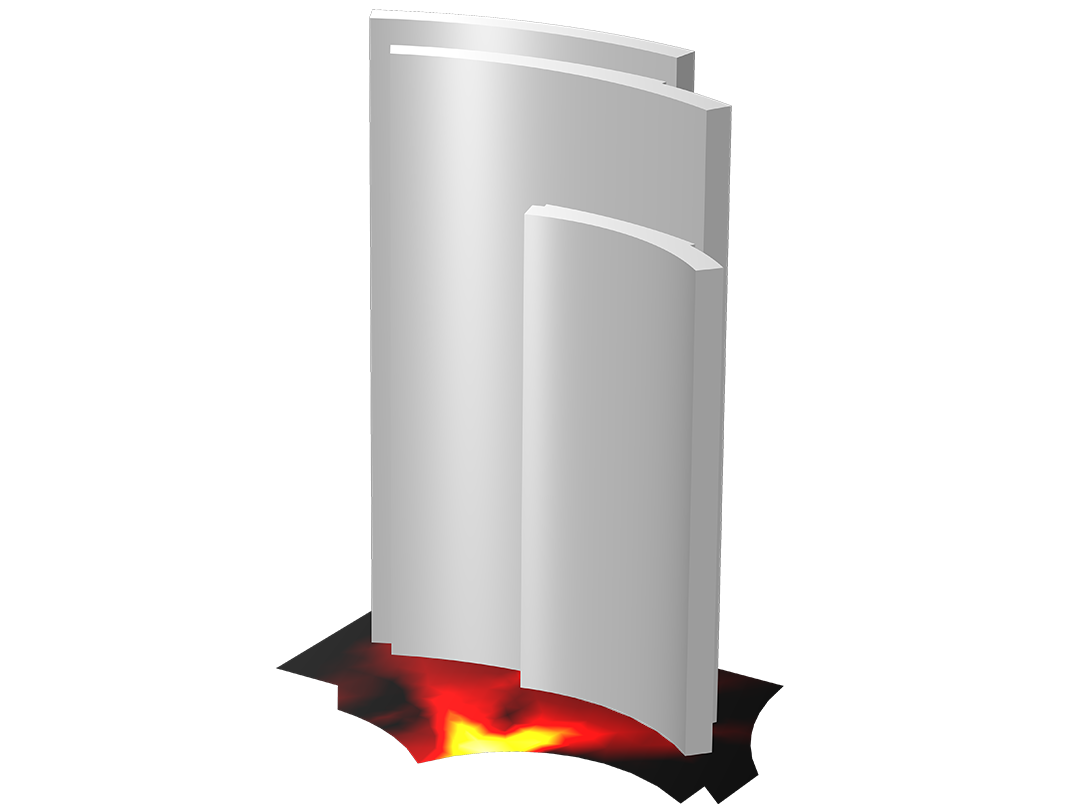
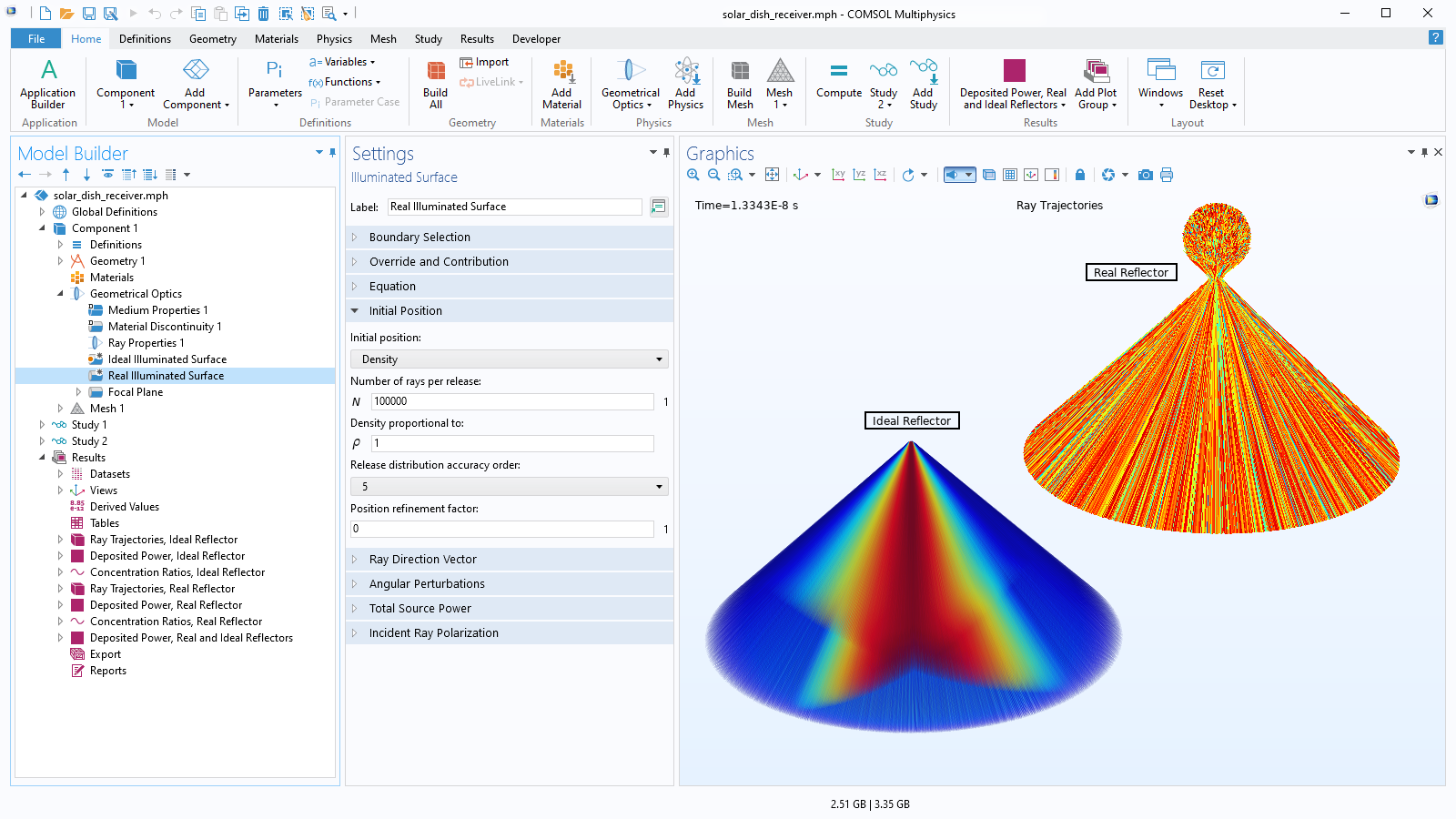
A paraboloidal dish can concentrate solar energy onto a target (receiver), resulting in very high local heat fluxes. This can be used to generate steam, which can be used to power a generator; or hydrogen, which can be used directly as a fuel source. In this model, the heat flux arriving on the receiver as a function of radial position is computed and compared with published values. Corrections due to the finite size of the sun, limb darkening, and surface roughness on the surface of the dish are considered.
Multiphysics Applications in Ray Optics
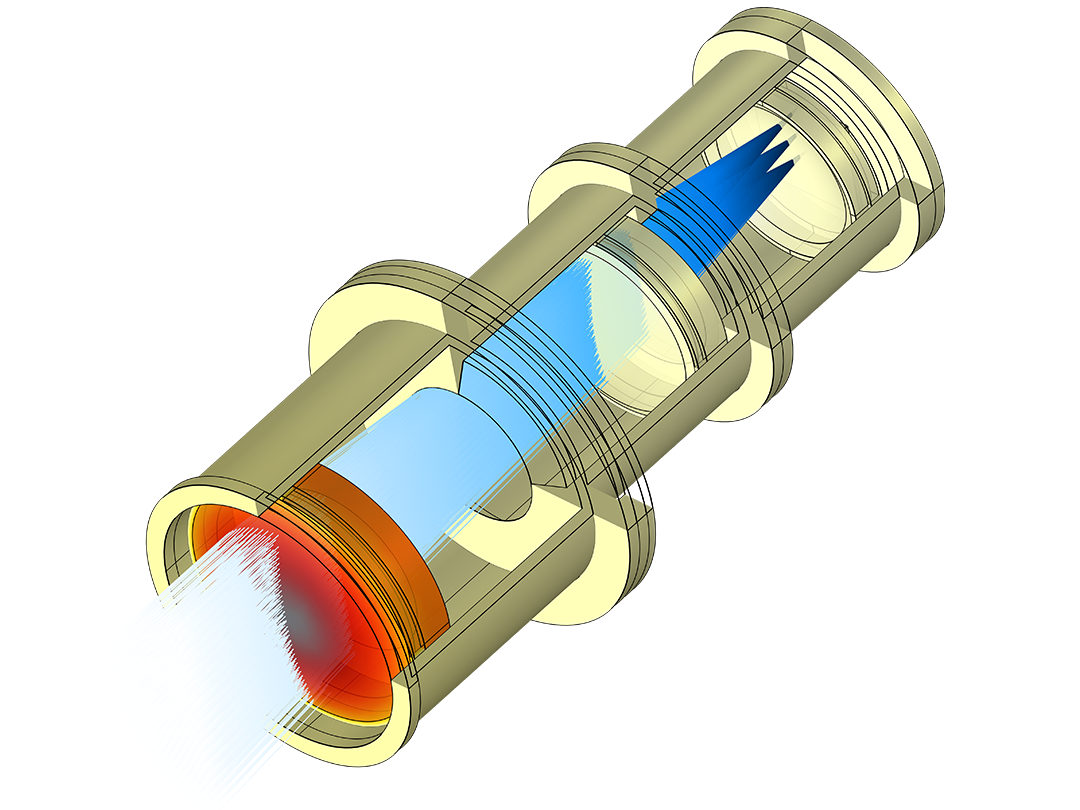
Stresses, temperature changes, and other physical phenomena can often affect ray trajectories, either by deforming the geometry of the domain or affecting the refractive indices within the domains. Similarly, high-powered rays can generate significant heat sources that affect the temperature field and may cause notable thermal stresses. The Ray Optics Module is fully capable of simulating such multiphysics applications.
Accumulator features on domains and boundaries can be used to create dependent variables that store information about the rays in the corresponding domain or boundary mesh elements. Specialized versions of these features for computing deposited ray power in domains due to ray attenuation or at boundaries due to ray absorption are also available. Using these Accumulator features, it is possible to set up unidirectional or bidirectional couplings between the ray trajectories and the dependent variables created by other physics interfaces. This can be used, for example, to create self-consistent models of thermal lensing effects.
Dedicated Postprocessing Features for Analyzing Rays
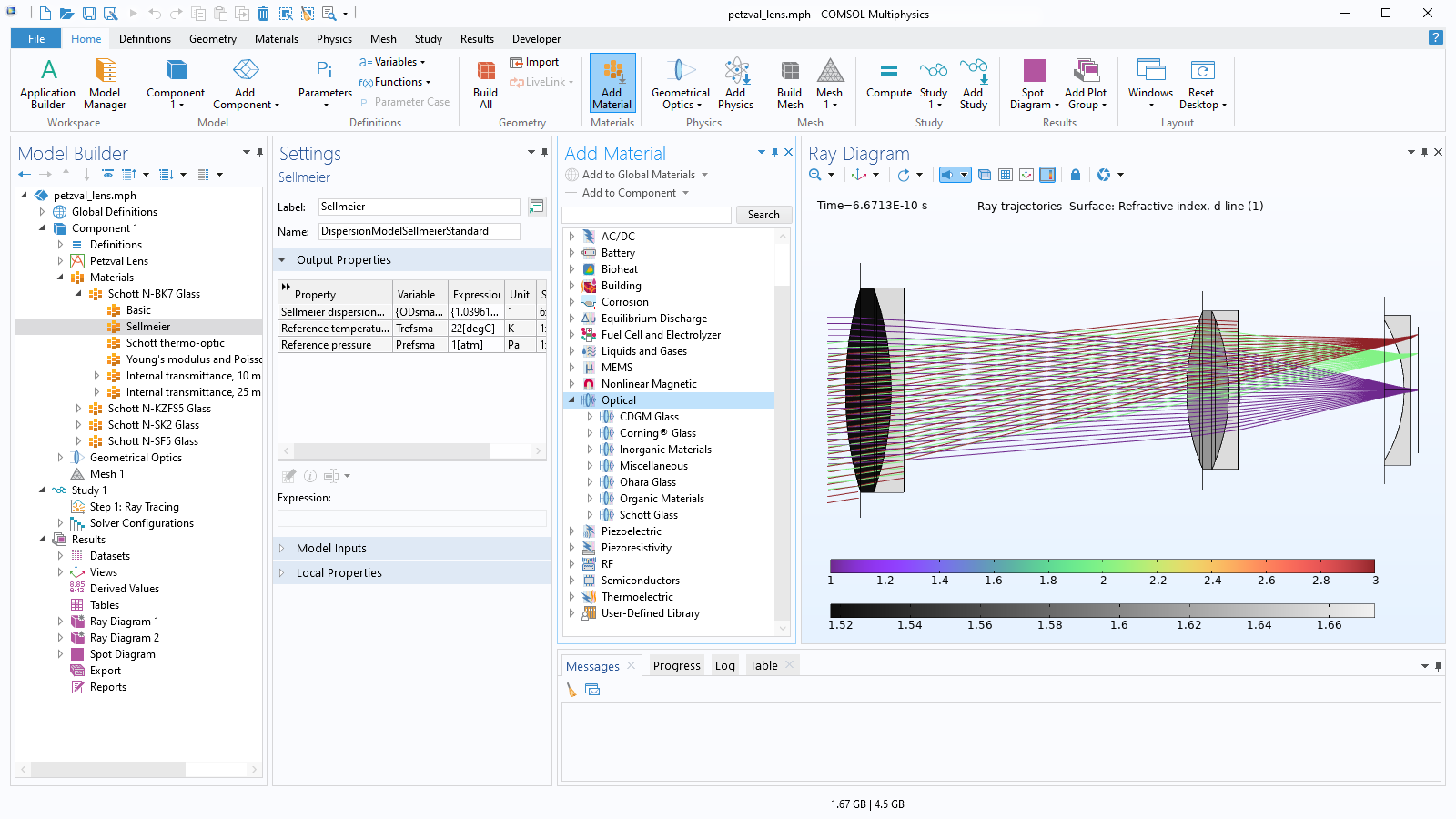
You can visualize rays using the Ray Trajectories plot, to which a color expression or a deformation can be added. Rays can be visualized as lines, tubes, or ribbons. You can also plot polarization ellipses along the rays. The Ray plot enables the plotting of a ray property versus time for all rays or two ray properties against each other at a specific set of time steps. With the Interference pattern plot, you can observe the interference of polarized rays that intersect a cut plane. Other postprocessing tools include the Ray Evaluation feature for generating tables of numerical data, the Poincaré map (spot diagram) for observing the intersection of ray trajectories with a plane, and the Phase Portrait for plotting two variables against each other for all rays as points in phase space.
Built-In Tools for Analyzing Ray Intensity, Polarization, and More
Built into the Ray Optics Module is a specialized interface for modeling ray propagation, known as the Geometrical Optics physics interface. The Geometrical Optics interface includes optional variables for computing ray intensity using the Stokes parameters, enabling the modeling of polarized, partially polarized, or unpolarized radiation. When releasing rays, the intensity can be specified directly or loaded from a photometric data file. The polarization can be changed at boundaries using boundary conditions for common optical components, such as linear polarizers and wave retarders. When computing the intensity, the rays are treated as wavefronts for which the principal radii of curvature are computed, allowing caustic surfaces to be visualized with ease. At boundaries between media, the reflection and transmission coefficients are computed using the Fresnel equations, with the option to apply corrections based on the presence of thin dielectric films. When the instantaneous electric field is of interest, as in interferometers, a variable for phase can be activated. Other physics interface settings can be used to enable the calculation of optical path length, allow rays to be released with a frequency distribution, and improve the accuracy of ray trajectories in absorbing media.
Convenient Solver Set-Up Using Tailor-Made Solver Settings
Although the ray trajectories are computed in the time domain, it is not always necessary to specify a list of the time steps. The Ray Tracing study step can be used to solve for the ray trajectories by directly specifying the desired range of optical path lengths. The study can be made more efficient by using built-in stop conditions to terminate the time-dependent solver if all rays have left the modeling domain or if the remaining rays have negligibly small intensity, preventing the solver from taking unnecessary time steps.
Michelson Interferometer
This model couples the Heat Transfer in Solids, Solid Mechanics and Geometrical Optics interfaces to compute the effect of thermal expansion of optical components on the interference pattern displayed by a Michelson interferometer.
Thermally Induced Focal Shift
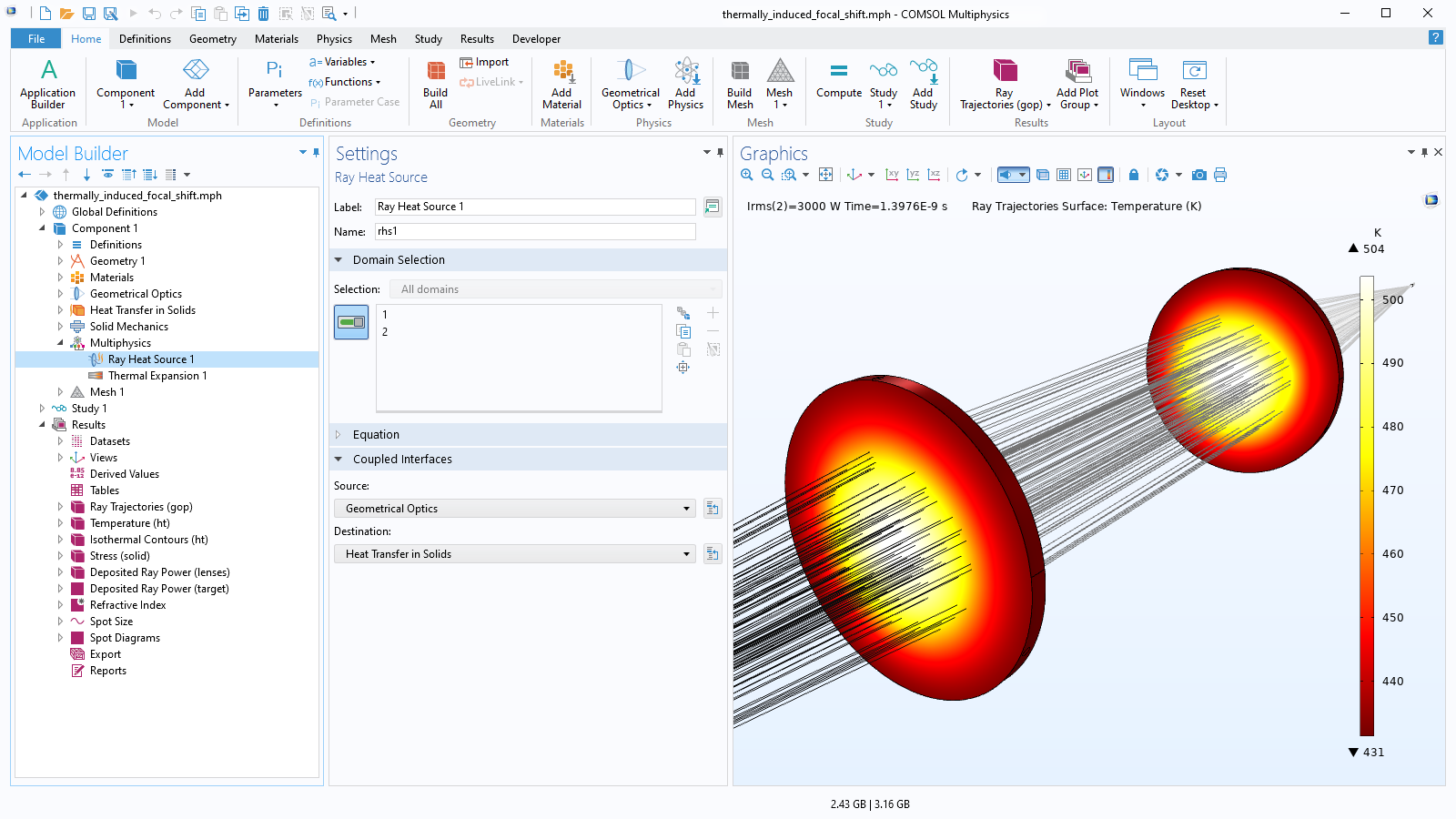
A modern high-power industrial fiber laser system can deliver up to 3kW of single-mode laser radiation on to surfaces to be cut, drilled, welded or marked. Even using highly transmissive materials, the optical component used to focus the laser beam onto target surfaces can be affected by the large amount of power carried by the light. As the ...
Solar Dish Receiver
A paraboloidal dish can concentrate solar energy onto a target (receiver), resulting in very high local heat fluxes. This can be used to generate steam, which can be used to power a generator, or hydrogen, which can be used directly as a fuel source. In this model, the heat flux arriving on the receiver as a function of radial position is ...
Diffraction Grating
This model uses the Wave Optics Module and the Ray Optics module to model the propagation of rays through a diffraction grating at different angles of incidence. It uses the S-parameters computed by the Electromagnetic Waves, Frequency Domain interface on a unit cell of the grating to specify the reflectivity and transmissivity of each ...
Vdara® Caustic Surface
When the Vdara hotel first opened in Las Vegas, visitors relaxing by the pool would experience intense periods of heat at certain times of the day, at certain times of the year. This intense heat was caused by the reflection of solar radiation from the curved, reflective surface on the South-facing side of the hotel. This model shows how a ...
Gravitational Lensing
This model demonstrates how the sun causes 1.75 arcseconds of deflection for rays grazing the sun's surface as observed from the earth. Einstein predicted this value after refining his theory of relativity during World War I.
Luneburg Lens
A Luneburg lens has a graded refractive index which leads to special focusing properties. This example model uses the Geometrical Optics interface to compute the ray trajectories and their optical path length.
Anti-reflective Coating, Multilayer
The simplest example of an anti-reflection coating is a quarter-wavelength layer. One big disadvantage of such a single-layer coating is that there is generally no practical material with the required refractive index to achieve a low reflectance. A combination of several layers can be used to reduce the reflection coefficient over a much wider ...
Corner Cube Retroreflector
A corner cube retroreflector can be used to reflect rays so that their reinitialized trajectories are parallel to their initial trajectories, regardless of the angle of incidence. This tutorial model shows how to simulate the reflection of a bundle of rays at a cube corner retroreflector using the Geometrical Optics interface.
Distributed Bragg Reflector
A distributed Bragg reflector (DBR) is a periodic structure formed from alternating dielectric layers that can be used to achieve nearly total reflection within a range of frequencies. In this model a Bragg reflector is modeled with a central wavelength of 550[nm] and stopband of 180[nm].